
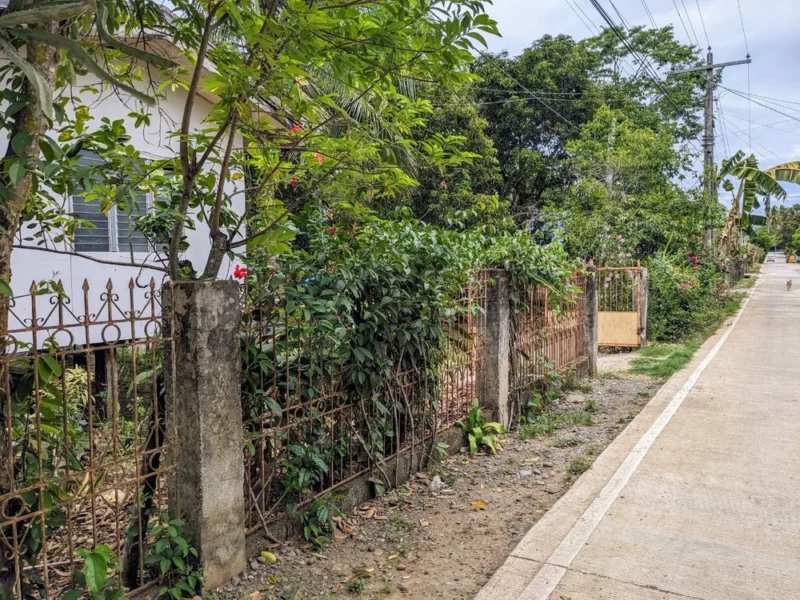
In “First Love Never Dies,” Kaisa Rillorta Aquino renders the ache of an old love, and the bitterness that comes when certain paths in life can no longer be traversed. The return of Patis, a childhood companion transformed by time and circumstance, conjures in Balong not only the ghost of an unattained intimacy but also the recognition of a country collapsing deeper into corruption. Appearing first in Likhaan: The Journal of Contemporary Philippine Literature, this story braids the personal with the political, and what emerges is a portrait of love as foreclosed as the place itself feels to the protagonist.
— Raaza Jamshed for Guernica Global Spotlights
THE RADIO SCREECHED angrily before the volume adjusted to Tatay’s liking. From outside, I could only hear the familiar drumbeat— boom boom!—and the station’s signature line, “Basta radyoooo . . . Bombo!” I went inside, my eyes gradually adjusting to the darkness of the room.
Tatay had taken off his shirt, more brown than white now, and wiped the sweat off his body. He sat down beside his small battery-powered radio. The fan whirred slowly. The afternoon expanded like a shallow pool of mud.
“Partner, it saddens us that Bombo Grace is not with us today,” a dignified voice began.
“That’s true, partner. Bombo Grace has always been a feisty, incorruptible journalist.”
“Go get us Coke, Balong. It’s so hot,” Tatay said as he leaned back on the rattan.
He handed me a ten-peso bill. I walked out of the shack and into the talyer, up the steps that led to the provincial road, empty at this time of day. All heat. At a distance, the parish church speakers recited the three o’clock prayer. I bought Coke at the sari-sari store next to our shop. Sneaking a quick gulp of the drink, I went back inside to where Tatay was sitting and handed it to him. He looked at the cellophane and turned to me, “Well, one of us has to start washing the dishes.”
“Later,” I murmured. The plates and mugs piled precariously at the sink.
Yawning, I lay down the papag across my father and his radio. We were nearly done for the day. The other pieces for the hauler truck that needed to be cleaned and used for the repair were still on their way from a bodegero in Jones. The signal broke and the voices coming out of the radio became mere scratches. Tatay extended its rusty antenna. I closed my eyes.
“ . . . by this provincial prosecutor, Partner. It’s unbelievable!”
“Bombo Grace has consistently championed the cause of the poor—”
—boom boom!
“Rallied against military abuses—”
—boom boom!
“Against this prominent issue of illegal logging—”
Then there was an actual booming at our door.
We nervously glanced at each other and then heard a voice call out, “Tito? Tito Caloy?” Tatay quickly put on his shirt and, a little rattled, stood up to see who it was.
After a quick moment, he was back.
“Someone is here to see you,” my father said with a goofy grin when he went back inside the room. Relaxed now. Moving the antenna carefully and carrying his radio to the back of the room, where he exited and left me alone.
“Ay, who is it?” I stepped outside.
Amid the clunks of metal and truck parts, between half-inflated tires and loops of water hoses, under the dirty light only the kinds of late afternoons in Santiago permitted, stood Patrice Estrada. We stayed there for a moment. Simply looking at one another.
“Patis,” I finally said.
She smiled. “Balong.”
“You’re back.”
Wasn’t it? Yesterday, I mean. It was only yesterday when I was nine and Patis was ten, a mere girl and a mere boy running around anthills screaming whenever the soil broke open. Some afternoons, we would climb the big star apple tree that bordered the wide expanse of their property, dropping the fruits to the ground hard, cracking them open. White liquid oozing, trickling the length of our arms. If it was in season, it would be the saraesa. When there were no fruits to share, we would knock on Apong’s house and watch her brilliantly winnow grains of rice using her bilao, her bright white hair knotted tightly on top of her head. In the sweltering heat, we would lie side by side, our skin slick with sweat sticking to the wooden floor, listening to her hum, all this life going on.
Patis had a huge fluff of aggressively curly hair then and skin that knew what it was like to be under the sun from morning until when dinner beckoned. We were kids. She was Patis then, small and lithe, and all mine. “It’s nice to see you,” Patis said, sounding strange and new and shy. The softness in her cheeks had been lost and replaced with what appeared to me as carefully applied cosmetics. Her skin shimmered at her smallest movements.
“Your hair,” I breathed. It was the color of the wisps at the end of a ripened corn: white and yellow and gold.
She giggled a little, her hand running through her long, straight, and smooth hair.
“Come in, come in,” I said awkwardly, realizing she was still at the door. I ushered her inside the talyer. Everything suddenly felt dirtier and more broken with her perfect face and hair and starched white dress in the middle of the mess of my side of the world.
“It’s messy. You can just—” I picked up a dirty hand towel from the weathered sofa as I gestured for her to take a seat. “Do you want anything to drink? Water? Coke? I can run outside quickly if you want. . . .”
She shook her head, a small smile on her lips, as she sat down. Her legs folding delicately over the ugly cushions. Then she told me how she found our talyer. She said she went home to Salvacion, our old barrio, where our neighbors informed her what my family was up to now in the city.
Patis raised a hand to cover her laughing mouth and said, “I knocked at your house and your mother wouldn’t let me in! She wouldn’t believe me when I said, ‘Auntie, I’m Patis.’”
“Eh, who can blame her? You look so different now!” I felt my ears burn red at the embarrassing wobble in my voice when I spoke.
Patis touched her new hair and shifted all of its length to her left shoulder, so easy and so magical, the gesture, that I had to look away and busy myself from tidying up our shop instead.
She nodded. “It’s been so long, hasn’t it?”
Suddenly, we heard Tatay’s engine start outside and then idle. Then he walked in to tell us he was going out. He didn’t say where, but I knew. We watched him put on his radio in his backpack and carry a jug of water with him. Then Tatay shifted uncertainly, eyeing me and my friend. In this business where we had nobody to trust but each other, we had gotten used to communicating like this. By the looks of it, and we had been waiting the whole day anyway, there must have been another collection. The authorities were coming down harder recently in our region, and if they were passing by Ilagan, our friends must have been checked.
He glanced at me and said, “We can close this down now. You should go bring Pat-Pat to that barbecue, that eatery, that place we like going to?”
Then Tatay addressed Patis, beaming. “Balasangkan, naning!”
I looked and looked and indeed, she was already a woman.
Patis and I, we’d just sat down at one of the bamboo chairs of the eatery when it began to rain so suddenly and so fully that the steam coming off the warm earth overpowered the scent of the smoke from the grill. “I love this,” Patis kept saying over and over. A moment ago, she insisted on watching and waiting for our barbecue to cook, standing so close to the grill that she would smell strongly of charred meat for the rest of the day.
“I love this,” Patis said again. “This place, look at this place,” she exclaimed. I looked, and really, there was nothing to look at. This was an old house the owner had converted into an eatery. The tables and chairs were sets of bamboo furniture varnished with a red sheen. Three fans were mounted on the walls, and right across us was a big, fake aquarium, its corals glowing neon green and blue. Christmas lights hung all around the corners of the room. Never mind that it was only the middle of October.
“What? There’s nothing to look at here. It’s nothing special.” I could hardly hear myself over the loud rain.
“Exactly!” Patis was breathless from excitement. “I love this,” she said once more, quietly to herself.
Right then, the server went around the grill and picked up our orders. He eyed Patis incredulously, and then placed on our table blue plastic plates of pork barbecue, balat, isaw, and paa, all orange from the marinade save for the cubes of betamax, chunks of blood that had darkened from the grill. A liter of Coke, a pitcher of water. Two glasses. A bowl of vinegar with chopped red onions and chili floating. She grinned at the spread in front of us.
“Mommy would get so angry if she knew I ate any of these,” she said, grinning widely and picking up the isaw first.
When Patis and her family left for Japan, we were all sad, but we were all also proud, and slightly envious, even. We knew that they moved out of the country not to seek a better-paying job for a brighter future, like one neighbor who was now a domestic worker in Hong Kong, but simply for a better future. And because they could. They were rich, had relatives already comfortably living there, and so they flew one unceremonious day in 1986. We were no longer kids then. We were on our way out of high school. A lot of things were happening with our bodies then, but something bigger than acne and wet dreams was happening in the country at large. And yet, at that age, all that mattered to me then was my dignity. I had just begun working at the talyer and was not yet used to my classmates passing by in tricycles craning their necks and pointing at me as I oiled one of the trucks. While they all headed off to the public university in the city, I was hauling illegally acquired truck parts from bodegeros as my father listened closely to the radio commentaries. Long words painted in red marked the streets of my usual route heading to the city. My mother suddenly became stern in getting me home before dark. Until one day, the sun still high on my way back, I saw Patis’ house had been boarded up, all signs of life taken away without any promise of return.
For some time, I foolishly hoped for a letter. We didn’t say we were going to write to each other; I didn’t even know they were leaving, but anyway. We had no telephones then, and I knew calls outside the country were expensive. Still, I held my hopes up, until gradually, my memories of her started to become vaguer, more bodiless.
What slowly took shape in front of me was new knowledge instead. Older neighbors often had hushed conversations about the Estradas during their late afternoon habit of burning the dried leaves from the narras and the chicos they had swept into small piles. While chewing nganga, they would chat loudly and without shame about the absent family. I listened to them talk about coal mining and the distant town of San Luis and the long-lasting power of the cronies of Dys in Isabela.
In a town as small as Salvacion, speculations build stories and stories become history. The Estradas were now remembered as the family that had run off with ill-gotten money and who were now, surprisingly, back.
“So, are you Estradas back for good?” I asked her, watching as she slowly ate one block of betamax after another, careful enough so her painted lips wouldn’t touch the charred blood, her free hand holding her blonde hair back. Patis nodded. She said her mother had decided it was time for their family to go back home and start a business here. One of their relatives owned a growing rice mill chain in Echague, a nearby town. They could expand that here in Santiago City, she said. Patis and her siblings were also going to go back to school here. I didn’t know she hadn’t begun studying for college yet.
“Why?” I asked her, wondering why a family as well off as hers did not send their children to a good school abroad when they were already in a country that was often praised for its educational system.
She set down her glass. The rain slowed to a drizzle, and it began to feel humid. “Well,” Patis started, “it turned out Dad had incurred a lot of debt. It’s a little embarrassing. So part of my college fund had to cover some of those for now. It’s fine, though. I’m looking forward to studying here. I heard school in Japan can be really difficult.”
I knew all about debt. My family knew all about debt. Utang na loob. This was the sustenance that kept our talyer running, slowly and often anxiously, for a long time. But I doubt this was also what the Estradas had going for them. I asked her what kind of debt it was.
“With some of his old compadres, you know, that kind of thing,” Patis replied, shrugging.
The onions floated idly in the bowl of vinegar.
I remembered a neighbor selling tupig and boiled corn door to door who had asked Nanay about the empty Estrada house down the street. My mother answered that they had left for Japan, and the neighbor scoffed loudly, saying something about hitting the jackpot and then running away. I couldn’t tell if he meant they should have shared their winnings, as in the tradition of balato, or that what they did was wrong and that he condemned it.
“From the coal mining?” I asked. My ears grew hot at my daring.
She looked up at me suddenly.
“What do you mean?” Patis leveled my gaze. Her perfect eyes narrowed, mouth stiffening into a thin, strange line. All familiarity gone. Where did it go? Here was a woman so far apart from the girl I spent summers running around with. The girl who used to be the axis where my time turned. I looked and looked and looked.
Without warning, I softened. I backpedaled.
“Nothing, just something the neighbors talked about when your family left. Forget it.” I breathed deeply. I wanted to be elsewhere, back in the talyer, oiling a truck, dripping liquid down the thirsty, abnormal part that needed attention. “Never mind what I said,” I stammered, calling one of the servers for more ice we didn’t need.
“No, tell me. What did they say about us?” Patis asked, leaning closer.
The empty, burnt stick from the barbecue she’d just finished in her dainty fingers pointed at me.
The rain had stopped completely, and it had gotten so quiet we could hear when a tricycle passed by. The afternoon had broken into a gorgeous, humid dusk. I spoke quickly, my eyes not leaving the plates in front of us, holding the sticks and the bones that had been sucked off, an absurd altar to this reunion. Said something about coal mining and the Dys and running off with illegal money.
A smile flashed across her face like a comet. She laughed. Said something about neighbors being jealous of their fortune and the opportunities a foreign country presented to a lucky family like hers.
Then that was that. She began talking about Japan as I nursed my glass filled with more ice than Coca-Cola. I tried to relax and listen to her as she described the city of Kyoto to me, the bright lights, the hordes of suited men always bustling about, but something had been unsettled.
“Everything was so beautiful. I lived there for six years, but sometimes, I would see something that would really make me pause and think, wow, I’m so lucky to be living here.”
I believed her. She was lucky.
During the bumpy tricycle ride on the way to their hotel where her family was temporarily staying and where I was dropping her off, she said she was applying to one of the private universities here in Santiago next year. I could hardly make out most of what she was saying, but I simply nodded, sure. The tricycle noisily cruised through my small town, and the air was cool from the rain earlier that day.
We went around the Mabini Circle, which led to Calao Bridge, beneath it a murky river that often overflowed during the rainy season. The tricycle took a turn, the houses on the left side of the street decked with lanterns and lights, while darkened shanties lined the other side. Then we were on the main road again, turning right to the mouth of the town center.
I felt her looking at me, expectantly.
“What course are you going to take?” I muttered, playing my role in this charade, giving in to what she was obviously waiting to talk about. Our tricycle stuttered to a jerky stop, letting through a Victory Liner bus heading to Manila.
“I’m not sure yet,” she began in earnest, trying to talk loudly over the sound of the tricycle’s motor about the courses that interested her, like business administration and commerce. Maybe even political science, something prelaw? Her voice gradually sounding as grating as the sound of the tires against the rough, ugly asphalt. Ah, I responded. Right, right.
Then we arrived at the hotel nestled between a public school and a long closed-down movie theater. I paid the driver from my own pocket. There were only a few cars packed in the small parking lot. Big cars with special plate numbers. For special people.
We entered the hotel, which was grand the way hotels in the province could be grand. The floor was smooth, pale marble, and the ceiling, though not very high, was already meticulously decorated with green trimmings and Christmas lights. The staff worked with an air of pride, that they were here, and that the light in the hall can make their skin very bright.
I turned to Patis to say goodbye when she frowned and said she wanted to invite me for a drink upstairs. She wasn’t done yet, it seemed, and already, I yearned for the quiet of the talyer, the familiar dreariness of home.
“Really, I shouldn’t,” I said, taking a step back. And anyway, we would be opening the shop early tomorrow, after Tatay had picked up the parts we needed today. I was suddenly reminded of the truck parts that were supposed to have arrived already and that must’ve been confiscated. I wonder how much that had cost us. I wonder if it made the local news. Mang Wappy was one of our most reliable bodegeros.
“Just one drink. Come on,” Patis insisted sweetly.
I looked at the time. It was only around six o’clock. I was about to open my mouth to say that I really must head home when she said, “I haven’t even told you about my daughter yet.”
“Daughter?” I asked, completely derailed. Or baited. What was she talking about? I looked around, suddenly feeling self-conscious. In a town as small as ours, this was the kind of news people blew out of proportion and devoured hungrily, passing in the carcass of the news from one household to another. Especially if it was about a family as influential as the Estradas.
Strangely, Patis was smiling, her small face victoriously broken open by her mouth wide with mirth. She walked ahead of me without looking back to check if I was following. People like her, they get what they want. I squared my shoulders and went after the sight of her yellow head as she crossed the lobby.
“It’s honestly why we’re all back here. It’s not simply that we’ve run out of money, or that the issue on coal mining or whatever illegal thing you were implying had quieted down,” she eyed me sideways. “It’s because I have a child now, and Mommy wants us to raise her here.”
The elevator opened in front of us, and out spilled a family of four. My mind felt like it had been bowled over. Emptied in one fell swoop. I didn’t understand it. Why was she telling me this? Did she come here to let me know she was a mother now? Who was the father? Why was I here?
Then we were already stepping inside, and then she was pressing the button for the fifth floor.
The ride up was short, but we were quiet the whole time. The elevator opened with a gentle ding.
I broke the silence first, not minding the crack in my voice when I spoke: “You really have a daughter?” She nodded, stepping outside first. “Is it so hard to believe?” Patis. A mother now. I exhaled slowly, feeling mortified at how I was dealing with this revelation. It happens, right? It happened already. We walked and turned a corner until Patis opened the door to their room, a wide and stylish two-bedroom with a beige wallpaper. She switched one of the lights on, and the room was bathed in a dim yellow. She pointed me to the sofa in front of the television and told me to wait while she made a drink.
She immediately went to the kitchenette and took two glasses, then placed them by the counter. I was quiet, just watching as she took an orange from the refrigerator and began peeling it, her back turned to me. Her arm and its small movements.
Then Patis glanced at where I was sitting, as if to check that I was still there, holding up the naked wholeness of the fruit.
“What was it like?” I asked without much thought.
She tossed the fruit and caught it with the same hand. She was showing off. “Giving birth? Painful.”
“No,” I said, pausing before trying again.
I wanted to reorder my questions, my memories, and biases until they could achieve coherence, but it was difficult to think in this room and its seductive dim lighting, alone with her and the sound of the bottles as she moved them with a mechanical sharpness I could only associate with experience. With experience and distance. She felt really, magically far away.
I was suddenly desperate. I had mostly been raised shameless, though this was a side of me I was careful not to reveal to her even when we were young and didn’t care for such caution. I asked again: “What was it like?”
“What do you want to know?” Patis answered instantly without looking back at me. For a moment, only the crisp clinking of the bottles over the marble surface punctuated the silence of the room. Then she took a tray of ice and placed a couple of cubes in each glass.
“What was it like?” It was an incomplete question, it sounded stupid, but perhaps it meant Japan. Perhaps I meant to be wealthy, or the plunder. Perhaps I meant to do it, as in sex. As in the whole thing: penis, vagina, in and out, right? What do I know . . . but I meant everything, how was everything that happened away from here? She glanced at me plainly, the glasses in each of her hands. She must’ve known somehow what I was asking, because she didn’t say anything anymore. Just walked to the couch and sat closely beside me. The leather hardly gave under her weight. Must be the real, expensive thing then.
Without saying anything, she handed me the drink. Gestured for me to try it out. She moved closer so now her legs pressed with mine, knee to hips. The proximity made me feel heady and hot that I took an unwisely long sip of the drink, and the liquid went down my throat in a painful trail of heat and then just complete fire. I laughed around a coughing fit. Hiccupping giggles burst out of me and tears started at the corners of my eyes. I wiped them away with what must’ve appeared like a wobbly, semihysterical grin.
See, I was embarrassed. I was expecting to hear her laugh, too, but she was just watching me. “I’m only used to drinking beer,” I admitted. When antsy, I habitually start to mouth off. I told her about how sometimes, I would join Tatay when he and the other men and the bodegeros from the nearby towns stayed in at the talyer for a few bottles. We would share one or two liters of cheap beer and drink it in plastic cups. If it were a good night, there would be pansit Cabagan from Mang Wappy. I bet she’d never tried that one before. Anyway, if we were drinking because it had been tough, there would only be the alcohol and nothing else. This drink was something else.
“That’s my favorite drink,” Patis only said. As if I hadn’t said anything at all, and she was just continuing off her own trail of thought that absolutely had nothing to do with a talyer and bottles of Red Horse Mucho. She only glanced down at her own glass, which looked different from mine. Must’ve been nothing but orange juice, as she was now a mother like she
said. “The bitters are excellent for the liver, but the gin is bad for you. So, they balance each other out. The good canceling the bad. The perfect ratio, don’t you think?” And for whatever reason, that struck a different chord. I felt annoyed.
I was already light-headed. “It was true, wasn’t it?” I asked, after a huge, heavy gulp. I didn’t cough or sputter this time. It burned, but I looked at her straight in the eye.
“Does it still matter?” Patis whispered. To me, to the empty room. To all the people who were probably asking the same thing in the broken comforts of their houses, in various states of neglect and poverty. Then she emptied her glass of orange juice. “Your lot—you’re always. . . . You’re overthinking this,” she added, as if as consolation.
But what she was saying, I realized in my soft, minor drunken stupor, was that I should let it go. There was something sweet and humiliating about this, and about the revelation that we were right all along. That they had taken part in the indignities and violence committed by the biggest of Isabela’s cronies was almost a negligible truth, because the bigger, more
rotten whole of it was that our lives kept running throughout the years because of them, too. Mang Wappy, our bodegeros, Tatay, and our talyer.
We were all in on it somehow. Our illegal truck parts, from the illegal loggers. The corruption. The day-to-day scrapings of my family; isang kahig, isang tuka. The mountain all fucking ravaged because we were all ruthless. How inconsequential to admit to this just now. Like this. I just looked at the expensive glass I was holding. The ice cubes had rounded around the edges now, watering down the fire in the drink. I swallowed everything in one go, the drink’s scorching flames nothing but warmth going down in me.
In the dimmed light of the hotel room, I looked at her, my friend from another life, glowing and washed out like an old, overexposed photo. Everything I had known about her, a life spanning a decade and a half, had melted away. She looked right back at me with an unreadable expression on her face though somehow, a part of me hoped to god it wasn’t pity.
Just then, someone buzzed at their door. My imagination permitted a small piece of fiction in which armed men and a flock of policemen? Or prosecutors? Senators? Whoever was supposed to be on the other side, basta, would be standing on the other side of the door, and Patis, including her family, would finally get retribution for all the debt and money and broken lands they took advantage of. They would be helplessly arrested, the other guests in this hotel would watch with me as they were escorted to the police car. We would feel righted, finally. It would make the local evening news, maybe even national television. On Tatay’s favorite radio segment.
Boom boom! Patis stood up to open the door.
It was her mother, whom I had known since I was a child, carrying a beautiful baby with a tiny pink bonnet covering her head. The baby’s face was red, and she looked like she had just finished crying. She rested her face in Mrs. Estrada’s bosom, who glanced at me, but did not seem to recognize who I was.
“I should go,” I said to Patis, who didn’t hear, her back already turned to me.
Patis took her baby in her arms, carefully but naturally, the body of the infant fitting perfectly in the crook of her thin arms. She shifted the baby’s weight so she was holding her with just her right arm as her left hand brushed her long, perfect, all golden hair away from her chest.
“I should go,” I said to nobody.
They were all still huddled by the door. Mrs. Estrada looking over Patis’ shoulder, Patis kissing the top of her baby’s bonneted head, and the baby not even dimly aware of my presence.
“First Love Never Dies,” by Kaisa Rillorta Aquino, reprinted with permission from Ateneo de Manila University Press, and originally published in Likhaan: The Journal of Contemporary Philippine Literature which describes itself as showcasing “the best of new and unpublished Philippine writing in English and Filipino … published annually by the UP Institute of Creative Writing.”