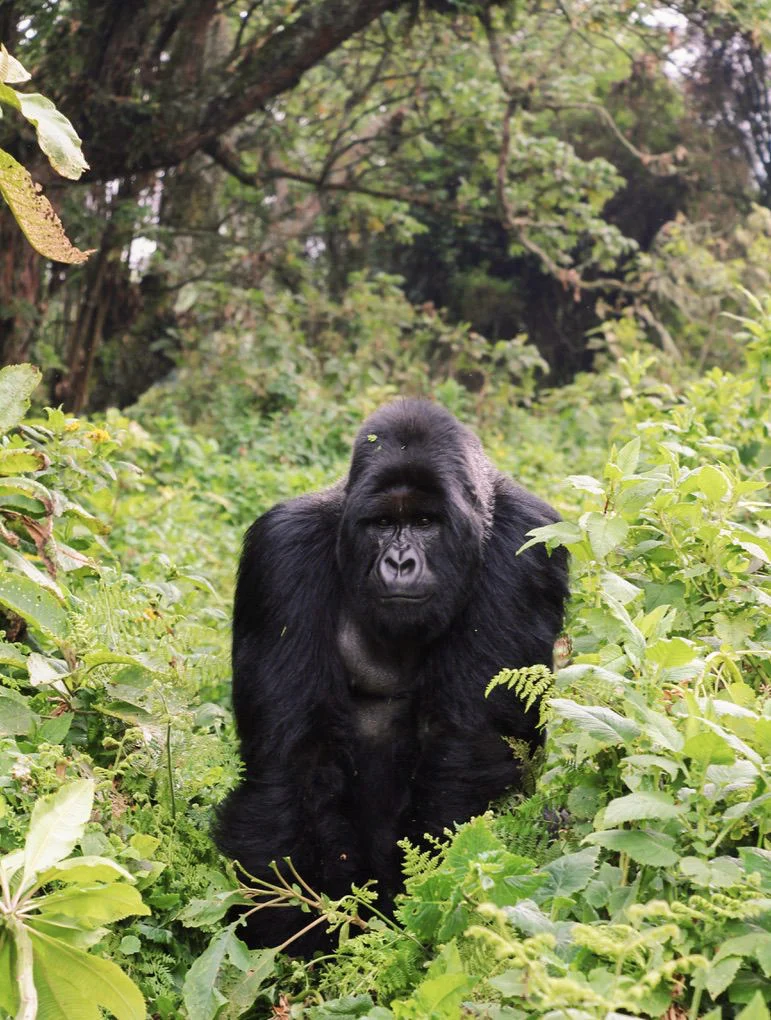
The eastern borderlands of the Democratic Republic of the Congo are a site of staggering beauty and complexity. At the heart sits Virunga, the first national park in Africa and home to the mountain gorillas made famous by Gorillas in the Mist. Since independence from Belgian colonial rule, the region has endured ceaseless armed conflict and displacement. Though much lesser-known than the preceding Rwandan genocide, the first and second Congo Wars (1996–2003) saw the highest death toll of any conflict since World War II. The region has been a hotbed of militant activity ever since, with over a dozen armed groups fighting for control over natural resources under ever-changing conditions. Yet amid this chaos, certain systems hold fast: mountain gorilla populations have rebounded from near-extinction, mineral extraction continues to uphold global markets, and foreign-led conservation operations maintain multimillion-dollar budgets. That dynamic began to shift in early 2025, however, when the Trump Administration dismantled USAID, swiftly eroding the global aid infrastructure that has shaped the region—and the world—for decades.
I first met Dominique Bikaba in 2019 while researching the colonial origins of great ape conservation for my undergraduate thesis. He was the exception to an historic rule: a conservation executive in Eastern Congo who was actually Congolese. He founded Strong Roots Congo in 2009, and after successfully lobbying the government for legal traditional land rights, secured a 600,000 hectare community conservation corridor connecting Kahuzi-Biega National Park and Itombo Nature Reserve. Years later, I returned to work as the conservation manager at Virunga National Park, overseeing an eight-figure portfolio of U.S. foreign aid. My role was one of countless dissolved during the aid cuts, which eliminated $1 billion in annual funding to the DRC alone.
But while the sudden halt of foreign aid devastated organizations dependent on Western funding, Bikaba’s work has only accelerated. Strong Roots Congo never received that kind of money, which Bikaba argues mostly employed foreign middlemen—people like me—rather than reaching communities on the ground. His organization remains on track to establish over a million hectares of community-managed forest, supporting conservation outcomes within and beyond the region’s formal protected areas. The organization’s model rejects the imposed separation of humans and nature, the very logic that once led to the eviction of Bikaba’s own family in the name of conservation. Against the prominent discourse mourning the collapse of U.S. foreign aid, this conversation illuminates the emancipatory conservation regime—led by the local and Indigenous communities long maligned by modern preservation efforts—that could emerge after the end of aid.
— Russell Reed for Guernica
Russell Reed: To many, conservation-based displacement sounds like a colonial relic. But for your family, and many others, it’s a much more recent reality. What is your personal history with Kahuzi-Biega National Park?
Dominique Bikaba: Kahuzi-Biega got that name when the modern conservation system took over, but conservation didn’t start here when Belgians decided to preserve it. When I talk about conservation, I distinguish between modern conservation—the model introduced through colonization—and traditional conservation: what communities were already doing to preserve nature. It was not called conservation, but there are well-documented systems of governance and management of traditional lands, natural resources, and species that form the basis of my work in conservation. Communities passed that knowledge on for generations before Europeans took over, and I think the biggest mistake modern conservationists made was to think that communities were the enemies of nature. They didn’t understand that humans were themselves an element of nature. So the Belgians came and forced people to separate, and in doing so, they actually made them enemies.
My family and my community were victims of that decision. The land now known as Kahuzi-Biega was first formalized as a forest reserve in 1937, which meant people could continue living inside. But when it became a national park in 1970, the policies changed and no one was allowed to live inside. So my family, my community, and the Batwa were all pushed out of their traditional lands. When I present my family, I say that I have three moms: my biological mother, my grandmother who raised me from age two, and the Batwa woman who breastfed me and carried me on her back. The difference was that my family and my community already had other people, other relatives living outside the forest, which was not the case for the Batwa. When we were kicked out of the forest, my family and my community could adapt because they relied on their relatives outside the forest. But the Batwa only relied on the forest, their only means of subsistence. The Batwa have been victimized more than any other community under the modern conservation system.
Russell Reed: What motivated the transition from reserve to national park?
Dominique Bikaba: Leading up to 1970, new biodiversity was being discovered every day. That included gorillas. They had already been discovered there, but as their importance increased, the government had to reinforce conservation policies around them. In 1975, they actually expanded the park to be 10 times its initial size, and the park now spans 600,000 hectares. Their intentions were good, but it went wrong. They had money, they had power, they had guns, they could decide anything. But they didn’t involve communities, and conservation doesn’t work that way. Even in countries that completely militarize conservation, the system eventually collapses.
Conservation is very political. It’s a strategic security asset for governments. And even after independence, governments have kept ties to the metropolitan powers—Kenya, Tanzania, and Uganda are still heavily dependent on the UK for conservation funding and tourism, and the same is true for the DRC with Belgium. While the Zairean [the former name of DRC under Mobutu Sese Seko] government made it a national park, Belgium played a big role in the park’s formalization and expansion—especially through Adrien Deschryver [the Belgian conservationist who championed Grauer’s gorilla conservation before he died under mysterious circumstances, much like his American contemporary Dian Fossey].
Russell Reed: Of course, conservation is only one cause of displacement in Eastern Congo. The region has also faced generations of conflict-related displacement, including through the Rwandan Genocide and the two Congo Wars. How do conservation and conflict intersect in Eastern Congo?
Dominique Bikaba: It’s difficult to separate conservation and displacement, even displacement based on conflict. The way Adrien Deschryver convinced our communities to leave the park, to leave their land, was by saying, “There is a big war coming and they’ll kill you in this forest. So you’d better leave and go where there are other people, so that you can be protected.” And the people were afraid. Congo has never been stable since independence. Displacement has come from conflict, from politics, from outside forces. And conservation is no different.
Russell Reed: Through these recurring displacements—conservation evictions, the genocide—foreign intervention is consistently pivotal. The result is that African conservation practice is shaped by foreign aid, which is itself shaped by Western attention.
Dominique Bikaba: Correct. These two things—what happened in Rwanda in 1994 and what is happening in Congo now—are not getting the same attention from the so-called international community. It’s just bizarre. Many people in the US, for example, do not know that there is a war in Congo going on right now. They don’t know that while some 800,000 people died in 100 days during the Rwandan genocide, several million Congolese people have died since then, due in part to instability caused by post-genocide displacement.
And again, the same thing when it comes to conservation. Grauer’s gorillas, the species we have in Kahuzi-Biega, are not as well known as mountain gorillas in Virunga. Because of different actors. If only we had the global media, if we had research, if we had people—if only the U.S. government was invested in that.
Russell Reed: Western awareness of certain primates is the direct result of Louis Leakey’s “trimates”: Jane Goodall’s chimpanzees, Biruté Galdikas’s orangutans, and here, Dian Fossey’s mountain gorillas. Because of this attention, mountain gorillas were brought back from the brink of extinction—they were actually removed from the critically endangered list in 2018, when their numbers surpassed a thousand again.
Dominique Bikaba: Right. But with Grauer’s gorillas, even with Adrien Deschryver, Belgium didn’t invest the same amount in spreading information. Today, many people still confuse them—they assume we have mountain gorillas here as well. And the Western lowland gorillas are known because they’re the ones you find in zoos around the world. But Grauer’s gorillas, nothing. Because they didn’t go through Louis Leakey’s pipeline, the other species were promoted instead, and we still don’t have access to the same resources.
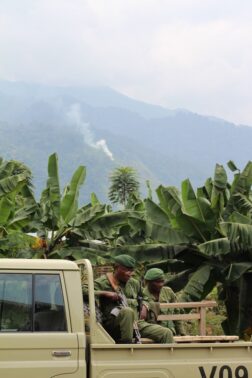
Russell Reed: Even though the Grauer’s gorilla is endemic to this conflict-ridden region of Eastern Congo, making it arguably the great ape most threatened by extinction.
Dominique Bikaba: It’s up to us, as Congolese conservationists, to bring that awareness. But as I said before, it’s like we’re fighting with international NGOs. It seems like we cannot talk about our own resources without international NGOs allowing us to do it. I need permission from an international organization to allow me to do this work. It’s stupid.
Russell Reed: Those resources follow Western interests—national security threats and charismatic species, yes, but resource extraction is also crucial. Where does mining come into play?
Dominique Bikaba: All the wars we’re talking about are about minerals. And since these minerals, including petrol and gas, were discovered in protected areas, you see how they have been dilapidated. The richness of biodiversity here overlaps with richness in minerals, which causes big confusion between international economics and conservation. Whether we accept it or not, mining will happen—even by force. So the question I want to put on the table today is: can mining support biodiversity conservation? So that it can contribute to the local economy, and so that the local economy can also support conservation locally. It’s a big question, but we must have this discussion. Because whether we accept or we refuse, they’ll exploit it.
I think it’s all intentionally designed this way, so that confusion is made. The actors creating conflicts are from the West. The ones proposing conservation models to adapt to conflict are from the West. The same people who are giving us lessons in conservation—I mean, it’s chaos. It’s chaos which is very well designed to ensure that nothing works.
If these big international NGOs came to DRC, to Africa, to support conservation—to preserve species, to support people to preserve their natural resources—they would have worked with those communities and their local structures. But coming to the country and opposing the local NGOs, the local structures—it means they came for something different. That’s exactly what politicians are doing on the African continent. It’s exactly what the NGOs are doing in conservation. And the impact is the same: rampant poverty, people being displaced from their traditional lands, losing their cultural values and their knowledge. If you see how much is invested in conservation on the continent, being handled by international organizations, it’s a lot of money. But when you look at the difference it is making on the ground, does it help to preserve species? Habitats continue to be degraded and species are still depleting. But things can work.
Russell Reed: What is the alternative, then? Tell me about Strong Roots.
Dominique Bikaba: The model we are putting in place is fragile, but it’s working. I began lobbying for a community forestry law in 2010, and with support from civil society organizations, the law passed in 2014. Through that process, communities and Indigenous people gained the legal right to governance and management of their traditional lands. We worked with seven chiefdoms to document the traditional knowledge they applied to preserve natural resources and species, while also citing numerous studies showing that there are more gorillas in non-protected forests than in the protected areas themselves. That sparked my interest—what did they do to maintain those gorilla populations and other species on their traditional lands? Through their regulations, communities could hunt for animal protein but also protect the species. And for me, that traditional knowledge and practice is really science.
We thought this knowledge should be valorized in conservation, and the only way we could make it was through the community forestry process. That’s how we started developing the corridor between Kahuzi-Biega National Park and Itombo Nature Reserve. The goal was to secure 1 million hectares. Today, we’ve secured 600,000 hectares of legal community forestry and are working to secure the additional 400,000 by 2028.
The difference is this: protected areas have displaced people from their traditional lands, which created conflicts between those parks and the communities around them. We have foreigners coming to dictate how to preserve a species, which is often a long-protected totemic species in the local culture. In community forests, people coexist with their resources, using the traditional regulations and management systems they’ve used for centuries. And community forests are cheaper. But just as modern science was not enough to protect the forests, traditional knowledge alone is not enough either. We have to harmonize traditional knowledge with science, bringing the two together to produce the best outcomes for conservation. We can make it happen.
Russell Reed: What makes the communities you work with want to participate in community forestry, despite the complex history of conservation-based displacement in the region?
Dominique Bikaba: Two main reasons. The first is that they are aware of the wealth of biodiversity on their land, and they are afraid that at any time, the government could allocate it to be a protected area and face displacement again. The second is that they are also aware that the land is rich in minerals, which means that the government could identify the forests as mining concessions and also lose control of their land. Through the community forestry process, they not only secure their land rights but also prove to the government that they are able to preserve those forests themselves, using legal instruments and customary regulations. So the government will say, “Oh, things are working here, so we don’t need to disturb them.” They’re playing offense to ensure that the government doesn’t take their land again.
Russell Reed: And how do the community forests relate to Kahuzi-Biega, the national park?
Dominique Bikaba: The community forests have actually helped protected areas to stabilize. To be granted a community forestry title, landowners must walk and confirm the boundaries with their neighbors—and in this case, the neighbor is the national park. We call it participatory mapping, which eventually allows for participatory demarcation. Since the creation of these national parks, the boundaries have remained unknown by the surrounding communities, and this has been the biggest cause of conflict between park management and surrounding communities. The community forests have been a big tool of conflict resolution and prevention, because now the community can say, “We have our own secured forest land outside the park, applying both our customary regulations and formal legal instruments to ensure the park remains where it is, so we can continue managing our forests.”
Russell Reed: You hold a rare pragmatism about the so-called modern conservation model. While many want to dismantle it entirely, you seem to see potential for evolution. Where do traditional national parks fit into the future of conservation, in your vision?
Dominique Bikaba: I wish I had a good answer to that question. What I know is that in a few years, we’ll sit at the table and do some comparative studies between protected areas management and community forest management and try to see which one has worked better—to see which one we should promote, or to see if we can reconcile both. In Congo, we have so many protected areas on paper, but we only have a few that are working because they have external investments, like Virunga and Garamba. But what happens to all the others that don’t receive foreign investment? Is this the best way to do conservation? No.
Of course, we need people from outside the region. We’ll never do conservation alone. And I’m not saying by engaging in traditional conservation that communities should work alone; traditional knowledge is not enough to preserve this forest by itself anymore. We need science and new technologies, which means that we will need a combination of actors, of brains, of hands. We need to collaborate, Congolese and other nationals working together. So the future of protected areas depends on how people will adapt to these new realities and to ensure that they can integrate diverse approaches to conservation.
Russell Reed: We are having this conversation in the immediate aftermath of the Trump Administration’s massive aid cuts, including the total dismantling of USAID. I actually lost my job at Virunga back in April because of those cuts. What has happened in Eastern Congo since then?
Dominique Bikaba: It has had a devastating impact on the region. We have already seen evidence that by cutting funding, many people who were benefiting directly—like those living with HIV or TB, who received medicine through USAID-funded hospitals—lost assistance, and the hospitals are collapsing.
But when it comes to conservation, it’s not the same thing. The question is, how was that money affecting the communities on the ground, and how was it affecting the NGOs that received this funding? In conservation, I think this funding was much more beneficial to those NGOs than to the communities they were meant to serve. And this is why some people say that before the aid and after the aid, the situation is the same. For local NGOs like mine, which were not getting money from USAID to begin with, nothing has changed. They continue working as they used to work.
Russell Reed: Having worked for USAID yourself for many years, what reform do you think is needed?
Dominique Bikaba: I worked for USAID’s Central African Regional Program for the Environment, as the landscape lead of the Maiko-Tayna-Kahuzi-Biega landscape. And personally, I think it was time to shut that funding down and redesign it to be much more beneficial to local people and to national parks. When I stopped working for CARPE [Central Africa Regional Program for the Environment], I was hired to evaluate the program, and I remember saying, “This USAID funding is just sending money back home.” Because it was like you have a million dollars, but not even $100,000 reaches the ground to support the people. I think the best model would be to directly support the people who need the funding. Part of this money should go to governmental institutions like ICCN [International Climate Councils Network] in DRC. I don’t see any organization—from the US, from Europe, from China, from anywhere—that will manage protected areas better than ICCN.
I don’t believe that local institutions don’t have capacities. My landscape had the highest evaluation when I worked for CARPE, and now I’m working for a local NGO. So how can you say that local NGOs don’t have capacities? The capacities I had at that time, have I left them to the international organization? It doesn’t work like that. It’s a way of trying to maintain the funding competition. If you pay good salaries for park rangers, if they are trained, if they have equipment, they will do better jobs than NGOs. If it’s about supporting communities on the ground, support them directly.
Russell Reed: Right. Virunga hired me partly to manage the massive administrative burden that came with USAID and State Department funding. If foreign aid was rebuilt without NGO middlemen, you could spend far less to get the same results—or spend the same amount and see a lot more impact.
Dominique Bikaba: Totally agree. That’s exactly what I learned from working at USAID.
Russell Reed: You hold an interesting dual role in conservation, working between field sites and international forums like the UN climate and biodiversity negotiations. How is Strong Roots received on the global stage?
Dominique Bikaba: I would actually say that this is the best time ever for Strong Roots in that regard. Because at these forums—the Convention on Biological Diversity (CBD), the UN Framework Convention on Climate Change (UNFCCC), Institut Congolais pour la Conservation de la Nature (IUCN)—all those big players are finally understanding and valuing the importance of working directly with local communities and Indigenous people. There is a big movement today to directly support the people who are on the ground, who are actually doing the work with traditional knowledge—not just to preserve nature, but also to sustain their ways of living. The big policymakers and enforcers are understanding this and actually promoting it now, which is a really good thing.
Russell Reed: Do you see the Strong Roots community forestry model as something specific to Eastern Congo, or could it be enacted elsewhere?
Dominique Bikaba: The law we passed is not just for Eastern DRC, it’s for the whole country. But the way we’ve used it here is special, the fact that we embedded it within modern conservation approaches and have actually used it to resolve long-lasting conflicts between protected areas and surrounding communities, and within communities as well. We’ve developed a holistic way of looking at it—going further on conservation, preserving species, doing research, honoring community contributions—and I think that made it special. It’s being replicated across the whole country, and other countries are approaching me for support in implementing it as well—in Congo-Brazzaville, in Cameroon, in Gabon.