I grew up in an old stone house on Al-Salt Street in the steep, narrow maze of the Wadi Nisnas neighborhood above Haifa’s port. Not long before my birth, Haifa was a sleepy city of limestone block houses and citrus orchards squeezed between the Mediterranean and Mount Carmel, but a flood of European Jews and the strategic needs of the British during the war broke Mothra Haifa out of her chrysalis, with a steampunk head at the docks and suburban wings extending up Mount Carmel. Haifa became known as Um Al Gharib, Mother of the Stranger.
“Yalla, Ibrahim, Habibi, take these sweets to the restaurant.” Mama calls me into our kitchen. I can smell the cool limestone and the herbs she’s drying. I’m seven, with a mop of black hair and otherworldly blue eyes. It’s early 1945.
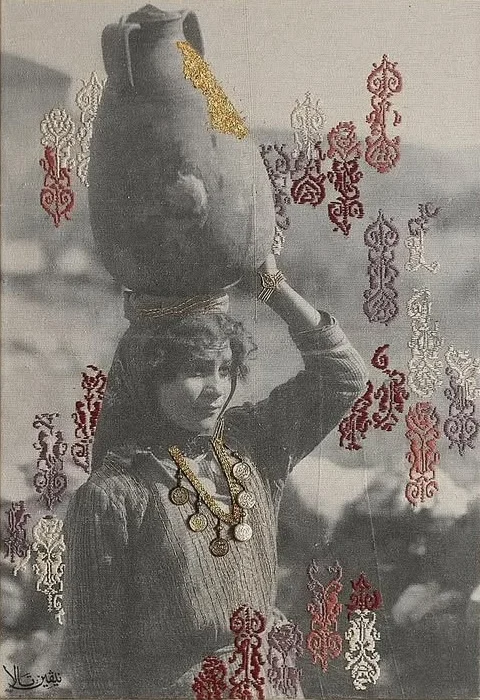
Rossetti would have loved Mama, with her lush features and cascades of raven curls, a troubled Persephone, her dark eyes gleaming with the last light of the living world upon the Styx. Until she was thirteen, she lived in the village of Bayt Thul, where young men assessed the strength, grace, and beauty of the unmarried girls as they balanced heavy jarras of water on their heads: from the well to the wedding, as the old village saying went.
And that village might have been her whole life, but her father married outside his clan, estranging both her parents from their families, and then a border dispute brought him to blows with a neighbor, whose heart gave out. Not only was her father jailed for murder, but the man’s family sued and won all his land and possessions. Destitute, Mama’s mother became a live-in maid for a wealthy Catholic family in Al Quds. Madam was Swedish, Sir from one of the ruling Ayan. Their son, a couple of years older than Mama, decided to play Professor Higgins and Mama emerged from this household speaking Parisian French, BBC English, and Lebanese Arabic (the family summered in the Matn mountains), though he never managed to teach Mama to read or write. Severe dyslexia, the words on the page like locusts swarming in a field.
Mama, baking all morning, looks exhausted, ever trying to find ways to alleviate our financial straits. Taking the tray of sweets, I slalom down the winding streets, avoiding donkeys and hawker’s carts, threading through Jews and Arabs in traditional or European fashions, and beet red British soldiers in khaki shorts.
Our “restaurant” is a food booth near the docks where Baba fries falafel palatable as rocks and serves ice cream that tastes of garlic and stale oil, delights that can only be sampled if a customer can find him. Today, presiding at his shigg under the shade of a carob tree a hundred yards from the booth, Baba hasn’t got around to opening. This is where Baba holds court every day, sitting with his cronies on olive oil cans topped with cushions. The people of our neighborhood (the men with affection, their wives with scorn) dub him the Sheikh of Salt Street.
Spotting me, he waves me over, crying out, “Ah, my little chicky’s here.”
He and Mama are an odd couple. Baba, thirty years older and four inches shorter than she, is stocky, troll-like, with crazy eyebrows, a roguish gap between his front teeth, and a clownish halo of nappy grey curls. When he married Mama—a Moslem peasant—his Orthodox Christian family cut ties, though they provided him with several properties for income. Baba sold these properties to invest in a hotel scheme fabricated by a con man who forged the share vouchers. Baba’s too proud to ask his family for help, but a few weeks after my birth, Mama secretly snuck me to my grandparents in I’billin and agreed for us both to be chrismated. As a Levantine peasant, she’s O Positive for Gods, her animist people wisely appeasing every colonizer. In Haifa, she and I are Moslem. In I’billin, on our trips to beg money (Mama tells Baba we’re visiting her sick cousin Muna), we slip on our eight-pointed crosses and attend St. George’s.
There’s quite a crowd at Baba’s shigg. I nearly drop the tray as he pulls me into his arms.
“My guests need tea, habibi,” he remonstrates, “and bring us a plate of those pastries.”
When I deliver the tray, Baba again snatches me onto his knees. “Is there a more beautiful boy in the world than this?”
“Alhamdulillah,” murmur several of the Moslems to save me from Baba’s vanity.
“That’s because he takes after his mother,” declares Savas Benrubi. One of the Greek Jews who made Aliyah in ’34, he resembles Mussolini and is famous for impersonating the dictator with a kitchen pan on his head.
“Not just Um Ibrahim!” protests Abu Amir, sensitive to rumors questioning the origins of my blue eyes. “Who’s more handsome than Khalil?”
The laughter intensifies because Abu Amir, ancient, slumped, and toothless, half buried in a white dishdasha, is blind.
“The British,” interposes Rasheed Assaf, the retired bookseller, “sons of dogs though they may be, have a nice saying.” He switches from Arabic to English: “Handsome is as handsome does.” Rasheed is a slender, dignified man with a pencil mustache and lugubrious eyes, always wearing a suit and tarbush. He lost his wife, two daughters, and his faith in God during the typhoid epidemic that swept Palestine at the turn of the century.
Abu Nabil sententiously interjects, “The Hadith tells us what’s handsome. Jabir ibn Samurah said, ‘I saw the Messenger of Allah (peace be upon him) on a clear night. I turned my sight between him and the moon and to me he was more beautiful than the moon.’ Which is to say that the most beautiful thing in this world is faith.”
As Abu Nabil says this, a couple of the other Moslems throw away their cigarettes out of respect for the Hadith, though Ahmed Deif, the baker, being famously tight-fisted, hands his to Savas for safekeeping.
Abu Nabil continues: “You need no other books but the Koran and Hadith. They embody all wisdom.”
“All wisdom,” scoffs Rasheed. “To quote the great Al-Ma’arri: ‘The inhabitants of the earth are of two sorts: Those with brains, but no religion, and those with religion, but no brains.’”
And they’re off again, arguing. I love being among them, smelling the apple-scented smoke of the nargilah they share, listening to their stormy voices.
Later that afternoon, I find Mama wiping down the whitewashed walls in her and Baba’s bedroom. She’s never idle. All the rooms are bare now. Over time she’s had to sell everything: the copper basin once used to soak wheat stalks for basketry (my baby bath!), the hand-made clay pots painted with iron oxide from the rocks of the Ghor, carpets woven by the Bedouin of Hebron. All gone, our home leached of color. All that remains is that wide-hipped, narrow-necked brass jarra sitting in the window niche opposite the bed, evoking Mama as a village girl tightroping home with every boy’s eyes upon her.
“Mama,” I say sheepishly, “Baba has invited Savas, Marwan, and Yava for dinner.”
Baba’s always doing this, turning up late with three or four people in tow, forcing Mama to perform miracles to produce a dinner that won’t shame us. She sends me to fetch a couple of chickens from the one grocer who still affords us credit, and more sumac so she can make musakhan. When I return, reentering the kitchen, Yava is chopping parsley for tabbouleh while Mama grills eggplant. Yava, Savas Benrubi’s wife, fled Odessa in ‘41. She’s Mama’s age, 25, and petite, hardly taller than I am. She never wears makeup, dresses in shirts and trousers, her mousy hair in a pixie cut. Her face, with its tiny, retroussé nose and dimples, doesn’t suit her somber nature. She often visits during the day to catch Mama alone. I once walked in on them in my parents’ bedroom, the two of them sitting on the bed, Yava brushing Mama’s hair. It wasn’t haram for Mama to be without her hijab in front of another woman, but I felt a tightening in my chest at the rhythmic sweep of the hairbrush, the breathy silence between them. When Yava saw me, her pale skin flushed, and she shouted, “You’re like the goddamn Gestapo. Why are you always sneaking around?” Outraged, I waited for Mama to defend me, but she seemed in a dream, staring at me without recognition.
I hear the door open and run to it as it disgorges Baba, followed by Savas and Marwan clutching bottles of wine and boxes of sweets.
Marwan snatches me into his arms. “Give me those sapphire eyes. I’m going to use them for cufflinks.”
I squirm and giggle as Marwan nibbles my ear. He’s handsome as a film star, always wearing a fancy suit, with lots of rings on his fingers. A few years ago, he gave up his job as a mechanic to be Savas’ secrétaire personnel, though his education consists of a few years at the madrasa and he speaks nothing but coarse street Arabic. He now spends nearly all his time in Savas and Yava’s fancy villa up the hill near the British barracks in a neighborhood occupied by a swinging set of wealthy francophone Levantines. His wife and two girls, who live in the nearby Moslem neighborhood of Wadi Salib, are never mentioned.
My beleaguered mother, as ever, produces a masterpiece. The sumac chicken makes Marwan jump up from the table to insist someone kill him this very minute so the taste of it can be the last thing he knows on this earth. Savas rolls up a piece of pita like a fat cigar and declares, We shall eat it on the beaches, we shall eat it on the landing grounds, we shall eat it in the fields, in a strange British voice that Mama whispers to me is Winston Churchill’s.
After we’ve eaten, Mama orders me to bed, but I slip into my usual spying place just outside, peeking at the adults through the gap above the door’s ill-fitting hinge.
For a while the discussion is serious: the irony of Jews being rescued by Russians, and whether the Soviets will ever relinquish the land they’re conquering. Savas says that six months after the liberation of Greece, it’s clear that nearly the entire Jewish population of his original home, Thessalonica, has been wiped out.
Yava interjects that she received the good news that one of her cousins survived the Odessa massacre and is now in a place called Brighton Beach in America.
Marwan asks Mama something I can’t hear, and she must have been evasive, since he protests, “Oh she’s so cagey. I think she must have a secret past. Is she a spy? Has she committed a terrible crime? We need to get it out of her.”
“Leave her alone,” Yava protests. I sense that Yava knows Mama’s secrets, which makes me dislike her.
“No, no,” Savas jumps in, “confession is good for the soul. We should all confess something. And no games, something serious. And since you’re so curious, Marwan, we’ll start with you.”
After thinking for a moment, Marwan says, “My confession is not going to seem like a confession, but it’s something I’ve hardly even been able to admit to myself. For the first time in my whole life, I’m happy.” He glances at Savas, and I’m low enough to catch sight of them touching hands beneath the table.
“Now it’s your turn, Savas,” Marwan counters.
“Okay.” After a sigh, Savas says, “I confess that all my life I’ve wished I didn’t look so . . . well, so much like a Jew.”
Flushing, Savas turns hastily to Yava. “You’re next, darling.”
Running her finger around the rim of her wine glass, she says quietly, “I often fantasize about killing Germans.”
“That’s hardly a confession,” Savas snorts.
“I’m not talking about soldiers.” Her finger reverses. “I’ve dreamed”—she glances nervously at Mama—“of killing every last one of those bastards.”
Everyone is quiet for a moment before Savas says, “Khalil, you’re in the dock.”
Baba looks troubled. He doesn’t like things to be serious, so he tells a story about when he was a boy and his mama locked him in the pantry as punishment for always running off to play with his friends. But he was desperate for a poo. He tells the story in his usual animated way, standing up, running around with his hands over his bottom, sending the tale in all kinds of directions before the denouement of him pooping in a big jar of pickled cucumbers.
Though Savas laughs all the way through, he insists on a real confession.
After a heavy sigh, Baba says, “When I thought Latifa had been killed by that bomb, I decided to throw myself off the steep cliff where the wheat is threshed in my home village.”
He’s talking about my birth. Mama was hugely pregnant in Haifa’s vegetable market when an Irgun bomb exploded, and she gave birth to me in all that smoke and chaos. Baba, searching Government Hospital, came upon the mangled corpse of a pregnant woman among bodies turned white by limestone dust.
“Now it’s your turn, habibti,” Marwan says to Mama.
“La, I don’t . . .” Mama looks distressed.
“Come on, what about those years in that wealthy house?” Marwan prods. “Don’t the maids know everyone’s secrets?”
“Leave her alone.” Yava slides a (hateful!) comforting arm around Mama.
“But she knows everything about us, and we know nothing about her,” Marwan protests.
Saving her, Baba snatches up her hand, kisses it, and sings:
“When the groom goes to meet her
To press to her forehead the golden coin
She’s lovely as a willow branch, fragrant as rosemary.
Praise be to God!
Listen to her. She is your life.”
Baba often sings this verse of their wedding song. Just before the wedding, the bridegroom is allowed one glimpse of his betrothed’s face. He sits opposite her, lifts her veil, touches a gold coin to her forehead and lets it fall into her lap. This symbolizes his promise always to provide for her.
*
Late July of 1946. Jewish survivors are arriving on rusted-out ships. The British are trying to stop them, and from the house we can often hear protests at the docks. Many are making it ashore, becoming absorbed into the Jewish suburbs up the mountain or down the coast.
Mama orders me to go help Baba, but I find him conducting his shigg. Most of Baba’s old Jewish regulars are absent, but I see Laszlo Kovak, a towering, rail-thin Ukrainian. His craggy face looks pained beneath a luxurious gush of dirty blond hair. When he sweeps it back, you can see that he’s lost the tips of several fingers. Though he arrived only a few months ago he’s already learned the rudiments of Arabic and sometimes politely interrupts to ask the meaning of certain words. I’m often the one to respond, since Baba’s English is sketchy.
When Baba pulls me into his lap, I whisper, “Shouldn’t we open the restaurant?” Saturday’s the best day, the dock area jammed with soldiers and boat passengers.
“Shall I feed them a little chicky?” he says, tickling me until I beg him to stop.
I know it’s useless and wistfully watch the crowds wandering past our shut-up booth.
Laszlo slips away. Remembering something I’ve been meaning to say, I hurry after him.
“Mr. Kovak, sir,” I call.
When he turns back to me, stiffly, as if his bones pain him, I say in English, “I know you want to learn Arabic. I should tell you that my father’s Arabic—” I hesitate.
But he understands, and in halting Arabic says, “His Arabic not . . . high?”
“He uses a lot of village words, and his grammar is not always as it should be.”
Laszlo examines me curiously for a moment, his eyes startlingly blue, like mine. “That’s good to know,” he says. “How old are you, Ibrahim?”
“Eight.”
“You’re a clever boy, and tall for your age, yes? I would have guessed you were twelve, thirteen.”
Despite Mama’s internalized voice murmuring mashallah and declaring for the benefit of any nearby djinn who might decide to kidnap such a paragon that I’m actually dumb as a donkey and scrawny to boot, I feel a warm swell of pride.
“Can I buy you a slice of cake?” He leads me into one of the new Viennese patisseries appearing all over the city and orders me a soda and a slice of sachertorte.
I’ve never been into a place like this: marble-topped tables, burgundy velvet booths, chandeliers floating above us like bioluminescent jellyfish.
He retrieves a notebook and pencil. “I want to know everything about my new home,” he says. “Can you tell me about the nearby villages?”
I explain between bites of that delicious cake that the villages are all known for certain things—one for shrewdness, another for the beauty of their women, and so on—and that they all have linguistic idiosyncrasies.
“In Ram Allah,” I say, “they used hol—frightful—when something is amazing. In Bireh they’d use fok el-fok, up of the up, first rate.”
He questions me for a long while, insisting I have another piece of cake, scribbling down everything. He’s particularly interested in how the villages empty out during the six yearly harvests.
He asks, “Do you think the fellaheen feel more loyalty to this country or to their villages?”
I’m not sure how to answer this. “Well, they’re very attached to their villages. They don’t like their daughters to live among strangers, and even wealthy villagers who live in cities keep their village homes because it’s the place of their history and kinship ties.”
“What if something happened to the village?” he says.
Using my finger to scrape every last smear of chocolate icing from my plate, I say, “How do you mean?”
“Well, I heard the British sometimes destroyed villages during the revolt.”
I shrug. “I suppose they’d rebuild it.”
Laszlo narrows his eyes. I sense this isn’t quite what he’s after, but he doesn’t pursue it.
This line of questioning reminds me of the shanty towns east of the city, former tenant farmers who lost their livelihoods after the Jewish Fund bought land and threw them off, now neither city nor village people, living in homes made of crushed petrol tins.
“And what do the village people think of the Bedouin?” Laszlo asks.
I give this some thought as I suck the chocolate off my finger, recalling the Bedouin who come every year to harvest olives, women with nearly black skin, in bright thobes, with ankle bracelets and tattooed faces.
Then I remember something: “The fellaheen have a saying: ‘City people are the lords of the world; the fellaheen are the donkeys of the world.’ But Baba told me that when he was young the saying was different. It was the Bedouin who were called the lords of the world.”
Laszlo tips his head, thinking about this as I add, “Abu Nabil is always going on about them being the true Arab, free of national and colonial borders. But mostly people say they’re thieves and gypsies.”
“Don’t you think they’re like the Red Indians?” he says.
The similarities strike me: the Bedouin live in mobile tribes in tents, love horses, raid each other’s encampments.
“The pure and original Americans,” Laszlo murmurs, almost to himself. For a moment his face becomes so bitterly thoughtful he looks bilious. Snatching a napkin to his mouth, he hocks something out of his clotted lungs. Crushing the now soiled napkin in his large fist, he says, “Which of us is pure anymore?”
We both look out into the street, our gaze drawn by an old man in a thawb and kufiyah astride a donkey so small his sandals are scraping the ground, a sight that gives the lie to this Viennese terrarium.
He asks me to walk with him up the mountain. Soon he’s struggling for breath, the skin around his mouth taking on a bruised yellow tinge. After a half hour, he slumps with his back to the trunk of a tall pine. I hunker beside him in the wavering sunlight, breathing in the tree’s resinous smell. We look out over the city, the tumble of square white buildings and red roofs, the smoking caldrons of the oil refinery’s cooling towers, the breakwaters of the busy port.
Pointing toward the river glittering in the distance, emptying into the taut bow of the bay that curves up to Acre, Laszlo says, “That’s the Kishon, right?”
I nod. “The Arabs call it Nahr Mukatta.”
“The river of something?”
“Of slaughter.”
“And we’re on Mount Carmel.” He pats the ground.
“My grandmother calls it Mount Saint Elias. She hates the Carmelites.”
“Hates them?”
“They’re French Catholics.”
“What’s she?”
“Greek Orthodox.”
“And who were those Nazis in the German quarter?”
“Templars. They’re Protestants. They hated the Carmelites, too.”
He convulses with something that might have been a laugh. “This country’s crazy.”
He points vaguely behind them. “And that way is the Jezreel Valley, right—the Emek—and the Sea of Galilee?”
I nod. “Arabs call the valley Marj Ibn Amir, which means ‘The Meadow of the Son of Amir.’ My grandmother calls it the Plain of Esdraelon, which is the Greek for Jezreel. It goes all the way to the Jordan River Valley.”
“You’ve been to the Sea of Galilee?” he asks.
“We’ve had picnics there. It’s beautiful.”
“It’s also called Lake Tiberias, right?”
I nod. “Or the Sea of Kinneret. And some people still call it—”
“Enough, please.” He cuts me off, looking a little bilious, dipping his head between his legs and murmuring, “Doesn’t anything in this country have one name?”
When he recovers a little, he raises his head and says quietly, “Good God, we’re not much to show for thousands of years of history, are we?”
It takes me a second to realize he’s referring to us, a Jewish man and an Arab boy.
Turning his face up into the glimmering, wavering light through the branches, Laszlo says, “It’s so good to feel the sun. One day I want to own a little farm, perhaps in the Emek.”
“Where are you from?” I ask.
“My parents were from Slovakia, and when they were kicked out, they moved to a shtetl in Ukraine called Justingrad. Most of the Jews we knew went to America, but my father insisted we stay for the pogroms. Why leave when you’re having so much fun, uh?”
Bitterness tautens his face. He turns to me, seeming to cruelly savor this bitterness, and says, “Where’d you get those blue eyes, Ibrahim?”
I know what he’s getting at. All my life, rumors have circulated that my real father must be al Inglezi or an Ashkenazi.
“They’re in my family,” I say defensively. “Warda means Rose. It’s a name often used for people who are fair skinned, red skinned. In the past, I mean.”
The bitterness, draining, desiccates his expression, like a wadi in the summer, returning him to an arid blankness, only the shrinking blue pools of his eyes left. “They came in 1919,” he says. “I was one of a little bouquet of blue eyes blossoming in 1920.”
I can’t believe he’s only 26.
“You ever wonder who’s staring back at you in the mirror?” He spits onto the rocky dirt a phlegmy, slightly bloody effusion and then looks up through the cypress’s branches with a grimace.
“I don’t resemble anyone in my family,” he says. “Dark hair, dark eyes. Proper Jews. I don’t know how my mother or father could bear to look at me.”
I don’t understand what he means and I’m afraid to ask.
“We should have come here to Palestine or gone to America. Oh no, America’s godless, my father said, and Palestine’s full of Bolsheviks. So he moved us to Szeged.”
He brushes the gap-toothed comb of his hand aggressively through that tawny gush of hair, mocking him with its lushness.
I ask him if he’s ready to leave.
“I’m going to stay here a while. You go.”
As I head down, he calls me back and pushes five Palestinian pounds into my hand. “For your help,” he says.
Hurrying down the dusty, rocky path, I feel strange about the money, holding it like I hold a dead mouse when I find it in one of the traps Mama sets, running through the house to fling it into the street.
When I arrive home, it’s still early afternoon. I look into the small mirror that hangs beside the front door. As I wipe away the chocolate staining my lips, I become aware again of the five pounds I’m holding. You ever wonder who’s staring back at you in the mirror?
Hearing laughter upstairs, I quietly ascend. The door to my parents’ bedroom is ajar. I look through the crack along the hinge to see Mama and Yava sitting up against the bed’s headboard. Yava’s wearing only her pants and bra. Her blouse must have lost a button. Mama is sewing it back on. Mama uses her teeth to snap the thread of the finished button and hands the blouse to Yava. But Yava doesn’t take it. Saying something I can’t hear, she jumps off the bed. She’s tiny, sprite-like, a pretty young boy. Running around to Mama’s side, she pulls Mama to her feet. Mama only feigns reluctance; she’s laughing. I feel a prickly heat that intensifies as Yava removes her pants, flinging them onto the bed, and then tugs on Mama’s dress. For a short while Mama continues to resist whatever this is, but suddenly, with an expression of mock exasperation, as if indulging the whim of an adorable child, she unzips the back of her dress and shimmies it off. She then slips on Yava’s blouse. Yava’s laughing now. Mama’s close to a foot taller, with a much bigger bust, so the blouse becomes a bolero top, and when she slips on the pants she resembles Alice after eating the cake. Yava, swamped in Mama’s dress, looks like a child playing dress-up. After also tying on Mama’s hijab, Yava retrieves the jarra from the windowsill and attempts without success to balance it on her head. Mama shows her, settling the Jarra upon her mass of black curls before walking around the bedroom with an exaggerated sway of her hips. When she returns to Yava, the two of them go very still, gazing at their reflections in the cheval mirror. Mama transfers the jarra to Yava’s head, holding it there to complete the transformation as Yava’s arm slides around the back of Mama’s exposed midriff. I can’t bear it. Sneaking quickly downstairs, I open and slam shut the front door, calling “Mama.”
I allow them a little time before ascending. When I enter, they’re dressed again, positioned awkwardly on either side of the bed. Running to Mama, for some reason I thrust Laszlo’s five pounds at her and burst into tears. Normally Mama has little patience for crying, but she falls to her knees, wrapping me in her arms.
I think Yava’s gone, but when Mama and I exit the bedroom, Yava is downstairs. Mama tells me to go to my room, but I remain on the landing, peeking down at them.
Mama’s saying something I can’t quite make out, so I take a few quiet steps down as Yava raises her voice. “You need to make a choice.”
I can’t hear Mama’s response.
“You deserve a life, Latifa,” she says, “What pleasure do you ever get?”
“Yava,” Mama sighs, as if this were a bone Yava has worried into splinters.
“Answer me. What life do you have here? And look at what’s happening. You’re about to be crushed, all of you.”
“What do you mean?”
Yava now takes firm hold of both Mama’s arms, as if she’s going to shake her or drag her out into the street. Becoming frightened, I hurry to the bottom of the stairs.
“Mama.”
Yava, turning desolate eyes on me, releases her and rushes out.
I run to Mama and fling my arms around her. “What’s wrong with her?”
Mama doesn’t respond, staring at the front door with a faraway look.
“Mama?”
Suddenly, she tears herself from my grasp, shoving me away. “Why are you always sneaking around, always listening?” She smooths and tugs at her dress as if she’s infested with me before storming off toward the kitchen.
*
There has been trouble for a long time, but I can really feel it now in the restless, pre-storm breeze ruffling brows, swelling rumors, rattling newspapers. The jabberwocky of my childhood—Rothschild, Balfour, White Paper, Partition Plan—is coming to its final verse. Baba’s shigg swells so much it blocks the road, though there are no longer any Jews in it. Mama murmurs, “If you could defeat your enemies by drinking coffee and talking, the Arabs would rule the world.”
A few days from the partition vote, I’m sitting with Baba at his shigg, surrounded by two dozen men, when Laszlo appears with a muslin sack slung over his shoulder. Baba’s happy to see him until Laszlo hefts the sack down, pronouncing gravely, “For your kindness, Khalil.”
Coffee beans. Baba frowns, angry, injured, refusing to look at the gift, and says nothing. Laszlo turns a hard and regretful glance upon me, as if he wishes he could see through me; as if he wishes I wasn’t there.
Baba leaves the beans in the street. By morning someone has taken them.
On the 29th of November, my family is joined in our house by the stalwarts of Baba’s shigg: blind Abu Amir, Rasheed Assaf, and Abu Nabil. We listen to the radio as the votes from one country after another for UN Resolution 181 to divide Palestine into Arab and Jewish states are read out. Mama stands against the wall, throttling a tea towel. Baba looks baffled, sitting in his armchair by the log fire with a Jericho orange, flinging its peel into the flames with a fizz, the air filling with citrus. As the countries and their votes are read out, Rasheed clutches his head and murmurs an Al-Ma’arri quote about time crushing men like little pieces of glass, Abu Nabil asks for the deliverance of God, and Abu Amir, Baba’s echo, finally finds his own voice, shouting, “Bolivia, they decide what’s my country and what’s not! Iceland. Is this even a country? And they have the right to give my city to Ashkenazi Zionists? United Kingdom. What’s this ‘abstain,’ those sons of dogs?”
The second the votes are cast, partition confirmed, gunfire begins, Arab fighters shooting at Haganah positions along Herzl Street and up into Hadar.
*
The British remain in Haifa, creating something of a buffer between the Jewish and Arab neighborhoods. Some months after the vote, in early ’48, during a period of relative calm, I’m hurrying to the food booth to retrieve kerosene and cooking oil when someone calls my name. It’s Yava, who emerges from the shadowed doorway of one of the many recently vacated houses. Beckoning me over, clearly too scared to venture further, she hands me a sealed envelope. She shocks me then by falling to her knees, gripping my arms so hard it hurts, and begging me to please hand it directly to my mother. Like most people, she has no idea that Mama, who speaks such flawless French and English, can’t read a word. Yava hurries back up the hill, and as soon as she’s out of sight I run to the booth and steam the letter open.
It’s written in English on lavender letter paper taken from the Bat Galim Hotel. In it Yava speaks of the first time she watched my mother remove her hijab; how this gesture toward undressing devastated her. Of how she longed to press that mane of wavy black hair to her face, to smell it and to smell my mother’s beautiful neck. (I want to tell Yava, with hotly jealous self-satisfaction, that Mama’s hair smells of her chamomile conditioner, and that her neck smells of bay leaf and olive oil soap.) Yava then speaks of Adam in paradise as neither male nor female—as both—before God split him to make Eve. After the Fall, Adam and Eve’s hunger is to be one again, to rediscover Eden in each other’s bodies. But God extended his curse of division, layering upon that first nakedness not only sex, but race, ethnicity, nationality, religion, caste, and class. Yava says: How cruel God is, and it has often seemed to me that love is not our way back to God, but our only defense against Him. As my father once exhorted me to obey him and be a good daughter, so God insists we give Him our love. I will not love Him. I will love you.
I sit in a doorway and read the letter over and over, confused about it being a woman who loves Mama like this, and by these strange ideas of returning to paradise by means of a lover’s body, of disobeying God by loving each other.
After sealing up the letter again with flour and water, I hand it to Mama when I return home. Murmuring that she’ll ask Baba to read it later, she shoves it quickly into the pocket of her apron, unable to meet my eyes.
In February, news comes that the Haganah have killed sixty Palestinians in the village of Sa’sa’ near the Lebanese border, blowing people up in their houses. A week after this, a bomb goes off in Ben Yehuda Street Market, killing about the same number of Jews. A few weeks later, a bomb explodes in Haifa near Said Khoury’s garage, killing thirty people, including Abu Nabil. Rumors then become rife about a massacre in Deir Yassin, a village near Jerusalem. It’s now the middle of April 1948.
Mama keeps telling Baba we should leave, but he believes people will be reasonable. On Radio Cairo, they’re telling us the Arabs are winning one glorious victory after another.
Then, late one night we’re shocked out of bed by a hammering at the door. It’s Savas disguised in a thawb and Keffiyeh. If he’s caught by the Arab forces, he’ll be killed.
Sitting down, breathing hard and rubbing his forehead, Savas glances at Mama with a pained look and says, “I need to tell you . . . Yava was shot by a sniper yesterday morning while hanging washing on our balcony. We’ve already buried her.”
Mama says nothing, her eyes going glassy as Baba begins to weep softly, almost absentmindedly, and says, “The world’s going mad.”
“It’s been mad for a long while, Khalil.” Savas tells us he’s arranged to take Marwan, his family, and all of us to Cyprus, but we have to leave in the next couple of days. He warns us that Jewish soldiers are out for blood following an attack two days before on a convoy heading to Hadassah Hospital on Mount Scopus. Eighty Jews massacred, including doctors, nurses, and patients. Baba says he won’t leave his country. Baba and I cry as we hug Savas goodbye; Mama remains numb and impenetrable.
*
Only the British army now stands between us and the Jewish forces, and though the British promise to stay until May, suddenly and without warning they evacuate. The Jews have all the high ground. Loudspeakers tell us they have the atom bomb and are going to use it on us. A couple of days after Tiberias falls, a massive explosion shatters all our windows. The Haganah are rolling barrels of explosives down the hill into Wadi Nisnas.
Just days later, during Passover, the Jews attack full force, taking the airfield and railway workshops. They’re using mortars. We can hear explosions and the pop of gunfire. People flood the docks. Mama says we should join them, but Baba stubbornly refuses. An hour later, we hear a gunbattle outside, Arab voices soon giving way to Hebrew and a babel of other tongues. A hammering at the door freezes us, but a familiar voice calls, “Khalil, open up.”
Baba does so, and there stands Laszlo Kovak, a STEN gun in his ruined hands.
After telling the men with him he’ll join them at Najada House by the bridge, he steps in, regarding us all cooly. “Khalil,” he says in the perfect Arabic we helped him learn, “you and your family need to leave the country.”
He retrieves a wad of British pounds from his pocket. Before Baba can take them, I run over, snatching the money and flinging it in a fluttering shower out of the door. Laszlo says nothing. Ordering Mama to fetch a sheet and a broom, he fashions a white flag, handing it to Baba.
“Bring food and water only,” he says, “It’s going to be a long, hot walk. The docks are hopeless. Head north to Lebanon.”
After checking the road, he takes a moment to gather the scattered notes, laying them just inside our threshold. “You’ll need money,” he says.
He glances at me. Not regret or sorrow. It’s as if he’s looking at a ghost he doesn’t want to believe in.
I beg to bring my football, but Baba says no. Mama dashes upstairs. I stand behind Baba at the door, his hands trembling around the makeshift flagpole as he peeks into the street. He has our house deeds and key. After a few minutes, he says, “Go tell your mother to hurry up.”
I find Mama in her underwear, strapping her bridal headdress with its few remaining gold Ottoman coins around her belly. She gestures me over to help with this. The brass jarra lies on the bed, a knitting needle beside it. Once her gold is secured, she flings on a voluminous abaya and ties up her hair. We hear shouting outside and the dry rattle of a machine gun.
“Mama, we’ve got to go.”
When I take her hand, she tugs it free to snatch up the jarra.
“Why are you bringing that?”
She doesn’t know how to answer me. “We might need it,” she says finally, hurrying out.
As we join Baba, he gestures toward the jarra. “What’s this?”
Mama stammers, “It’s not heavy.”
“Amra Majnouna,” Baba says, “who’s going to steal an old brass jug?”
He snatches it from her, handing it to me, “Yalla, Ibrahim, put it back.”
As I run upstairs, something occurs to me. I’d wondered where Mama hid Yava’s letter. Now I tip the neck of the jarra toward the sunlight lancing in the window and catch a flash of lavender. She was trying to fish it out with the knitting needle, still on the bed, like the instrument of an abortive crime. Why would she put the letter somewhere she couldn’t retrieve it? And how strange to hide it inside that jarra she once set upon her head to show off her funambulist grace to the village boys. Returning the jarra to the windowsill, I run out.
Baba has me hold the flag while he locks our door. We head north through the streets, then up over the hills, joining dozens of other families carrying what they can in carts, on donkeys, on their backs. As we crest a hill, we encounter a troop of about a dozen Jewish women soldiers.
One says in Arabic, “Are you running away, out of the country?”
We say yes. It’s strange. They’re holding rifles and look so happy and so pretty; and as we go by, one of them, giddy with excitement, repeats, “Bye-bye, Palestine. Bye-bye, Palestine”; and it’s awful and humiliating but it’s almost as if she’s being nice, as if we were leaving her house after dinner.
I glance back at Haifa’s tumble of pale buildings in the bright sun, the Mediterranean exhaling and inhaling its gentle waves, plumes of smoke everywhere, gunfire crackling. This is the last time I’ll ever see it.
*
I have an American passport now. My mama was Moslem, my baba Orthodox, my biological father, Catholic. I’d like to think I was born out of love, but I suspect, with my thirteen-year-old mother served up as a living doll for the tawny-headed and blue-eyed boy of that wealthy household, that the truth is more sinister. My daughter has no idea I’m Palestinian. She thinks I’m Lebanese. On our arrival in Lebanon in ’48, Mama, ever practical, pulled off her hijab, and we slipped on our Orthodox crosses, saving us from the fate of most of the Palestinian Moslems, abortive and unwanted, stuck in those miserable camps. I received a free and excellent education at an Orthodox school, and we were quickly made citizens. Baba, the Sheikh of Salt Street, was a man too idiomatic to be translated out of his world and died within a few months of a heart attack. Mama was one of the first casualties of the Lebanese civil war, stopped in her car by a gang seeking revenge for the Kataeb massacre of 27 Palestinians on a bus in Ain el-Rammaneh. She swore she was Moslem and Palestinian, but her identity document said she was Orthodox and Lebanese, so they cut her throat. At that time, I was living in Boston. I’d met my wife, Emma Levy, while at university there. Strange to think that my daughter, Ava, could return to Israel on a Birthright trip and choose to live in Haifa. I suppose I could go back now, too, but I’m too old. I’m not sentimental. Despite everything, I’ve had a good life. But I am curious to know if our old stone house still stands in that city of strangers, and if Mama’s jarra, wide-hipped and slender-necked, remains upon its ledge, gestating in its swollen belly Yava’s lavender manifesto for a new world.