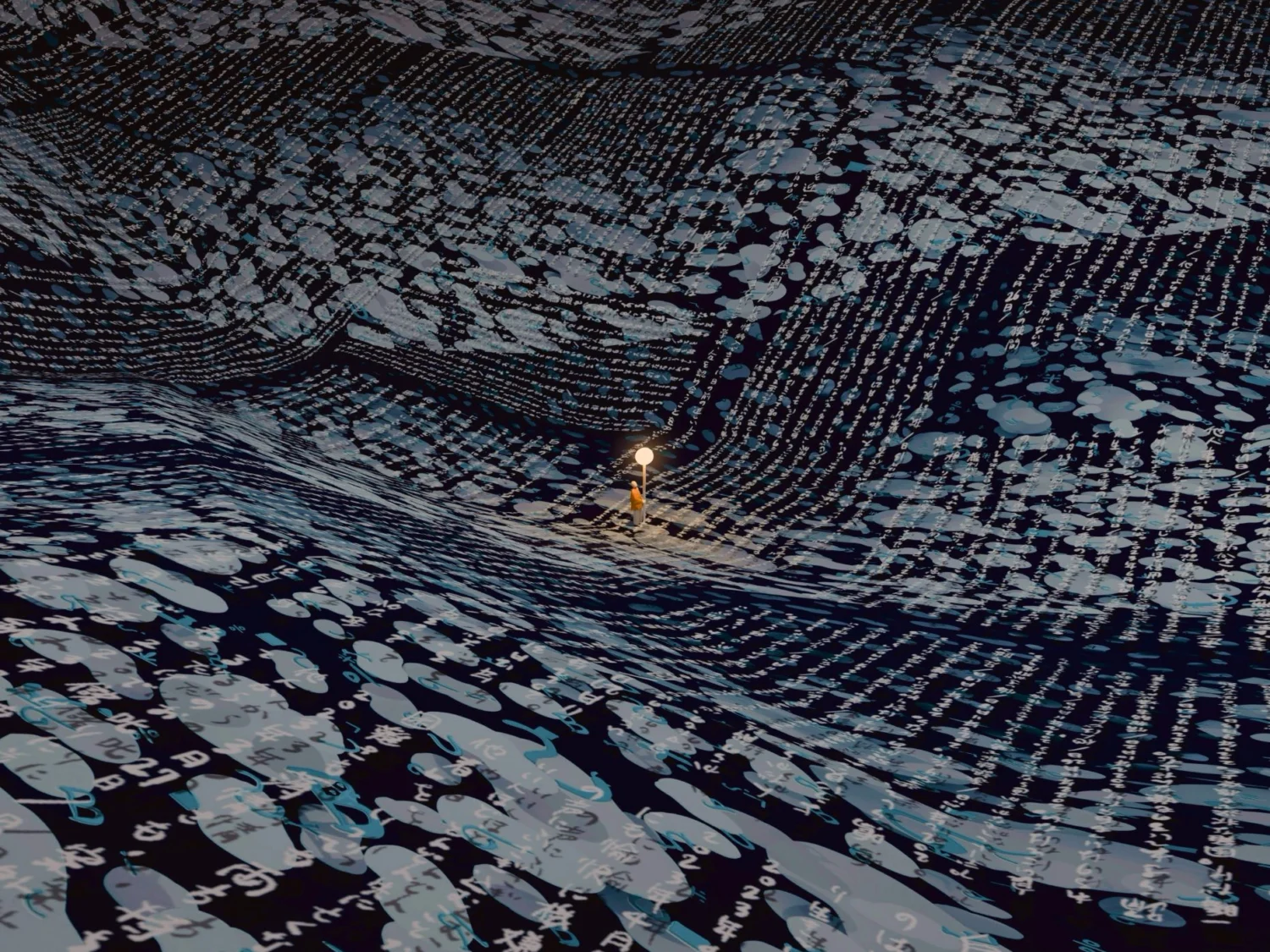
Zashiki-warashi, a child spirit said to bring good fortune, roams a grandmother’s ancient home in rural Iwate. A grandson returning to the house from his Tokyo apartment senses the spirit’s presence, and understands it for what it is: a quiet provocation to recognise happiness, and to choose it.
Written by Masami Kakinuma and translated from the Japanese by Sharni Wilson,“Go for it” braids an inherited folklore with the muted disappointments of adult life. Published first in Creation of Stories All Around Japan, the story reimagines good fortune not as a whimsical gift of fate, but as a condition made possible through attention, reciprocity, and the courage to move toward the life one once wished for.
— Raaza Jamshed for Guernica Global Spotlights
Yuto stared up at the ceiling, but the wood grain looked like clumps of worms, about to squirm around; he squeezed his eyes tight shut. Lying in his futon, he couldn’t get to sleep—by his side, his gran was reading him folktales.
“…Soon afterwards, the family of that house and their servants, who numbered more than twenty all told, were poisoned by toadstools. They all perished in a single day, save a seven-year-old girl, who grew old without producing an heir, and in time fell ill and died.”
“Nooo!” Yuto frantically burrowed under the covers of his gran’s futon. After the zashiki-warashi spirits moved out of a house, the people who lived there were doomed to horrible fates—Yuto was very young, and he felt how unfair and terrifying it was.
Gran did her best to comfort him. “There, there, I didn’t mean to scare you. But you know, zashiki-warashi aren’t malevolent beings.”
She patted his head as he snuggled up to her, but the idea that zashiki-warashi left and took away people’s happiness lodged in his mind; he sobbed bitterly and eventually cried himself to sleep.
*
“What—propose?” Yuto choked out. His low-alcohol cocktail had gone down the wrong way.
His friend Keita had pressured him into coming along to check this place out, to see whether Keita should bring his girlfriend here, as she had wanted to go to a late-night cafe. And then Keita had casually dropped that into the conversation like an afterthought.
“She’ll like it here—it’s got a great vibe,” he went on, over Yuto’s sputters.
Yuto coughed and cleared his throat. “Nice of you to be so thoughtful.”
“Where do you take your girlfriend on dates?”
Uhhh—Yuto swirled the drink around in his glass. “I dunno. It’s so hot in the summer, so cold in the winter, I don’t feel like going out much, I guess…”
Keita looked at him for a long moment, his eyes serious, and then grunted as if to fill in the awkward pause. “Hasn’t she said she’d like to get married soon?”
“Uh-uh. I mean, she hasn’t brought it up.”
“What about you, Yuto?”
“Ummm. I … dunno.”
You dunno, Keita echoed, looking briefly appalled. “So you’re more focused on your career at this stage?”
“Uh-uh. I don’t care about getting promoted or anything like that.”
“Well, that’s one approach.”
“Mmhm.”
Keita glanced away and tapped his phone. “Anyway, this is the engagement ring I’m looking at.”
Yuto peered at the phone that Keita angled toward him. On the screen, an intimidating diamond sparkled in a pink gold setting. “Wow.”
“I know, right?” Keita swiped through a few more pictures, beaming.
Other than “wow”, Yuto had no idea what to say. Keita was focused on his phone, looking at the gleaming ring. Yuto had to stop himself before he admitted out loud: you seem really happy.
Yuto got back to his studio apartment and gargled as usual, but the sweetness of the cocktail lingered in his mouth. He should’ve had the parfait instead; that was the late-night special.
He took a quick shower and sprawled out on the bed. When he looked at his phone, there were several missed calls from his mum. What a pain, he thought, but he called her back.
Her voice came booming down the line almost immediately, shouting “You hardly ever return my calls!”
“What?” Yuto turned the volume down.
“Don’t you ‘what’ me! So yesterday I went to your gran’s, okay? She wants to see you.”
“Um, okay.”
“She asked me how’s Yuto, is he alright living all alone, what’s he been up to? But I couldn’t answer any of that because you never tell me anything!”
“Ah…”
“Don’t you ‘ah’ me. Look, you said you were going to take the week after next off, right? I told Gran you’d go see her then.”
“Huh? No, I might have mentioned it, but you can’t just go and make plans for me like that…”
“You’re the one who hasn’t been to see her in such a long time; honestly, if I didn’t do something you wouldn’t organise it yourself, now would you? You’ve always been so…”
“Okay, fine, I’ll go. Bye.” He hung up before she could get started on his other personal failings.
He hadn’t been to visit his gran since junior high. It wasn’t that he didn’t get on with her. When he was at school, every time he got the traditional New Year’s gift of money from her via his mum, he’d call and thank her, and once he was out in the real world, they exchanged New Year’s greetings cards. He had sent a gift last year to congratulate her on marking her 80th year, the traditional milestone of Sanju. But he didn’t like how gossip had a way of spreading in the countryside, or how his relatives got on his case. The different feel of the house she lived in, which was old-fashioned compared to his parents’ place in Tokyo, might have put him off too. The year the great earthquake struck, he had genuinely wanted to go with his mum to check on how Gran was coping in the aftermath. However, as the TV bombarded him with horrific footage of the disaster, he couldn’t bring himself to go.
Whenever he imagined his gran’s misery or his mum’s exhaustion, the dread would crush him all over again, and he couldn’t shake the urge to stay in Tokyo and try to blank it all out. By the time normal service was restored and he could call his gran, she told him it would be too difficult for him to visit just then, and to his shame, he accepted her words at face value.
Yuto turned back to his phone and tapped out a quick message to let Hiroka know he was headed for Iwate.
It’s a long way away, so I thought I should probably let you know
Her response pinged back quickly:
You should always let me know, not just probably!
It’s only one night at my gran’s
Can I come with?
He hammered out a reply, not giving it much thought:
Whatever
What do you mean, whatever?
Don’t mind either way
So it’s all the same to you? You didn’t think to invite me?
Yuto pushed down the urge to argue back and ask what her problem was, and he sent a few more messages to placate her, saying things like: we wouldn’t be staying at a ryokan, so it wouldn’t be much of a holiday; it’s way out in the countryside, but if you don’t mind that; maybe we should plan some kind of trip for a later date, etc, but she didn’t reply again.
Alone, Yuto boarded the Tohoku Shinkansen.
Iwate’s closer than I thought, he realised, and immediately regretted not taking the night bus instead, which would’ve been much cheaper than the bullet train, since he was travelling solo.
On an afternoon long after the summer holidays, he had expected the train to be deserted, but it was full of all kinds of people: business travellers, groups of middle-aged women, and families with children. He didn’t need to commute to rural areas for his job, and he couldn’t imagine himself as a father. In a few decades time, when he reached his mum’s age, he couldn’t picture himself enjoying a trip with a group of friends, either.
He killed time by playing with his phone and staring out the window, and then changed from the bullet train to a local train, getting off at the station closest to his gran’s house.
As he left the station, he was greeted by three kappa statues. Perched on boulders in a pond edged with stones, the reddish-brown water sprites seemed to be in the middle of a chat. They had the air of salarymen hitting the pub after work. All three were as long-limbed and spindly as a certain comedian who was constantly on TV.
“Yutooo!”
Yuto looked around and saw a woman in her forties running toward him. Behind her, a tiny pink-beige microcar was parked. She must be Ms Sasaki, his gran’s neighbour. His mum had told him about her: apparently she had moved here from Tokyo a few years back, and his gran was very close to her; she sometimes helped out with the farm work, or lent out her cute car when his gran had errands to run.
He said hi, and she encouraged him to climb into the back seat. The way she spoke reminded him of the kindly manager who had shown him the ropes when he was new to the workplace. She told him that Gran had been in good spirits every day lately and laughing at all her anecdotes. He was reassured to hear that his gran was happy.
Driving along the road, jolting and bumping at times, they passed a few large, relatively new houses among the fields of vegetables.
A few minutes later, they arrived at his gran’s house, an ancient wooden hiraya; coming back there after such a long time, Yuto was struck by the lonely, isolated nature of the wide acreage. It gave him a twinge of anxiety to think of his gran out there, working in the fields all alone.
He thanked Sasaki, who had to be off on her next errand, got out of the car and set foot on the weed-dotted ground. He looked up at the roof of the house, which had been repaired in one section with deep red tiles; the outside of the wooden house had deepened to a much darker brown than he remembered.
He rattled open the sliding door to reveal the concrete doma space, and the earthy-musty petrichor of a massive tree after rain flooded his nostrils.
“Oh!” his gran exclaimed, in a tone of surprised joy. “I’m so glad you came,” she said over and over, gently patting him on the arms and back in welcome. “You’ve really grown. It must be hard, all alone in Tokyo.” She took his hand and led him inside.
When he went to wash his hands at the basin, he used the tap with the little red circle on it, but the water didn’t warm up, so he had to rinse the soap off with cold water.
Glancing through the bathroom’s half-open door, he noticed the yellowing white showerhead which lacked a water pressure control, and the motley blue, white and black tiles that covered the floor. A faint smell of two-in-one shampoo floated out, a brand that hadn’t changed in decades.
He took a seat in the living room and reached out for a fun-size bag of sweet treats from the tray on the table. Next to the tray stood a vase of flowers as big as his palm, along with the same Nambu ironware teapot she had always used. It was exactly the same scene he remembered from childhood.
“You finally get a holiday, and your mum tells you to come all the way out here? Sorry about that, I know you have a lot on.” His gran settled her comfortably rounded hips into a chair.
“Oh, yeah, I’ve been quite busy…” Yuto swallowed. “Sorry it’s been a while. I’m happy to see you’re so well.”
“I’m wonderfully well. Now, I should get dinner started—you must be hungry?” And, without demanding why he had failed to visit her for so long, as he had feared, she calmly got up and headed for the kitchen.
“I came here to see you, that’s all—you don’t need to bother too much about dinner.”
“Don’t give me that. You’ve come all this way, so I want you to eat up, and please don’t hold back.” She deliberately wrapped her half apron around her waist.
The kitchen floor, with its faint pattern of little cream flowers, took him back to his childhood. It had felt a little sticky to walk on in bare feet, he recalled. The old-fashioned gas stove, a bottle of soy sauce left out, three calendars hanging on the wall, the dish cupboard with the frosted glass doors, and the stacks of aluminium pots … time seemed to have stopped here since his last visit back when he was in junior high.
Left at a loose end, Yuto watched his gran as she busied herself in the kitchen.
“It’s hard to cook with you watching me like that,” she said, but she looked gleeful.
Yuto felt he should offer to help, but there didn’t seem to be anything he could do, so he continued to look on. The leeks he glimpsed over his gran’s shoulder were longer than the ones to be found in Tokyo, and the shiitake mushrooms looked luscious.
The chopped vegetables tumbled into the pot on the stove with splashing thuds.
“Hellooo!” a familiar voice called out from the front door. Gran must have invited Sasaki over for dinner.
“This is my contribution.” Sasaki proffered a plate wrapped in clingfilm.
Gran’s face lit up. “Oh, tofu dengaku, how lovely.”
“Yuto, you might not have had this before,” Sasaki said.
“I’m excited to try it,” he said politely. The long pieces of tofu were nicely browned, with a miso glaze.
“The traditional way is to skewer them and grill them on the hearth, but they can also be fried in a pan,” Sasaki explained.
“Oh, that’s great.”
When Sasaki took off the clingfilm, a delicious aroma of garlic wafted out. She deftly set the plate in the middle of the living room table and bustled back to bring his gran’s dishes in from the kitchen. “Ooh, hittsumi soup!”
That must be the soup Gran was preparing earlier, Yuto thought, as he sat there awkwardly waiting for the food to be set out. He seemed to have missed the window to offer to help; when he turned toward his gran, she beamed at him and asked if he would like some mugicha, as she got the cups out.
The table was laden with the hittsumi soup, white rice, tofu dengaku, greens with a walnut dressing, and sakana no nitsuke, a fish dish simmered in flavourful sauce. In sync with Sasaki and his gran, Yuto put his palms together and said, “Itadakimasu.”
The hittsumi soup had a smooth, mellow dashi flavour that slipped down his throat easily, and he felt it gently warming his insides. He asked his gran what the mochi-like things in the soup were, holding one between his chopsticks. She explained that it was a hittsumi dumpling, made by kneading soft wheat flour, salt, and hot water into a dough; the dough was torn into small pieces by hand and simmered in the broth to soak up the flavour.
He took a bite of Sasaki’s tofu dengaku—as he expected, it had the punchy garlic tang he loved. The sakana no nitsuke, which his gran said was left over from yesterday, was so delicious that he couldn’t stop eating more and more of it, and he shovelled down the rice.
“Your gran taught me that walnuts go so well in a dressing,” Sasaki began, with an easy smile. “Sorry for gate-crashing your family reunion, but we have so much fun together, I’m constantly popping over.”
People seemed to naturally flock to his gran; locals were always coming round to share food or dropping by for a chat and to check on her, one way or another.
“Yuto, it might be hard for you to see it objectively,” Sasaki led in, “but while your gran’s house is old, it’s so beautiful, don’t you think? The garden produces a lot of vegetables, let’s go see it later; we pulled turnips that were a really unusual colour,” she rattled on. Every time Yuto responded, with a “mmhm” or an “uh-huh”, Gran smiled at him.
“Garden”—the word summoned up a vivid memory of the girl he used to play with.
“Watermelon!”
Sitting side by side on the veranda, legs dangling, Yuto and the girl took giant bites into the watermelon wedges his gran had chilled for them. The juice smeared all around their mouths.
“Want some salt?” Yuto looked over at the girl.
“Does it make it taste good?”
“It’ll be a lot sweeter.”
“Really?”
Yuto sprinkled a bit of salt on her watermelon, and the girl shrieked with laughter.
“Wow, it’s so yummy.” When she looked up from her watermelon, she was sticky with juice from chin to neck. “After we finish this, are we gonna play again?”
“Hmm, I dunno…” Yuto said. He pursed his lips and sent watermelon seeds flying into the garden: ptui, ptui, ptui. The girl squealed with delight and copied him. Yuto’s seeds were flying further than hers; the girl frowned and then spat one in his direction with a sly grin.
*
“What are you smiling to yourself about? Fond memories?” Sasaki’s voice brought him back to the present moment. “Well, I should be heading back soon.”
She stood up to ferry the dishes back to the kitchen for washing up, but when Yuto told her he would take care of it, she grinned and let him take charge of the dishes and cups.
Yuto dried the dishes his gran washed, wiping them off with a plain white tea towel, and then he went back to the living room and sent Hiroka a message to say he was in Iwate.
Having fun? she texted back.
When he replied Sort of, she sent back an expressionless face emoji and nothing else after that.
By nine pm or so, Gran was ready to go to bed. “Rest, you must be tired,” she urged, so Yuto went into the tatami guest room and got into the futon she had laid out for him.
There was a monkey painted on the sliding fusuma door, and he had the odd feeling it was watching him; he rolled over onto his back. A cord dangled from the centre of the ceiling light, which was shaped like an upside-down tulip.
Staring up at the ceiling, he noticed the sinuous eddies of the wood grain. The lines looked like they were creeping steadily further apart, and he got the same feeling of unease that used to come over him so long ago, when he had slept here next to his gran. To shake it off, he tried to think about something else, and the girl he had remembered earlier sprang to mind. Her hair had been cut in a short bob, and she had worn some kind of yukata, he thought, sifting through hazy recollections. Slowly, a few more details came back to him: the watermelon they’d shared had been so delicious, and they’d waved sparklers around in the garden as well.
It was way too early to fall asleep—he got up and slid the fusuma open. The adjoining room was also tatami, with sliding glass doors at the end which gave onto the garden on the west side of the house.
He inched a glass door open, and the verdant scent of the night swept in. There was a gibbous moon, shining brightly nevertheless, and the scattered stars seemed to cluster around it. Yuto breathed in deep and savoured the cool breeze. In the absence of artificial light, he was surrounded by surprising darkness.
No car noise, no human voices, only the ti-ro, ti-ro of crickets chirping to his right and left. Time passed slowly; he felt as though he were suspended, floating in a magical night that would never give way to dawn.
Still, he began to feel the chill, and he knew he should get back to bed. When he lay down again, his head felt cool; the breeze from outside lingered pleasantly on his skin, and he closed his eyes. His body heat was gradually warming the futon.
As consciousness receded, he sensed a vague presence by his side.
“It’s been a while.” It was the voice of a child, which sounded familiar. “So you can’t get to sleep?”
“Yeah.” Oddly, Yuto didn’t feel at all scared. “I was just thinking about back when I was little. I remember being really happy back then.”
“Are you happy now?”
Yuto hesitated. “Uh, I don’t really know…”
“Mm.”
“My friend’s getting married.”
“Mm.”
“He seems so happy.”
“Mm.”
“But I feel like things haven’t been going so well for me lately…”
“Mm.”
“I’ve been with my girlfriend for three years, but I still don’t really get her.”
“Mm.”
“When we go out, I try to take her where she wants to go, at a time that suits her, but by the end of the date she’ll be kind of sulky.”
“Mm.”
“I always do as she says, you know?”
“Mm.”
“I really wonder whether we’re okay.”
“Mm.”
“It’s hard to judge, I guess.”
“Mm.”
“I feel at home here. But I’ve been away too long.”
The girl listened quietly, as he vented all the worries that lurked at the back of his mind.
When Yuto woke up, it was after noon.
The fusuma were wide open, and the sun angled in through the glass doors to reach the room he lay in. He sat up unhurriedly; he felt much lighter than usual. Maybe the dinner last night had done him some good, or maybe it was that he’d slept well for the first time in ages…
Yawning, he headed for the living room, and his gran asked him, “Do you always sleep in this late?” with a wide smile. Breakfast was on the table, and as Yuto briskly stirred his natto, he told his gran about his experience of the previous night.
“Gracious, that was our zashiki-warashi,” Gran said cheerfully.
“Huh? Zashiki-warashi?”
“Your mum used to play with her all the time too.”
“What—seriously? There’s a zashiki-warashi in this house?”
“Didn’t you know? She’s been here all along.”
He remembered the folktale his gran had told him when he was a child. The first time he heard it, it had terrified him. The irrational fear had stayed with him, unconsciously associated with his gran’s house; maybe it had contributed to keeping him away.
Out of nowhere, little footsteps could be heard, scampering about in the hallway; startled, he turned to his gran. With a calm smile, she looked toward where the sounds were coming from.
His childhood terror came rushing back to him. What if the zashiki-warashi left this house? He looked pleadingly in the same direction.
“Oh, that’s right,” Gran began, “today, Sasaki said she’d take me out in the car. Since you’ve come all this way, how about we take a little outing before you go?”
As she looked at him eagerly, he chewed on a tomato with unnecessary force to quell his anxiety and nodded.
Sasaki took the wheel, telling Yuto in the same lively manner as yesterday, “Isn’t it funny how if you live close to a tourist spot, you don’t tend to go there?”
Sitting next to him, Gran was looking out the window with a radiant smile. “I’m so looking forward to it!”
The place they drove to was called Denshoen Park.
They passed through the entrance, which was a large barn with a thatched roof. The breeze carried smells that he wasn’t used to; he got a whiff of sand and fresh green leaves.
“It’s like a museum,” he muttered. Sasaki guided them around, reading out the descriptions of the buildings. They saw a waterwheel, a well, and replicas of toilets and baths used long ago. Visitors could also try their hand at making the small wooden votive plaques called ema.
With a twinkle in her eye, Gran mentioned that she knew the perfect spot for Yuto to visit.
There was a building known as the magariya house, which had a lived-in feel to it. Once they were inside, Sasaki led them on at a brisk pace. Yuto followed reluctantly: through a doorway, the walls were shrouded by bunches of motley cloths in overwhelming numbers, and he stifled a yelp. Struggling against his rising sense of dread, he couldn’t take in much of what Sasaki said, but apparently they were Oshira-sama dolls. They were made from sticks of mulberry wood, with the head of a girl or her horse carved into the end; visitors dressed the mulberry sticks in cloths upon which they had written a wish. The dolls numbered a thousand or so.
“Come, come,” Gran called, beckoning Yuto to the room where the zashiki-warashi were. “See, have a look over here,” she said, taking him by the hand to pull him along.
In the gloom, written in hiragana were the words: Oku-zashiki. Gran grinned and waved him inside first.
Yuto walked on nervously. The small room’s sliding door was open, and as he walked in, a little shadow floated hazily in the orange light.
A grunt burst out of him as he edged closer—a cut-out of a child with a bob was silhouetted on a paper lantern. She was looking at him with eyes full of mischievous calculation, one hand spread palm open in front of her.
“Honestly,” he groaned. When he turned around, he saw his gran giggling like a child.
“That’s a zashiki-warashi.” Sasaki was struggling to keep a straight face as well.
“It’s only a display,” he muttered under his breath, trying to put a good face on it, but his deep-seated worry welled up again, stronger than ever—something terrible could happen to his gran, and Sasaki too, if the zashiki-warashi moved out some day…
After they left Denshoen Park, Sasaki took them to a popular Jingisukan restaurant.
Yuto ordered the basic set meal (the “assari”), and he was served raw lamb that looked beautifully tender. Sasaki and his gran taught him the best way to cook it: the cabbage, onions, bean sprouts, and carrots were placed around the edge of the round grill, leaving a gap in the centre for the meat. The lamb didn’t have the strong gamey smell of mutton, and they could devour it the instant it was done.
It was getting on for evening by the time they left the restaurant, and Sasaki laughed. “I can’t tell if that was lunch or dinner.”
Gran laughed as well, saying that good food was good to eat at any time. “Yuto, why not buy a few souvenirs to take back with you?” she suggested.
He said he didn’t mind either way, and Sasaki drove them to a roadside station where souvenirs were sold.
The local produce hall had a huge variety of things, from turnips and wasabi to unrefined doburoku sake and beer; he found himself walking around in circles inside the shop, repeatedly picking things up and putting them back again.
“Oh my, they’re here as well!” Gran called out.
Yuto went to her: Gran was holding a zashiki-warashi key ring. The tiny girl doll was made of soft, springy material, dressed in a red kimono tied with a yellow obi. She had black hair, cut in a short bob, and her eyes were big and round.
Gran bought him three as souvenirs. “One is for you. One’s for your mum. And the last one, you should give to someone that makes you feel happy when you’re with them.” She handed him the bag.
Someone that makes me feel happy when I’m with them … He thought about it, and sent a message to Hiroka:
What would you like as a souvenir?
It didn’t change to ‘Read’.
“Could I come back to Iwate another time…” he wondered aloud.
A smile came to his gran’s face at his soliloquy. “That would be great.”
When they arrived at the station, Yuto got out of the car to walk to the ticket gate; Gran got out too and clasped his hands in hers, repeating passionately, “Go for it, go for it.” Yuto was bewildered by her intensity but he returned her grip without embarrassment, nodding over and over again.
In the driver’s seat, Sasaki was waving goodbye.
Wishing he had taken a few more days off, Yuto took his leave reluctantly, turning to look back several times before he entered the station to board the train.
By the time he reached the platform for the bullet train, it occurred to him to call his mum. “I’m just about to leave Iwate.”
“Did you have a good time?”
“Sort of. Last night I thought I saw a girl, and Gran said she was a zashiki-warashi. Maybe she was the one I used to play with when I was little.”
“Oh, you got to meet her? Isn’t that great?” For his mum, it was clearly no big deal.
“So she is a zashiki-warashi then? But then, will she stay at Gran’s house for good?”
“What are you talking about?”
“I can’t help worrying about that. If she left the house, something horrible would happen to Gran, wouldn’t it?”
“Oh no, you were worried about that?” His mum scoffed. “You silly boy!”
“But it was in the book Gran used to read to me.”
“It’s not like zashiki-warashi call down misfortune,” his mum said, snorting with laughter.
“Huh?”
“Okay, so you think Gran’s only happy thanks to the zashiki-warashi?”
Yuto called to mind his gran’s smile. In his mind’s eye, she always had such a kind look on her face.
Because of the zashiki-warashi that lives in her house … or is it?
Was Gran’s happiness bestowed upon her by chance, by some other being? Maybe I had it all backwards.
His mum sighed. “You know, if something’s bothering you, you can always talk to me about it.”
He envied his mum’s incredible confidence. “Sure, okay, bye,” he said to cover his awkwardness, and hung up.
Go for it, go for it.
Watching the scenery speed past outside the bullet train window, he turned his gran’s words over in his mind, and the warmth of her wrinkled hands returned to him.
He took one of the key rings she had bought him out of the bag. One for me, one for my mum, and the other for…
His last message showed up as ‘Read’ but there was no reply.
Are you happy now?
Last night, when the zashiki-warashi had asked him that, he hadn’t been able to give a confident answer.
You think Gran’s only happy thanks to the zashiki-warashi?
His mum’s words came back to him too.
Gran’s natural warmth gathers people to her because she’s great to be around; the zashiki-warashi is drawn to her as well, and that’s why she’ll stay.
Yuto reflected on his own life. I have Hiroka, Gran, my family, and my friends. The zashiki-warashi at his gran’s house had appeared to him. And the gift his gran had given him was in his hands.
Are you happy now?
He wondered how Hiroka would answer that question.
Yuto gazed at the zashiki-warashi. A happy future was within his grasp. He held the doll gently, with the hope that she would want to stay with him always. The scenery outside the window was fleeting past at the speed of wind.
Next time I’ll bring Hiroka with me. Now I know what I want.
He sent a message to her:
I have a souvenir for you, can we meet up tonight?
Nestled in his palm, the thumb-sized doll in the red kimono only had eyes painted on her little face. And yet she was definitely smiling at him.
“Go for it,” written by Masami Kakinuma (trans. by Sharni Wilson), and originally published by SHORTSHORTS as part of Creation of Stories All Around Japan, a Japan Cultural Expo initiative that describes itself as a project in which “young contemporary writers create short stories inspired by local legends set in various locations around Japan.”