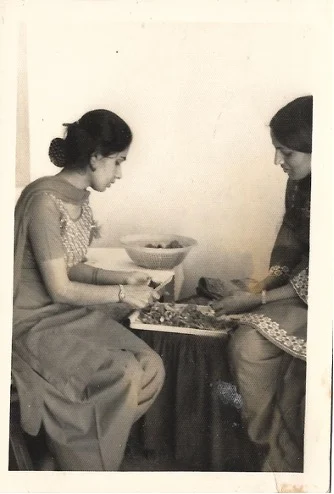
My son likes tomatoes, birds, dogs, cats, string cheese, the pedestrian wait signal at the traffic light. He says, “park” and “up” and “off”. He says “baahir” for outside and “ao” for come. Since he was born, I am scared to think through to the end of a thought, in case I find myself facing an uncertainty: a future in which he is not happy, or he is unwell, or he is not there. I am aware I am in the middle of life now, a bustling, hard, joyous time where the days blend into each other. This is what my mother must have felt when she was pregnant with me. I keep trying to look for a way to live my life by watching hers. But it’s hard to take stock when I am in the thick of it. Every day is beautiful and also terrible in how quickly it goes by.
During the year that she was pregnant with me, my mother lost one of her uncles and her brother-in-law. They died in front of her; she saw their dead bodies. She was twenty-seven at the time. And then, after I was born as one of a set of twins, she lost my brother just a few hours after his birth. I think about the way death shadows my writing; and I wonder if some of the losses she faced while I was growing inside her were inherited by me. At times, I think about how much of my history my children will worry over. Will they sift through my life the way I want to sift through my mother’s past? The deaths that chased her the year she was pregnant eventually gave way to a period of happiness that lasted thirty-eight years, until my father’s death. This past year was the first year she forgot their wedding anniversary, seven years after he died.
Muhammed Ishaq (1987)
My mother says that she had trouble conceiving for seven years. Then she and my father moved to Baghdad and the doctors there told her she would have to go to London for treatment. They would take the eggs out of her body to strengthen and fertilize them, before inserting them back in. My father was employed by the government of Pakistan at the time, so he applied for funding to cover the procedure. His application was approved and she traveled to London in 1987. While there, she stayed with her oldest maternal uncle, Muhammed Ishaq, one of seven uncles and aunts on her mother’s side.
Muhammad Ishaq was a kind, and gentle man who was always laughing, according to my mother. He had moved to England in 1962, leaving behind a wife and five kids. In England, he had a brief marriage with a Scottish woman, and from this he had another daughter, my mother’s step-cousin.
While my mother was in England, she took English classes. Every week, her uncle would go with her to class and sit on a bench outside. She felt so guilty about him waiting in the heat for her that she quit the classes after only three or four weeks.
One day, they were all at home and her uncle felt unwell. She asked him what was wrong and he said his chest felt heavy. By then his brief second marriage was over, though he maintained a close relationship with this daughter from that union. His wife from Pakistan had moved to be with him.
Muhammed Ishaq collapsed in the living room, and died later that day. “When did you find out he had died?” I asked my mother, “And how did you react?” She told me then that she rode with him in the ambulance. She had worried that the CPR, performed amid the blaring sirens, would hurt his chest when he woke up. When they arrived at the hospital, the paramedics ushered him away, behind doors. Finally, a doctor came to them and asked if the man had any blood relatives, so my mother stepped up. They took her into a room and told her, very kindly, that he had actually died back at home. They had hoped to revive him, but it turned out they could not. This was the first person she ever watched die up close. My mother’s other younger uncle, Abdul Razzaq, flew back to Pakistan with the body for the burial. He said he had to buy a ticket for the dead body. When I spoke to him about his brother dying, some thirty-three years after the fact, he only said: “It was very hard.”
It makes me sad that my mother’s uncle died in front of her and while looking back at the long arc of her life, this—the first death she ever witnessed—only ended up being an afterthought. “I was in the ambulance,” she said, almost as if she was remembering again, after many years of having forgotten.
My mother’s side of the family is traditional. Mohammed Ishaq moved to the United Kingdom, married and left another woman and yet his first wife still took him back. His children speak of him fondly; my mother speaks of him with love. The family has a relationship with the step-daughter. It reminds me that what remains after you die is not what you did and not the manner of your dying, but only how people felt about you. My uncle’s death taught my mother that death can come unexpectedly. She learnt that lesson two times over within that same year. Yet, for many years after my own father’s death, all I could think about was yellowing eyes, knees buckling into a wheelchair, a body so thin it looked like it would break apart at any second.
What is better? To die quickly, or to be able to say goodbye? For my son’s sake, I hope I die quickly. For my own sake, I hope I get to say goodbye. Some days I can hear my son playing upstairs. We live in a small house, and both ends of the short flight of stairs are childproofed with a gate. But sometimes if I am downstairs and my husband or my mother are upstairs with my son, I hear him laugh and make a dash for the stairs. I think, sometimes, of him falling down the stairs, and his neck landing at an angle, hitting the metal gate downstairs, his small body bruised and still. And each time my brain short-circuits, thinking, oh no, oh no, oh no, until I hear the laughing upstairs continue. Ever since I became a mother, I am always in anticipation of something going terribly wrong. And my mother is always telling me, it will be fine, he will be fine, everything is fine.
I told my father through the year that he was sick, that he didn’t know exactly when he would die, that he could live for years and years, and yes, maybe cancer would kill him, but it might be when he was eighty. “You will be fine,” I said. “It will be fine.” Sometimes he seemed cheered by this. I wonder how many times my mother looked at my father that year and wanted an end to the suffering, even if it meant she would lose him.
By the time my mother left England, her uncle was dead and buried on a small plot of land in Pakistan. By then, she was pregnant with twins, one of them me.
Anjum Amin (1987)
After my mother had completed her treatment in England, and once her pregnancy had been confirmed, she and my father returned to Baghdad before travelling back to Pakistan as her due date approached. My mother was in her final trimester. She was expecting to deliver in Islamabad. My mother’s older sister was married to my father’s older brother, Anjum Amin. This uncle, my father’s brother, was thirty-four at the time. He felt some discomfort and laid down on his bed to rest. His five-year old son, Ali, began to take off his shoes. The whole family, all my father’s brothers and sisters, had gathered to welcome my parents home.
Eventually someone suggested taking Anjum to the hospital. Someone else suggested giving him a Nitrstat pill for heart attacks, but my father vetoed it, saying they should check with the doctors before medicating him. Anjum died en-route to the hospital, and for many years, my mother says, my father blamed himself for vetoing the medicine. My mother was sent to stay with her mother; everyone worried the shock and the weight of staying in a house struck by such an unexpected tragedy would affect her pregnancy. My father buried his brother the next day, and my mother’s sister became a twenty-eight-year-old widow with two children under five. She never remarried. When my father came home after the burial, my mother said his voice was hoarse from crying. I had never seen my father cry, so this story stayed with me for a long time. In pictures, Anjum Amin, the uncle I never met, is tall and thin.
When my father died in 2017, three decades after his brother, my aunt said to my mother, “Now we are the same.” But it was not the same. My mother had thirty-eight years with her husband, and my aunt had seven. I believe that had he lived, the sisters would have talked less on the phone. But they had shared the moment of loss. My mother says this aunt is her best friend. She is like my mother. Her son, my cousin, is like my brother. I want my son to be close to his children.
*
When I was nine weeks pregnant with my son, I began to bleed. The doctors had not been sure I would be able to become pregnant. I carried with me my mother’s stories of her seven years of infertility. I went to the hospital with my husband, and while we waited in the Emergency Room, I went to the toilet every five minutes to see if I was still bleeding. When I called my mother, then visiting my brothers in Australia, she asked me what I had done to cause the bleeding. I shrank in the face of this questioning.
I had not known that I wanted the baby until I was faced with its loss. I felt afraid suddenly of what lay ahead, but thankfully the pregnancy remained viable and I carried my son to term. Afterwards, when I knew everything would be fine, I told my mother she should not have made me feel like the bleeding was my fault and on the phone she sounded stricken, “I was worried,” she said, “I felt helpless.” I thought then of my father and the medicine he did not let his brother take. In Islam, we believe that you will die when the time of your death is written, never sooner or later. And the time of your death is written when you are born. This is meant as consolation to those who have lost loved ones. But still, people cannot help but say, you should have done this, you should have done that, if only this had happened this way.
*
When I was six years old, my parents lived in Germany and, one night, I spiked a high fever. My father, probably still haunted by the sudden death of his thirty-four-year-old brother, drove through every red traffic signal in his way, his hand on the horn so the car made a continuous blaring sound as it sped down the streets of Bonn. Having been told this story so many times by my mother, I almost remember it myself. She says, in the hospital, after I had recovered, the doctors were taking some time to discharge me, and I was crying to have the needle taken out of my hand. My father took it out himself and was later told off by the nurses. “You should have been here sooner then,” he said, “She was hurting.” When he was dying himself, I sat with him in hospital rooms at night and told him that the hair falling on his pillow would grow back, that he looked better thinner, that the pain would fade. My mother played Surah Rahman by his bedside. I had forgotten about that until two days ago, when I thought it might soothe my son if I played a Surah for him to sleep to. The one I accidentally picked was Surah Rahman. Suddenly, I was back in the hospital room in Islamabad, and my father was making small moaning noises. My aunt, my mother’s sister, his long-dead brother’s wife, was in the room. “You’re looking good,” I often told my father. “He’ll be fine,” my aunt often told my mother and me. My cousin also stood in the room like a sentry.
Every time my son touches my shoes, I think of my dead uncle whom I never got to meet. I think of my cousin taking off his father’s shoes a few hours before he died.
Bilal Sohail (1988)
My twin died a few hours after birth. Now that I am a mother, I can understand what it might have meant for my mother, who had to grieve a baby she carried inside herself for nine months after seven years of waiting to have him. She told me when I was eleven and begging for a horse (“How many children do you have who are eleven and want a horse?”) about the twin I’d never met. I didn’t mention the horse again. We lived with our cousins, Anjum uncle’s son and daughter. By then I had two brothers, so there were always five children in the house. Still, our mothers must have watched us closely. My widowed aunt had had three miscarriages before having her two children. They built a happy home. We played cricket on the rooftop, drank from juice boxes, spent endless hours on the street making up games.
*
At the hospital, right before my scheduled C-section, I had a contraction. I told the nurses I was in pain, but they did not believe me. They readied me for the operating table, took me to the toilet, and then I lay on the stretcher, stiff with pain. “I’m hurting,” I said. Still, they plugged wires on my body, calmly said a doctor would be in soon. They thought I was nervous because the procedure was about to begin, but suddenly a voice in the room urgently said, “There’s no heartbeat.” I heard that with my whole body.
The room became alight with sound and alarms. Doctors rushed in and out. Then the pain stopped suddenly, and the baby’s heartbeat came back. The rest of the C-section went as planned. Later, I asked my doctor what had happened, and she said, “I think you had an intense contraction and the baby went into distress.” I joke about that sometimes, “I could only handle one contraction,” but I tell the story less and less as my son becomes older. It’s harder to imagine him not here as my love for him grows by the day. I miss who I used to be as a daughter, but I am beginning to love who I am as a mother.
I was twenty-nine when my father died. While sorting through his papers, I found a small newspaper article announcing my birth. My mother said he had been furious to see the article, worried it would cause people to treat me differently when I grew up because of the nature of my conception. He loved me like that, fiercely, like a hard-won prize. I recognize that love as the love I have for my son, and I am grateful for the gift of having been loved and for being able to love back like that.
Sohail Amin (2017)
My father was diagnosed with Stage 4 pancreatic cancer in May 2016. It took one year from diagnosis to death. This is the only person close to me who has died, though both my mother’s parents died during my lifetime. Before he died, the chemical imbalance in my father’s body caused him to hallucinate. He often worried he was in India, that the authorities there were going to imprison him. I wonder often where that fear came from. He was born in 1952, five years after the formation of Pakistan. Maybe it was something my father’s generation had inbuilt in them, this fear that the land under their feet was hard-won and could be taken away. He tried to instill in us the belief that nothing was ours, except what we earned ourselves. Everything else was luck or privilege.
My brothers live in Australia. They like it there. Sometimes, I send them this quote by James Baldwin from a 1984 Paris Review interview, “I think it is a spiritual disaster to pretend one doesn’t love one’s country. You may disapprove of it, you may be forced to leave it, you may live your whole life as a battle, yet I don’t think you can escape it. There isn’t any other place to go—you don’t pull up your roots and put them down someplace else. At least not in a single lifetime, or, if you do, you’ll be aware of precisely what it means, knowing that your real roots are always elsewhere.”
The year after I got married, my father had been dead for four years. I had moved to the United States a year after he had died, gotten married three years after he had died. That was how I measured time then. On his birthday that first year after my wedding in 2022, I spent the whole day crying. I had cried like that only once before, when I had seen his dead body wrapped up in a shroud at the hospital. I told my husband I was crying because I was living a life which would be unrecognizable to my father now. He never met my husband, had never been to the United States. I had been close to him, and sought him out for advice on everything. Four years after his death, I felt unmoored again, wanting to have him back.
After the ambulance ride with her uncle, Muhammed Ishaq, in England in 1987, my mother rode in an ambulance again for the second time with my father in June 2017. My father’s stomach was filled with fluid, a condition called ascites that stretched his stomach out, and made it wet to the touch, his pores leaking fluid. He had to have the fluid removed every few days, a complication of the cancer. While in the ambulance, she held his stomach so it would not jerk around during the bumpy ride, causing him more pain. Later, after he had died, my mother told me that when she was getting in the ambulance with him it occurred to her that he may never come home again, alive. He did come back home, but only briefly. Soon after, he returned to the hospital, and then he died. We brought his body back to prepare it for burial. By then we were ready. We could not see him suffer anymore.
Once, a friend of mine asked me to interrogate my writing about my father’s death: “just saying that he suffered isn’t enough to make readers care about the death of your father.”
Maybe witnessing death with everything in you open to it, then recounting it and sharing it with others as something that belongs to you, is an act of worship.
Among other things, this is what my mother has taught me: Look. These people died, but we remember.
*
There will come a time in my life, and my son’s life, when my mother won’t be alive either, and then one day I won’t be alive, and his father won’t be alive. I want to document the rest of her life for him, and in doing so, I want to document mine too. But these days, every day is new, and sometimes there is no time for the past. For example, I notice birds everywhere now, even when my son is not with me. I think, I wish he were here, so I could point out that bird to him. He would follow it around until it flew away.
My mother also lost her mother, my grandmother, in 1999, when I was eleven years old. I was old enough to know Bari Ammi. But I don’t remember her well enough to miss her, and it pains me that there may come a time when my son doesn’t miss my mother. I did not write about my grandmother here, because thinking of my mother losing her mother makes me think of losing mine. Right now, my son calls us both mama. He asks for my mother when he is hurting, or when he cannot fall asleep. When I joke with my mother about how jealous I am, she says, “How many adults do you know who weep over their grandparents? He will love you the most.” She has seen enough of death in her lifetime to know that it will come for her. Every day, I think about the fact that my son will never know my father. But for now, the only possibility open to us is to enjoy my son’s life. He likes to be in water, he drinks the bubbles in his bath and we are resigned to it, he hates sitting on the potty, he needs to pet every dog he sees. At night, he cannot sleep unless a very specific routine involving milk, music, and shush-ing is carried out. These are mundane things that feel fantastic to us now. I cannot believe I am living this life. One day it will be a different life. For now, we watch the birds in awe.