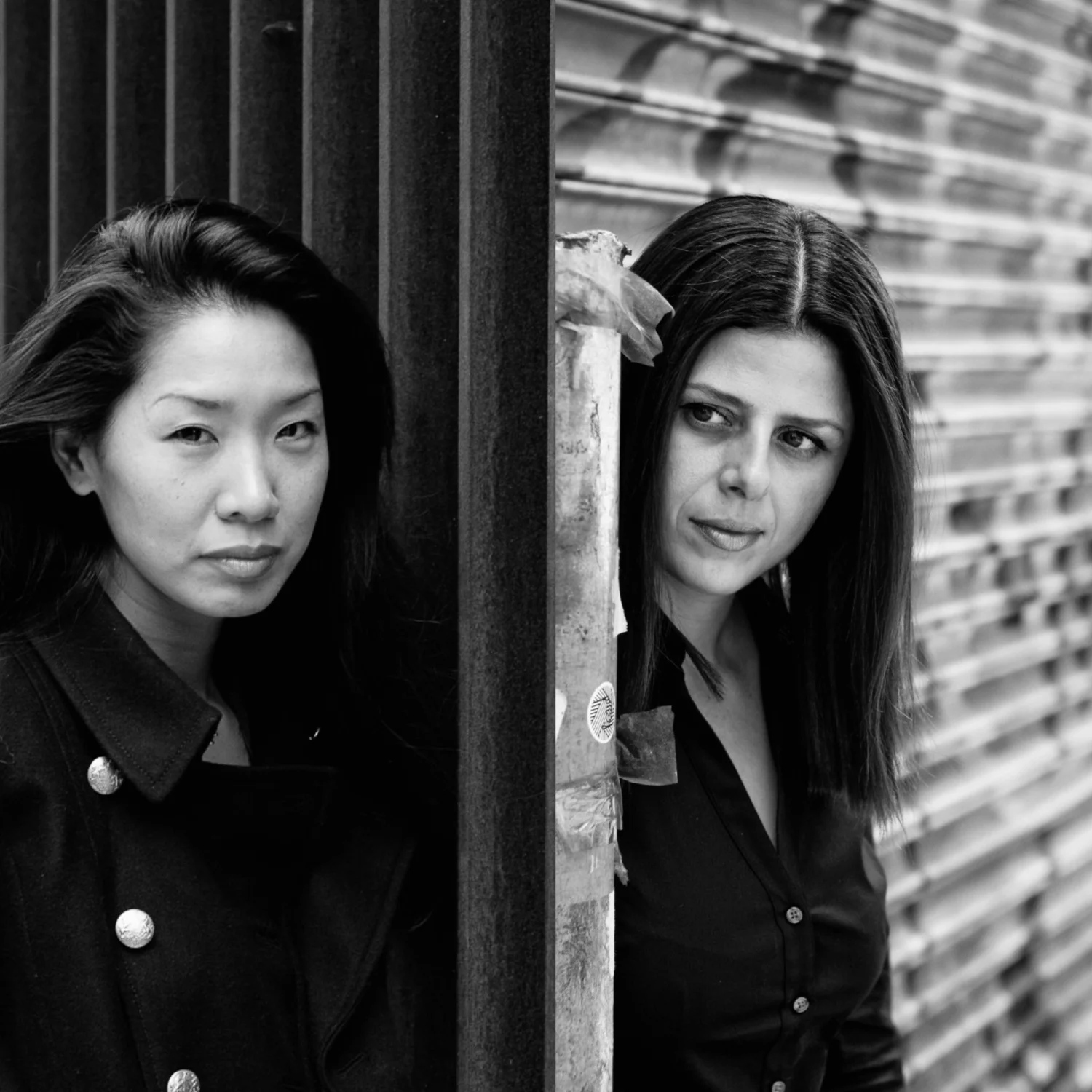
A question can be an invitation to step beyond the story others have assigned us. In this conversation, poets Tina Chang and Nathalie Handal turn that invitation toward each other. Their questions move between two new collections, Chang’s LION and Handal’s Roma Roam, allowing each book to illuminate the other. Both collections are restless in form and geography. LION moves through myth, zuihitsu, documentary fragments, visual art, and dream, tracing female lineage and Asian American life amid violence, surveillance, and erasure. In Roma Roam, cities, bodies, languages, and histories enter one another; Rome reads at once as a place, a lover, an archive, and a consciousness in flow.
Across both books, survival is set forth as the recovery of interiority, the refusal of disappearance, and the difficult freedom of imagining oneself beyond violence’s final account.
— Raaza Jamshed for Guernica
Tina Chang: Your newest collection Roma Roam begins with place and roaming. You write, You tell me: I’m going to another country,/another city, another body./Perhaps my heart will stay uncertain, and I will destroy my history but I am leaving. How has place transformed within your collections and how has roaming changed your idea of home?
Nathalie Handal: Place has always been one of the first languages of my work, but place is never only place. It is movement, belonging. In Roma Roam, it becomes an accomplice, lover, body, and system of thought, where empire, migration, beauty, ruin, and longing collide. Rome is the poem’s waterways, the Mediterranean’s great spirit; the Tiber one of the city’s original sentences. Place becomes an argument with time, an archive of rupture and seduction, where history and intimacy are inseparable. And roaming resists itinerary and arrival. In earlier books, I often wrote toward fractured geographies—Palestine, inherited homes. Roma Roam reimagines home as multiple and unfinished. What holds the work together is not rootedness but route: where we are continually made and unmade.
That unstable self—the self as a site of opposing forces—makes me think of the contradictions held in the central figure of LION. What does the title LION hold for you, and how does the lion move through the book? In “Heartbeat: A Zuihitsu,” you write: In the Lion dream, I am predator / and prey, two faces, one turned / toward appetite, another toward / extinction. Is the lion a metaphor for the self or a figure of female power, survival, grief, appetite, violence, loneliness or is it a way of holding all of those contradictions at once?
Tina Chang: A lion in Chinese tradition is a very powerful force. When I was a child living in Taiwan, I remember stone lions that guarded the front of my family’s home. I was taken by them as they didn’t seem like one animal but many animals. The Chinese lion is an amalgamation and a dream. It’s the composite of the lion, dog, phoenix, tortoise, snake in some versions and in other versions it has wings. I love the idea of the impossibility and hybridity which is what the lion means to me. It is a force of contradictions: predator and prey, ferocious and tender, hungry and sated. I found the animal was closely associated with the feminine muscularity of the book. I could have chosen the word lioness but I wanted to claim terrain traditionally dominated by men while holding space for the concerns of living in a woman’s body.
Likewise, can you also talk about the title for your collection, Roma Roam? One word signals specificity while the other signals a dream journey of sorts. How did you combine two unlike elements?
Nathalie Handal: “Roma” gives us the specificity of the city—its architecture, mythologies, cinema, saints, decadence, ruins. “Roam” undoes fixity, turning the city into motion, into a way of inhabiting and being inhabited. And roam echoes Rome; the city is already inside the movement. The title also reflects something fundamental in my poetics. I’ve always inhabited the unstable border between place and movement, belonging and estrangement, rootedness and drift. Rome is the place, but roaming is the consciousness moving through it—an interior state, a fever dream, a historical current. To roam Rome is to be altered by it, but also to let one’s own histories—Bethlehem, New York, the sea, exile, desire—enter and alter its meaning.
This makes me think of LION, and of the way you enter lives that might otherwise be reduced to a single public narrative. One of the emotional centers of the book is your insistence on restoring interiority to women whose stories have been reduced to the fact of their deaths. You write of Michelle Go, I want to know something about her inner life. A train heads into its own dark mouth. Is lyric imagination, for you, a form of witness against erasure?
Tina Chang: Michelle Go was an Asian American woman who was killed during the pandemic and there was so much written about the details that marked the end of her life. Her story was reduced to a few minutes of a news article and that became her singular story but if we delve deeper, research tells us she was a cheerleader and worked for a plumbing company. If we research further we may learn about her childhood. As a poet, I imagined her life beyond the reported details. The imagination allows space for that lyrical impossibility. By contemplating the potential of Michelle Go, that rumination on the music of her mind resists erasure by insisting on the power of her interior life. In this way, there’s a kind of world-building through envisioned intimacy, thereby creating three dimensional realities of women beyond the journalistic facts of their deaths.
In Roma Roam you approach intimacy with a city and love/lover which sometimes feels one and the same. Can you talk about that?
Nathalie Handal: The first poem was “The City,” published in Poem-a-Day by the Academy of American Poets. It begins with Cavafy’s sense of the city as something we cannot escape because we carry it within us, then expands that idea: one city contains many cities, one body other bodies, one lover the traces of others.
That sense of one body carrying other bodies makes me think of LION, where familial intimacy feels like a living current—your mother’s heart, your daughter’s body, your grandmother’s hair, generations of women moving through one another. You write, “I make a promise to my mother that I will live,” and “I am knowing my mother / through this gentle body.” Is motherhood a refuge, burden, inheritance, a warning—or all of these at once?
Tina Chang: There are many kinds of lineages of which we are a part. The relationship at the forefront of the book is the relationship between the speaker and the mother. This is where all of her life’s lessons are learned; there’s growth through infancy, childhood, teen years, and into womanhood. With each phase of life, the speaker is mothered. When I first gave birth to my daughter, something shifted in me. I moved from thinking of myself as a single entity toward thinking of myself as a part of a delicate whole and, suddenly, I could see it: the wave of feminine energy that moved from my ancestors, to my grandmother, to my mother, to me, and then my daughter. While family and legacy can materialize in so many forms, this is one of them. Motherhood in its highest form is an offering. To mother is to give, to gift, to sacrifice, to restore all that was incomplete and broken. To mother is to promise to outlast the wreckage that life may bring.
Nathalie Handal: Your collection is not a book of doom, even as it inhabits what can feel like impossible circumstances. What allowed it to remain a book of transformation rather than devastation?
Tina Chang: The heavier the emotions, the more I seek a balance, and that comes in formal and collaborative invention. After the killing of an Asian American woman, Christina Yuna Lee in 2022, I grieved her loss. This came on the heels of the killing of Michelle Go, who was mentioned earlier, who was pushed into the subway tracks as she was commuting to work. Prior to this, the Atlanta spa shootings in 2021 left eight people dead, including six Asian American women. After such colossal loss, I was filled with dread and fear. Locating the work of this collective of women artists, most of whom participated in a group art exhibition at the Eli Klein gallery to honor the life of Christina Yuna Lee, I was shaken awake. I collaborated with the work of six women artists in the making of this collection: Christina Yuna Lee, Astria Suparak, Hồng-Ân Trương, Haena Yoo, Hong Chun Zhang, and Joeun Kim Aatchim. Each of them has created language and worlds all their own and their bodies of work kept me spirited, inspired, and most of all hopeful. The power of their collective voice moved me away from doom and toward the empowered act of creation.
Roma Roam also explores intensity of feeling, beginnings and endings, and everything in between. How do you end such a work that wishes to continue on?
Nathalie Handal: The city doesn’t end, and neither do longing, history, or water. Rivers keep moving, histories remain unresolved, longing changes form, cities keep speaking after we leave them. Roaming is not arrival but transformation—being altered by encounter and carrying that change forward.
Tina Chang: What about the figures who roam or haunt each place? Who do you imagine is the envisioned “you” of these poems? Who do you envision is the recipient of these emotions and longing?
Nathalie Handal: The “you” is intentionally unstable. At times it is a lover, or the memory of one, becoming inseparable from the city itself. But the address keeps expanding: Rome as beloved and betrayer, Palestine as absence and inheritance, the Mediterranean as a living alphabet, or the self one has outlived. Longing is rarely tidy enough to belong to one recipient; it spills across bodies, seas, and losses. I wanted the “you” porous enough to hold eros, grief, migration, and wonder in the same breath.
I recognize another kind of insistence in LION: not the erasure of devastation, but the refusal to let devastation have the final word. You write, “There is no greater art than to live,” and “We wonder, we begin again.” Is LION ultimately a book about survival? And if so, what kind?
Tina Chang: The book begins in myth. The speaker is born “an ember of wanting,” and becomes visible and present in the world. Throughout, there is the myth of “the seekers” or entities of surveillance and sometimes destruction. As the speaker moves through the book, she is first invisible, or made to disappear. In the second and third sections of the book, the speaker is watched and pursued. By section four, there is a significant transition where the speaker begins to claim her own presence and that comes in the form of voice, community, and a feeling that she is most definitely not alone which causes her to claim her power. On a personal level, I arrived at the same revelation: I felt isolated and frightened during the pandemic. As I sought the work of other Asian American artists, their vision felt unstoppable to me and by leaping into that collective narrative I realized destiny was something claimed: I wasn’t working toward survival. I had already survived.
Can we shift gears and talk about how you envisioned a structure for Roma Roam? I love “The Untouchable Waters” as its own distinctive vessel where an Italian translation appears at the base of the page while “Close-Up” draws from cinema. How did you decide on form in this newest work? How has form grown with you?
Nathalie Handal: Form is a way of listening to what the poem wants to become. Each arrives with its own pressure, breath, architecture. One formal approach couldn’t hold a book that is cinematic, historical, multilingual, sensual, at times essayistic, at others elegiac. Rome is not one register. Neither is longing or memory. So I let the poems find the vessels they needed. “Close-Up” draws on cinema—the cut, frame, zoom, the way an image can hold emotional voltage without explaining itself. I wanted the poem to move like film: to pan, tighten, juxtapose. Rome is, after all, a film set; love and its illusions unfold frame by frame. With “The Untouchable Waters,” the two languages resonate across the page, the Tiber flowing between them—a river of history, migration, and what cannot be contained in one tongue. Form has grown with me because I trust it more now to be hybrid, intuitive, disobedient. My life has moved through languages, cities, and literary traditions; the poems do the same. I want form alive enough to hold fracture and music, documentary and dream.
That movement between fracture and dream makes me think of the formal restlessness of LION. You move through zuihitsu, lyric, documentary fragments, mythology, reportage, dream logic, and recurring visual motifs. How did you find the forms the book needed? Did fragmentation arise from the material itself, or from something closer to haunting and recurrence?
Tina Chang: There were two anchoring poems in the collection and they happen to be lengthier forms. One genre is the zuihitsu which translates from Japanese and means, “following the brush.” It’s akin to a stream of consciousness that embraces essays, poems, to do lists, emails, texts. I found this genre to be freeing yet disciplined. It offers a sense of meandering but it does hold a gravitational center. The Asian American female experience couldn’t be held in a strict form so the zuihitsu provided liberation. The second anchoring poem is a pecha kucha called “Tangle” that collaborates with Hong Chun Zhang’s visual art. Her ink paintings focus on varying emotional, familial, and political interpretations of hair. Here, the Japanese pecha kucha form encompasses twenty slides/images for twenty seconds. I responded to each image to build a long poem incrementally and this scaffolding created its own life force.
I love your work with character. You say, “A man should know the distances between himself and home.” Can you explore this idea?
Nathalie Handal: I’m interested in distance not only as geography but as consciousness: the distance between who we believe ourselves to be and what we do, between impulse and consequence, the self and its own truth. In Roma Roam, home is also integrity—a center within the self where one remains answerable to love, care, one’s own humanity. A man should know when he has strayed too far from that center, from the courage love asks of us. Sometimes the deepest exile is from who we might have been, had we known how to stay.
Perhaps another aspect of distance is hunger, which feels like a powerful current in LION—not only desire or grief, but a kind of famine of safety, recognition, belonging. Was hunger one of the book’s central engines from the start?
Tina Chang: I love how you phrase it, “famine of safety,” and that’s exactly right. In LION, hunger signals desire, seeking, a sojourn to find out what one is hungry for. Since LION is largely a myth, I’m not speaking of hunger for food or for materiality. Hunger is a story and a pathway to understanding human need and the lengths to which people will go to satiate themselves. When we speak of survival of the fittest, we are referencing strength, hierarchy, dominance as much as we are referencing caregiving, nourishment, community, and resilience. What the speaker is hungry for is the desire for visibility, free from judgement, gender bias, pursuit and brutality. In our current culture, to be seen is to face conflict, violence, and erasure. The ultimate hunger is to be safely seen.
To be emotionally seen feels so central to Roma Roam. There is not only a personal rupture but also an infidelity that touches language, place, and history. How does infidelity function in the book?
Nathalie Handal: Infidelity interests me because it makes certainty impossible. The lover becomes strange, the past changes tense, memory becomes unreliable. But there is another infidelity in Roma Roam: to belong to several worlds, alphabets, and intimacies at once is to refuse the fantasy of a single allegiance. Rome understands this—it preserves and betrays its own past everywhere you look. The book doesn’t ask whether betrayal can or should be forgiven. It asks what betrayal reveals—about pleasure, power, the stories we tell ourselves to remain inside love. Perhaps the deepest infidelity is not to another person, but to the truth we already know.
If betrayal alters the past, LION makes me think about poetry’s relationship to the future. The speaker says, “We are, all of us, running toward the future,” and artist Hồng-Ân Trương writes, “The future is now.” How does time move through this collection, and what does an Asian American future mean to you?
Tina Chang: The future is a construct and a dream. It’s an invented idea that offers us consolation and hope, a way to build the present out of something unknown. Encountering Astria Suparak’s artwork showed me the face of an Asian American future from the perspective of white media and filmmakers who often envision a future complete with pseudo Asian iconography and even non-Asian actors playing roles intended for characters of Asian descent. Suparak’s work comments on these fabricated realms of future time, based on stereotypes. I wanted to approach the poems in LION both domestically and mythically. As the book moves toward the future and the final poem, “Always More Than One of Us,” there is no more pursuit or threat of danger. In the future where we are mirrored in our own likeness, multiplied, and dictating our own outcome, we are safe.
As a global citizen—a Palestinian, Mediterranean writer shaped by the Caribbean, Latin America, Southern Europe, and Asia—you’ve lived amidst unimaginable destruction as well as extraordinary survival. What do you think we’re surviving, and what does it take to survive? When so much is being lost, how do you reach for beauty?
Nathalie Handal: We are surviving disappearance. We make archives of beauty: a poem, a gesture, a street remembered, a body loved. To make beauty in the presence of loss is to say: this, too, existed; this, too, remains. Perhaps beauty is what disappearance leaves unfinished.
Tina Chang: Yes, to survive is to be called to dream beyond erasure. When the body is restricted, surveilled, or threatened, it’s the mind that can mend the spirit and that’s what feeds us and offers us the intention to live fully, without bounds. The imagination strives relentlessly to be free.