
“I have seen the workers, the fishermen, / the solitary poets by the sea, / but never a man so swift / climbing four floors of despair by hand,” writes Jean-Pierre Rueda this month in his poem dedicated to Mamadou Gassama, the Malian migrant who stunned the world in 2018 after scaling four stories with his bare hands to save a dangling child from a Parisian balcony. Defying the “cold iron and empty air” of the verandas, Gassama’s impossible ascent reverberates through Guernica’s November-December issue, as it considers the structures we are made to confront—and the startling feats, of mind or body, through they can sometimes be outmatched.
In fiction, Rat Lung by Zoë Eisenberg brings us to Hawaii, where a young caretaker navigates the clash between her local reality and a wealthy transplant’s imported idyll. The story traces the porous line between caretaking and servitude, nature and nuisance, and how class and culture collide in viscerally bodily ways—culminating in “a barren pool of dark, gluey fluid” streaked across the floorboards. Extending that tension between aesthetic veneer and what festers beneath, Zachary Gaouad’s (Us) The Camera leaps into the vertigo of the contemporary feed, capturing the disorientation of a mind saturated by “54 frames in 38 seconds,” where digital noise blurs truth with spectacle and unsettles what it might even mean, in 2025, to tell the story straight.
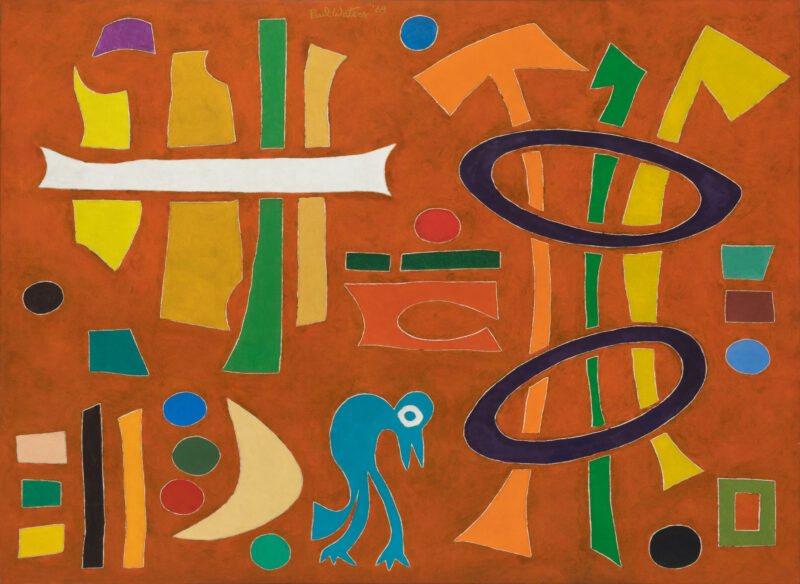
In nonfiction, Mona Eltahawy writes with her signature clarity about discarding the old script that a woman’s life must be generative. Her essay Childfree by Choice rejects both the literal family tree and its softer metaphors—my books are my children—to ask what a woman’s life looks like when its roots belong wholly to the self. Meanwhile, John Kidwell’s The Graffiti Question breaks open a deceptively simple prompt—what is graffiti?—to carve out an inquiry as illuminating about the stakes of beauty, property, ethics, revolt and art as it is about the limits of our definitions, in the face of images intent on slipping past their grasp. Finally, in conversation with William Pei Shih, the visionary artist Paul Waters—whose six decades of work mix West African traditions, downtown conceptualism, and a lifelong commitment to racial justice—reflects on childhood shadows, early rejections, and the quiet stamina that shapes an artist’s path.
Our Global Spotlights piece turns to Palestinian life in the West Bank: in The Museum of Gush Etzion Dina Awwad-Srour documents with haunting precision the process of seeking a permit across the separation barrier—envisioning, as a fragile foothold into an imagined future, the military base transformed as a museum for the violence once enacted there. What begins as a degrading errand thus becomes an act of looking closely at the structures—both material and discursive—designed to constrict movement and redirect the gaze, revealing how power distorts not just lives but their legibility.
Finally, two poems by Yolanda Castaño, My Longest Relationship, and Suspended, consider the distance between the selves we imagine and those we actually inhabit. Wry, sly, and full of feeling, these poems insist that alternatives and absences are no less real than the inhabited contours they press against. Three lyrical poems by Jean-Pierre Rueda—The Marble of the Soul,Yosemite Bound or how a river remembers, and Wherever a heart beats for another —travel across inner and outer terrains, moving from ars poetica to the lived grain of Fresno’s heat-haze asphalt, lending indelible texture to those miraculous bursts of human courage that, for an instant, seem to make the world anew.
Guernica’s November-December issue grapples with the conditions we inherit, the ones we scroll through, and the ones from which a world-tilting detail sometimes breaks free—stubborn as a graffiti blooming on a derelict rural wall; surefooted as Mamadou Gassama, lifting that child over the railing, carrying in his arms “a forgotten / truth: / that humanity, too, can soar.”
Featuring striking original art, courtesy of the artists, by Paul Waters, Maria Guzmán Capron, Lauren Trangmar, Pepe Baena Nieto, Amadou Opa Bathily, Zachary Gaouad, Roshan Elqurashi, and Mohamed Alimrani.
–Youmna M. Chamieh, Editor-in-chief