In November 1982—in the midst of Israel’s second invasion of Lebanon and on the heels of its massacre of thousands of Palestinians at Sabra and Shatila—Kathy Engel addressed an audience at the New York City Society for Ethical Culture with the following remarks: When any poet is labeled inadmissible, when any voice is silenced, when freedom of speech for any of us becomes negotiable, then each of us is threatened. The exalted Palestinian poet and exile living in Beirut, Mahmoud Darwish, had not been granted a visa to the US for the event. The line-up—comprised of Lebanese, Palestinian, and US poets—now had a gap, and Kathy Engel and her co-organizers would not allow this gap to be silently overstepped. She read a statement they co-authored:
We are diminished by the absence of Mahmoud Darwish from this stage tonight. Our poems cannot be complete while his voice is banned. We speak as poets despite the many attempts of different governments to separate and silence us. We raise our voices here with the voice of Mahmoud Darwish whose spirit is with us, moving towards home. The poet has been barred, but the poem continues. The poems will not stop.
The poems will not stop bombs from falling. The poems will not stop power from its absolute corruption. These are all arguments often made, but at the same time the poems will not stop surfacing in our heads. They will not stop pouring out of pens, as the history of Palestine’s long liberation never ceases to be written. Poets speak, and that is action, but they also act, and this is what has drawn me to Engel’s work at a time when I feel despair about our ability to effect change as writers and believers in human rights. She has always written poems alongside other work that saw her putting her body, her time, her energy, and her relationships in between the oppressor and the oppressed—in Palestine, in Nicaragua, in New Hampshire. In our conversation, Engel reflected on her first anti-nuclear occupations at Seabrook and Shoreham. Her epiphany in those spaces: These are my people, this is my place.
Where is that place, and who are the people that populate it? They are who Engel and co-editor Kamal Boulatta thank in the introduction to their 2006 anthology We Begin Here: Poems for Palestine and Lebanon, when they write of “individuals who believe…that aesthetic expression can be formidable when its articulation is inseparable from the struggle for political justice and social change.” They are who Engel means when she says later in her preface, “We are strangers who meet seeking peace.” I met Engel last June at a poetry festival I helped organize. In addition to We Begin Here, I’d recently read her life-affirming collection Dear Inheritors. Engel’s strong adherence to justice-seeking—in both verse and in person—is what made me want to have a conversation.
I wanted to learn more about Engel’s faith in poetry’s indispensable belonging in social movements, a faith that seemingly has not flagged for fifty years. The author of seven collections of poetry, Engel not only gives voice to other poets, sharing words of her heroes and comrades when she touches a microphone, but she also pours her frustration, sorrow, witnessing, and sublime gratitude into each poem she writes, resisting the neoliberal impulse to separate poems about nature from poems about political oppression, to separate poems about horses, mimosa trees, the love of family, the haunting call of home from poems about police brutality, Palestinian resistance, and the horrific recent past that saw Indigenous women and girls systematically killed and erased at Canadian “reform” schools. The next time I would hear Engel read was at a fundraiser reading she helped organize to raise money for relief in Gaza. Among others, Engel read alongside both her daughter, the writer Ella Engel-Snow, and the Pulitzer Prize-winning Palestinian poet, Mosab Abu Toha, who, in addition to sharing poems, spoke with reverence about the strawberries his father would grow in Gaza. I wanted to learn from her about how to speak on these topics for all the right reasons, how to let go of all the divisions between people, emotions, perspectives, and generations, and how to persist in using poetry to stand up for justice. All while keeping the world’s wonder—animals, oceans, fruit, the lyrical ‘I’—on the page just the same.
I also wanted to know if what comes off in her work as unflagging—her faith in humanity, the vital function of art, and that another future is possible—does in fact flag, and if so, how does she replenish her sails with wind, how does she weather the storm?
In this time of such proud and out-loud fascism ruling in America, I see in Engel the opportunity to learn from a living leader. Though “leadership”, too, is something Engel has helped me learn to rethink, as the division between leader and follower is yet another separation she would remove in building the world she still believes is possible and necessary. I was grateful to sit down with her for an interview on July 3rd, 2025, a few days after she performed at the second annual Flower City Poetry Festival in Rochester, NY.
— Tyler Barton for Guernica
Tyler Barton: How are you feeling?
Kathy Engel: I’m okay. You know, I never liked the 4th of July. For years my older daughter and I organized, along with others, a 4th of July walk for “interdependence” in our community. It has long been a thing we did, and then we began connecting with other groups and made it a street block party. But other than that, I ignore this holiday. I always used to write something. Now I’m just like, Well, I have nothing. I have nothing new to say.
Then again, we do have our Sunday vigil this weekend, a vigil to support Palestinian sovereignty. The beautiful small group we work with has been hosting it every Sunday since October 2023, right here in Sag Harbor. So this Sunday we’ll be there, and some of us will hand out leaflets. I’m really proud of it. This place is not wildly active. I grew up here. We’ve been demonstrating here since we moved back from Manhattan in 1994, and with Women in Black since 2003, trying to prevent the US invasions of Iraq and Afghanistan. So there’s a history. This vigil started really small, but it’s become an interesting, intergenerational, unexpected group—steadfast people with very different ways of being public and engaged. It has become a very strong group, but we’re all amazed at the people who don’t show up. But it continues regardless of the size.
Anyway, Sunday we will be out, even though it’s been pretty ugly lately, because there’s a group that comes and harasses us.
Tyler Barton: Oh.
Kathy Engel: Viciously.
Tyler Barton: I can imagine.
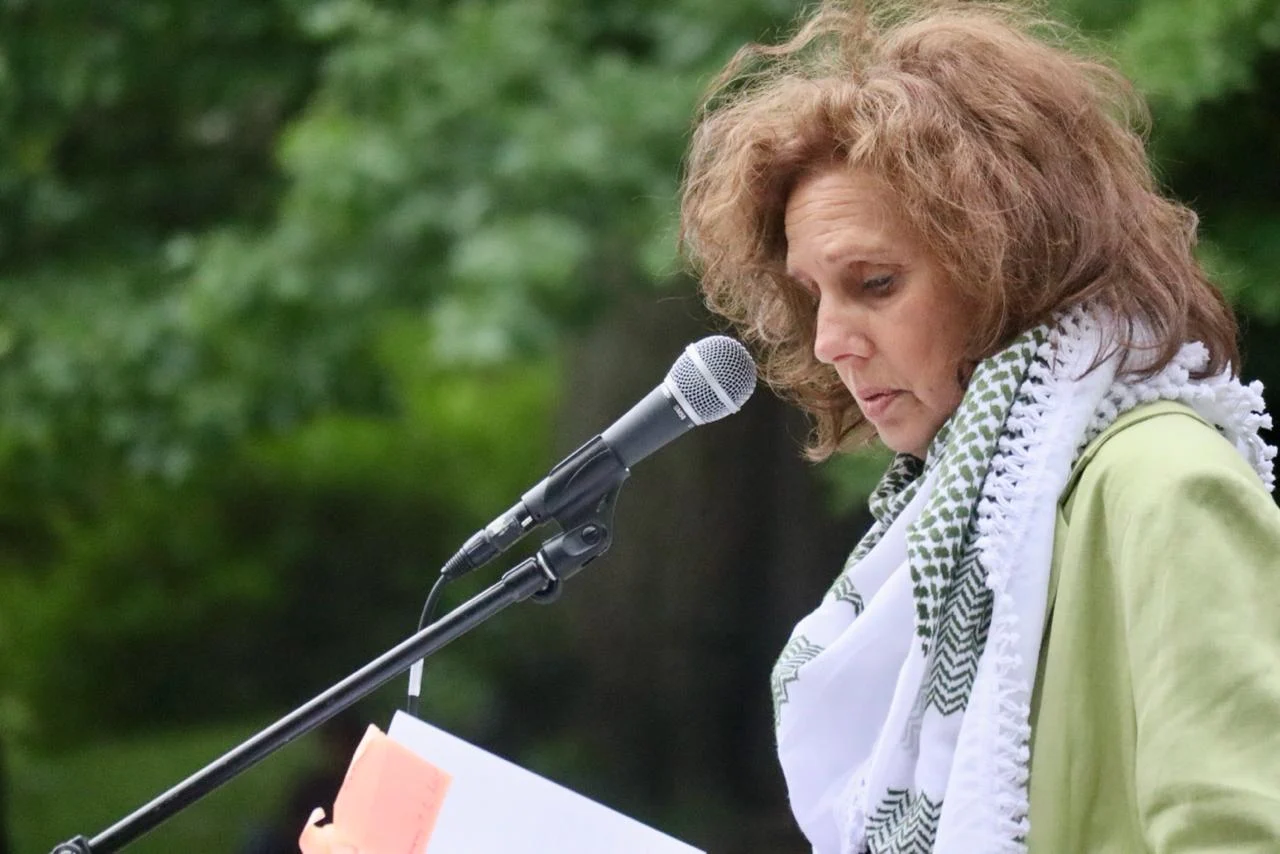
Kathy Engel: Did you get any bad feedback from my reading? [Engel performed at the festival wearing a keffiyah, sharing poems that center Palestinians, Lebanese, and Indigenous peoples, and the working class.]
Tyler Barton: No, not at all. People loved it. And it’s not like I was prepared for detractors, but I was maybe bracing. I did have someone email ahead and ask which night of the festival would be the least political [laughs]. They wanted to bring a friend who loves poetry but didn’t want to hear “anything about Israel”. I said, “Don’t come Friday.” But you know I really wanted to say, “Actually, you should come on Friday,” because I do want people whose minds are made up to hear a poem they might not know they need to hear, something true, beautiful, and heartbreaking and that makes them feel, and then they learn it was by a Palestinian writer, or about resilience in the face of slaughter. To show them it isn’t scary to hear words. To prove persuasion and empathy are still possible. But I know that these days a single mention of the genocide can make someone fold their chair up and go home. I did see one couple do that during your reading, but you could tell it was their loss.
You know, I’ve always tended to steer away from this stuff, the explicitly political in poetry, but lately I’ve been feeling that’s a mistake and that one should steer toward it, because it can be productive. To have the confidence in one’s convictions to say “No, no, you should hear this.”
Kathy Engel: Just hear it. Just see what happens. Hearing it isn’t going to hurt you. It may feel like it hurts you.
Tyler Barton: Were you politically active before you were a poet? Or were you a poet first?
Kathy Engel: I started writing poetry very young, so, yes, a poet first. But at the same time I always had this leaning, this inclination, this kind of yearning—how can I engage? How can I connect? I was always someone who started things, but back then the things I started weren’t overtly political. I went to an experimental school for a period that my mom and others had started, where I was involved in unscheduled, student-led spaces. I came from a family of educators. I wasn’t even political in college. I have always been an introvert, you know, in many ways.
My mom was a social worker, and later in education and started the school, so I was raised to be conscious of service.
My dad was a documentary filmmaker who made a film when I was 13 that was critical for my development: Dr. Spock and his Babies, about Doctor Ben Spock, the New England pediatrician who was radicalized during the Vietnam War and became outspoken. That was my dad’s contribution to the movement, to make that film, and I was in on the film mix, and I wrote a poem about it. I met Ben Spock and made brownies for the reception in my dad’s Upper West Side apartment, and that was a pivotal time for me, because I saw that artists had a role to play.
So from a young age I had the desire, and also fear like, How will I do it?
Tyler Barton: So when did you figure out how you could engage politically and poetically?
Kathy Engel: One day I was at work—I was working at the Academy of American Poets as a bookkeeper and a program associate; this was 1978 or 1979—and got a call from my dad who said, “Grace [Paley] and others are going up to Seabrook, New Hampshire. There’s a nuclear power plant, and it’s what they’re calling an occupation. It seems really important. Do you and Jon [Engel’s partner] want to go?” And I said, “Yeah, I think we should go.”
That was a pivotal point—everything changed. I became totally immersed, and everything started to seem connected. Of course this decision led to more activism, including my being arrested at Shoreham Nuclear Power Plant years later. So there was really no going back.
I became friends with the people I met there, like Denise Levertov. We were setting up our tents, roaming around; it was dusty, hot, with bugs everywhere, and I was trying to figure out, Okay, what’s my role here? How am I gonna fit in? And there’s Denise on the ground in a circle, reading poetry to a group of people. I was like, This is it. This is where it is. These are my people. We became friends in a very beautiful and moving way. I mean, I was very young. I was in my early twenties, and I kept thinking—this is going to be my community.
And so I became politicized very intensely, very fast, because I had been waiting for this.
Tyler Barton: What was your poetry like then?
Kathy Engel: I had studied poetry as an undergrad—with Jane Cooper, Galway Kinnell, Jean Valentine—but I was by far not one of the better poets. I kind of went through a period of asking, Why am I not good? It was partially a crisis of: What is my voice? What am I supposed to say? What can I say? I was often holding back the ‘I’, feeling at that time that in order to be a good poet I had to take myself out of the poem in a sense, that there was too much of me in my early writing, and that it was self-indulgent. What ended up happening when I held back the ‘I’ is that my poems lost their juice and emotional connectedness. I thought I had to be more distant, but I’m not good at that.
Tyler Barton: Tell me more about wrestling with that question of permission in your work. What stories, topics, places, people do you feel that you have a responsibility to speak up for in your writing? Is there ever a discomfort, or a questioning, Am I allowed or even able to speak to this?”
Kathy Engel: It’s an ongoing question of, What do I need to say? What I’m supposed to say, and according to whom? What is my responsibility? Where? When? How do I do it? When am I going over?
It’s a very hard question, and I’ve grappled with it because things have changed in terms of awareness and consciousness, and how we see accountability. I’ve long been working with many different communities, like in my work with MADRE [an international human rights organization that began in Nicaragua in 1993, of which Engel is the Founding Director], for example, where I was conscious of my role as a white, privileged, Jewish woman. My role was not to be the center, but to work with people to create things, and then stand back.
At one point or another I’ve had friends, from every kind of background, criticize me for that, for standing back. They’d tell me: You know you need to say what you need to say, and claim that place. That’s part of your job, too.
Tyler Barton: Tell me about your poem, “Unmarked graves of Indigenous children, 2021” from Dear Inheritors.
Kathy Engel: That particular poem I was very uneasy about. I wrote it when I became aware of the discoveries. I’ve been long involved with different Indigenous communities; I have a close relationship with a number of Indigenous leaders and poets, and specifically connected with members of the Shinnecock Nation, near where we live, but I’ve also been engaged with Indigenous struggles in active solidarity for many years, and in Nicaragua too, through MADRE.
But “Unmarked graves…” really came to me when a member of my beloved extended family, a Shinnecock pastor, called me to tell me about the situation. We talked often about it, and she kept telling me that so many people weren’t talking about this. I felt that it was incumbent upon me to—I mean, I felt she was telling me: write the poem. So I wrote the poem. Which is not to say I didn’t also feel it deeply, and I felt it part of my responsibility, but nonetheless I was very uneasy about it, so I showed it to a friend and I asked her, “Is this okay? You know I don’t want to burden you with that, but what do you think?” She thanked me for writing the poem and later told me she had read it for an audience at one of her sermons.
I wouldn’t just go out there and put that poem in the world without checking with people in a community with whom I have mutual trust and honesty. And I also always try, when I do a piece like that, to share my relationship, that I put myself in it in a way that is hopefully respectful, reverent, and shows that I’m not just writing about people. I’m having an experience.
It’s about relationship and experience. Grace Paley used to say, “It’s how you do it.”
When we went to Nicaragua with a group of women, including June Jordan, we were asked by the Nicaraguan women if we would tell their stories. I mean that was in 1983, and we’ve learned a lot since then, but we were asked. They gave us this book with their letters to Ronald Reagan and the US Congress that insisted—Stop killing our children. They looked at us and said, “Tell the President.”
Tyler Barton: So MADRE was born of that trip to Nicaragua?
Kathy Engel: Yes, and that trip to Nicaragua was for “Talking Nicaragua,” [a dramatization about US foreign policy in Nicaragua of which Engel was a co-producer] which was born of a reading called “Moving Towards Home” that we organized in November 1982 at the New York Society for Ethical Culture. The event featured Palestinian, Lebanese, Israeli, and US poets, in the aftermath of Israel’s invasion of Lebanon and the Sabra and Shatila massacres. Sara June, Kamal Boullata and I came up with the idea. Etel Adnan read. Stanley Kunitz read. Kamal read a poem by Mahmoud Darwish because he was denied a visa. It got strong press, and there was even a little video clip from local CBS about poets making peace.
Congressman John Conyers came to New York in his tuxedo. He was the only politician on the national stage who was speaking out, questioning US-Israel policy. He did a beautiful job hosting. Then, Conyers hosted us in Washington, DC, the year after. And then in Detroit.
But there were fireworks at the end of that first NYC event [in November 1982], after June read her closing poem “Moving Towards Home,” which is an indictment of the Israeli participation in the massacres at Sabra and Shatila. Just after she finished, an Israeli poet moved to the foot of the stage and shouted a racist attack at June. There was also fallout from PEN America, a sponsor of the reading, and others. Ostensibly those who were angry said that it was a “setup” because the name of June’s poem was the same as the title of the event, and we closed the reading with that poem. I mean, that’s what they said. Honestly there could have been no other way to close the reading. And it’s clear they just couldn’t tolerate Israel being held accountable for the massacre. This led to the end of my friendship with Galway Kinnell, who had been a teacher and friend. It was for me a pivotal moment, because we were really attacked. I was twenty-five. And I was the only Jewish one of the four of us.
I soon learned that some board members of PEN America were also really upset, and they had a special meeting to disavow their relationship to the reading, which was also a benefit through UNICEF for children in Lebanon.
It was after the “Moving Towards Home” event that Michael Ratner—from the Center for Constitutional Rights—came to Sara, June, and me, and said, “We’re doing a groundbreaking lawsuit on behalf of Nicaraguans who were kidnapped, raped, and tortured by the Contras [a right-wing counter-revolutionary militia supported by the US]. Though there’s a solidarity movement in the US with El Salvador, we feel that people don’t realize what’s happening to Nicaraguans. Could you do a cultural program to widen the audience the way you did for Palestine?”
So we came up with this dramatization called talking nicaragua. Sara Miles wrote the script and then another writer worked on it as well. Susan Sarandon, Giancarlo Esposito, Ed Herrmann, Rosalba Rolón and Alvan Colón from Pregones Theater all participated. Nicaraguans who were plaintiffs in the lawsuit came to New York City to participate. We did a one-night performance that was videotaped for PBS.
Of course then PBS’s people didn’t show it, because it was too critical of US policy. That is what led to the invitation to Nicaragua. My husband Jon was the photographer, alongside me, Sara, and June, who was on assignment from Essence magazine and the Village Voice. That trip then led to the forming of MADRE and the Coffee Brigades as well as a photo project Jon was asked to create.
Tyler Barton: Did you ever write something you ended up not publishing or working on because you felt you didn’t have the right experience or perspective to speak on it?
Kathy Engel: I usually wouldn’t write it if I didn’t already have some connection, but you know there are poems I would definitely write differently now. It’s one of the questions that I grapple with…
I will never forget this moment in 1990, in the West Bank. We were standing in a bulldozed home, where this man is living under plastic sheeting held up by a few poles. His kids had all been imprisoned with no due process; they were really kidnapped, hostages. Despite this, he had set up a little table and some teacups, and he hosted us. It was this very small delegation. He said to us, like so many people did on that trip—Don’t forget us. Tell our story.
It’s an important question and it comes up a lot with my students. I never have a fixed answer. I’m always nervous. What is my job here with the voice that I have? And the job is never to tell someone else’s story unless they’ve asked me to. But also I try to implicate myself, or not to implicate, but to question myself and question my role.
And Grace said it’s about the love: Did you say it with love?
Tyler Barton: I find it very refreshing to find these subjects come up in your work, because I feel like when I was in my MFA program ten years ago, writing was supposed to be about beauty, wonder, personal pain, but probably shouldn’t be about politics, or anything specific about widespread oppression.
Kathy Engel: Can I say something about that, though? I don’t think they’re separate.
I had a beautiful poet friend we lost much too young because of cancer. Safiya Henderson Holmes—look her up, if you don’t know her work. She was one of my closest friends, but we used to laugh and say we were going to read a love poem when we got asked to read at a rally. She was an amazing force and we were sisters. We even wrote a poem together once for a reading at an event for the William Moses Kunstler Fund for Racial Justice, which I am so proud to have been part of in its early days.
It’s funny—I was just asked if I would contribute a bunch of poems to a new project. In the letter of invitation it was clear that they think of me as a political poet. I mean, I know I am a political poet, but I argue at times with that category, as I think everything is political and I don’t think the challenges I address are “issues” but part of the map of the world.
I think highly of wonder. I try to write about beauty and to write into beauty and honor beauty. Beauty is part of the politics of resistance and resilience, of possibility. And we see that in a poem, the beauty, the tree I’m looking at right now. And, yeah, hopefully, that comes through.
Because that’s why I always integrate the poems. I don’t put them separately. I keep myself in them. But when I was a young, I didn’t think I was allowed to do that, and you know my poetry was terrible. It was separate from me. Galway did say to me when I was very young, “You’re a spiritual person.” I looked at him like he had ten eyes. I grew up in an atheist family. But he was seeing something in me. I mean, I was always my most at home in community, yet also craved quiet and solitude, like being next to a tree, or in the ocean. Because I’m not just interested in reacting. I know that I can’t, especially at my stage of life, just be running on urgency all the time. It’s what they want, you know that? So I worked really hard for years to allow myself back into the tree, and the tree root, and the love.
I had a poem last year called “Veto,” about how the US continually vetoes UN resolutions for a ceasefire. And I sent it to someone who I trust who said, “There’s always a question with this kind of poetry: Will it make sense to anyone out of context? You know, the word “Veto” even?” He said, “I’m really interested in timeless poems.” So I started thinking, What does that mean? What is timeless? And how?
Have I ever written a timeless poem? [Laughs.] I’m not saying anything that I know. I’m saying that these are the things I ask.
They’re human challenges, the things we’re dealing with. I mean policies, dictators, democratic impulses. I don’t know how to describe this time. So I don’t have a brilliant answer. What I’ve learned is that I have to write what I have to write. What am I doing here, otherwise?
Tyler Barton: It seems you also feel impelled to write of plants, animals, and nature. These subjects often populate and steer your poems, maybe serving as answers or sources of power—trees, horses, oceans. Are you trying to translate the communication you find with animals? Are you trying to put that relationship with nature on the page? Are you trying to make their voices heard?
Kathy Engel: Oh, well we’re all animals. I don’t think we’re anything but animals.
I just feel that there is so much to learn. People in different cultures and communities have always had this notion that separation, or the creation of hierarchy of life, is pretty violent—and violence is part of life, don’t get me wrong. But horses were part of my beginning; I became connected with horses at a very young age. There was a horse in my life who I saw right after she was born. I was a little kid, and we grew together. She was my rock. I always had friends, but she was my solace and my—it was something more. I think we, as humans, have evolved in such uneven ways.
I mean, I don’t know who’s trying to tell anybody anything, but I do know that I have a lot to learn from all the living. I read about that a lot, but also, I feel it. I notice the turkeys who hang out here and I watch them, the way they congregate, and the way they move together. And the geese—their formations, rhythms, seeming intentionality. I wrote a poem about this that is not in that book, about trying to learn from their democracy in flight.
I learn from the horses, I learn from the canines, I try to learn from all living things. I’m trying ultimately to unlearn the separation between us. And that’s one of the things that makes life possible to me is the never-ending ways of learning.
Tyler Barton: You have to think, anytime there’s a separation between things in life, who’s making money from that?
Kathy Engel: Right. Who gets some power from that? That domination that says, “Put the mind here, and the heart over here.” English is here, but history is over there. Potatoes are here, and tomatoes—you know what I mean? But I think the answer is in the integration.
Many of us have been trained to disregard our intuition. We lose so much of our power to think even, and to come up with ideas, and to come up with solutions and visions. When we do that, we’re missing so much.
Tyler Barton: Do you have a morning practice?
Kathy Engel: I sit and listen to whatever can be heard. I do so every morning at home, near trees and sea. Even if I’m in the city. There we have a little landing, so I go out even when it’s cold, or I just open the window wide. I need to spend a little time listening.
I learned a certain ritual nearly ten years ago, on my sixtieth birthday, when a group of intergenerational women were gathered by a dear sister. We were in a circle, and one of the women in the circle shared that she had been through a terrible crisis and had been on the edge, and she told us how she had come back. She had these chants that she said, and then she asked us to write down ten of the negative things that we say about ourselves, things that limit us. And then to write the opposite of each of those things, and with each positive one, rip up the negative ones.
I kept with it after that circle. I reduced the list so that I could remember it. I keep a few of those positive ideas and add some from time to time, and that’s part of my morning, saying them aloud. I usually listen to a short meditation. I like to sit longer with my notebook. Thanks to Sonia Sanchez, I write a morning haiku, and I have done so every morning for more than ten years, I think. Then I do a list of gratitudes.
Afterward, I either go to the horses, or visit with a particular tree, or go to the water, and often have some kind of connection with those who’ve died, who’ve left, who are important to me. I don’t do it all every day, but when I can, mostly I do. Then I write a haiku. Then I read a poem by someone other than me, usually more than one. I may listen to The Slow Down, or to Poem-a-Day. And that’s my beginning. That’s the basic. I run in the morning, too, and that’s meditative for me as well.
I went through a period of intense anxiety. There was a lot happening in my family, and I lost my brother to suicide—there was a lot going on. I’d read somewhere that if you wake up really anxious, the first thing you should do is open the window and stick your head out, or otherwise just go outside. And I started doing that because it fit me. That’s what I did as a child, not knowing I was doing it. I was seven when we moved to Eastern Long Island. I would go out each morning to the ocean, to feel the wind, the wind, the wind. And that helped me, you know. I don’t know how to put it—the cuttingness of it, the intensity. The outdoors, for me, is one of the central things.
Tyler Barton: What do you think we learned from living through the COVID-19 pandemic? And what did we fail to learn? From your perspective, what were the lessons we could have learned but didn’t?
Kathy Engel: Bayo Akomolafe says, “The times are urgent—we must slow down.” I love his writing, especially his book of letters to his daughter. I think about going to Bread and Puppet Theater when Ella was about twelve and Jaja was eight, and the circus that summer was in honor of the slug. I was so taken with that. At first I was like, Okay, that’s cute. But then I realized I kept referring back to it. I think with the pandemic there was an opportunity there, to take in what that could mean. When suddenly you could see the horizon differently, because so many things had stopped.
I think the possibilities we were granted were ones of care, and interrupting the kind of ruthlessness that our dependence on dominance and capitalism enact. We can do all these amazing things, but we can’t really talk to each other. We can’t live together. We can’t. What have we learned? That’s my question.
I recently found a poem from 1982—this is part of the work I’m doing—called “Letter to the Editor” and it’s about the mirror or parallel between what happens in an individual relationship where there’s abuse, violence, and pain. And there’s a chance to either break the pattern or else reenact that pattern. The poem is about a child who was abused and then grows up to become violent with her own child. I mean, you look at the world, all the incredible, loving things humans can do, but there’s also that. So, what does it mean?
Tyler Barton: What does it mean?
Kathy Engel: I think about when I stopped doing the national work and started focusing on smaller actions—what the late Princess Elizabeth Thunderbird Hale from Shinnecock would call “small, brave projects”—I saw all these people starting to farm again, and all the ways of building community. In 2016, when this tyrant was first elected, my best friend Alexis De Veaux and I were just talking about what needs to be done, and I said, “I think we need to build strong communities.” And I still believe that, but we’re just dealing with so many assaults at once.
I don’t believe everything needs to be said, but if so many things have not been acknowledged, it allows fear to grow. Which has everything, tragically, to do with money. The way fear is used. And there was such a terrible fear at that time, during the pandemic. Look at what people lost. I know people who have been sick ever since.
Oh, a storm is coming, wow.
Anyway, I don’t know if any of this helps. What do we dare to learn? What can I let go of and say?
I was recently talking with my mom about some political thing or organizing approach, and she said to me, “Well you used to say the opposite,” and I said, “Yeah, mom, I learned something. I changed. Aren’t you happy about that?”
Tyler Barton: You’re talking about learning and what can be learned. One of my last questions here is actually to go back to talking about June Jordan and your friendship with her, which was born in those late 1970s spaces where poetry and politics could meet. What did June Jordan teach you?
Kathy Engel: June taught me to believe in my writing.
She invited me to Stony Brook to read when no one was treating me like a poet except people in political movements. She supported younger poets; she was just amazing. She taught me to read the headlines and then read the article and understand verbs and nouns and accountability, and to read it in terms of power and race and gender. To know the difference between when something just happens, or when somebody did something, and when something just happens to somebody, or when somebody perpetrated it, and how that is often a question of race and class and gender. “You know, the writer of the article doesn’t get to write the headline,” she used to remind me.
Once I was struggling to write something for MADRE, and I didn’t trust myself writing prose at all. It was a statement, or maybe a fundraising letter, or whatever it was. Just write the way you write, June told me, and use everything you know about poetry.
[Jon comes in—“He’s trying to batten down the hatches, because it looks like a storm.”]
When Ella was born, June asked me, “What do you need for her?” and I had the audacity to say, “A poem.” And weeks later I got this lullaby that she wrote for Ella. I learned from her as a mother in the sense that she was a mother to the world. That all children have a relationship. She loved young people, believed in them. When she would go and talk to students, they would say, “But June, the news, it’s so terrible,” and she would say, “You’re the news. You are. That’s good news.”
She taught me that an essay doesn’t have to be some rigid formulaic thing outside of yourself. She taught me that poets can write the best essays. She’s in a category of her own, but she taught me that I could think about essays the way I think about poems. I began to understand that they are not separate.
It was June, Sara Miles, Vivian Stromberg, and Norma Becker from the War Sisters League, who really brought me into the question of Palestine in 1982.
She knew how to have fun. Her laugh and her delight. She had an incredible energy and verve. And she taught so many people. She had a poem called “Apologies to all the people in Lebanon” which was published in The Village Voice, and she got a lot of flack for that. And a lot of love. People are still reading it. Angela Davis read it at a big conference in the beginning of this period of the genocide in Palestine.
June had this way of believing in young poets, and supporting them. She wrote a blurb for my first book, which I don’t even really talk about that much—a chapbook that I made when Alexis De Veaux and I decided we should put our work into the world ourselves, be in charge of it. I made the chapbook Banish The Tentative and Alexis made an amazing book in a kind of sheath or portfolio, with her illustrations, called Blue Heat, that was just republished by Sinister Wisdom. June gave me that blurb as she was so generous that way. She was so generous in her support and her enthusiasm. But at the same time she was totally in touch with her rage and her indignation, all of it. It wasn’t separate.
I remember after Moving Towards Home, she asked me, “What did Galway say?” and I told her what he said, and she said, “Oh, well. But what did he say about your reading? Did he like it?” I told her, “He said I read well.” And she said, “But what did he say about your poem?” She was simply a champion of young poets’ work.
We were in Nicaragua in 1983 on a high school playing field in the Afro-Caribbean town of Bluefields, and they asked June to read. It was like she was Stevie Wonder or something. She was a rockstar, in her neat blouse and skirt, and it was—I spoke about this at her memorial in Berkeley—it was one of these moments. They knew who she was.
Tyler Barton: Who are your leaders?
[In the interview Kathy Engel spoke at length about writers, activists, and friends Engel has learned from, grown with, and remains in solidarity with, but afterward sent me the following email.]
Kathy Engel: As you predicted, I was thinking about my discomfort responding to the question about leadership. Here’s the crux of it for me. There are many ways of leadership. I hope to support the enactment of honoring and uplifting the different ways people contribute towards community, towards vision, towards making a more just, loving, healthy, sustainable, and noticing world. I’ve had this exchange with colleagues, community, and so called students. Yes, there are projects, individuals, who—in their vision, work, and way of being—help me. So, so many. And yet, I resist the way leadership is so often categorized and characterized. I know humans crave icons. I’m just interested in the ways any one of us can be the guide, the spark, the contributor, etc. Horizontal!