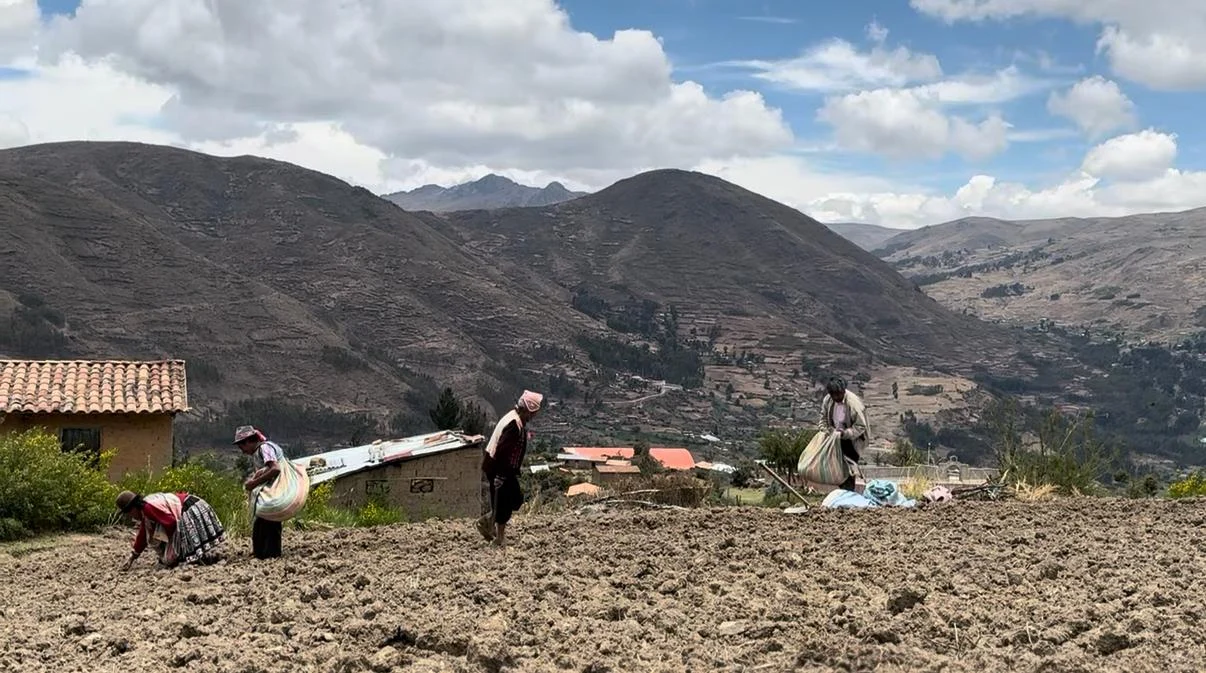
An estimated 29 percent of the global population experiences moderate to severe food insecurity. The liberal aid apparatus has responded to this crisis in full force: the second Sustainable Development Goal is “Zero Hunger,” and the World Food Programme has an annual budget of over $8 billion, making it the largest humanitarian organization in the world by expenditure. But when did people become so hungry in the first place?
I spent one undergraduate summer in rural Uganda leading an impact evaluation for an initiative led by the International Food Policy Research Institute (IFPRI), headquartered in Washington, D.C. Across eight remote agrarian regions, I saw varying degrees of malnutrition and food scarcity, witnessing the paradox of the modern food system firsthand: even farming communities often struggle to achieve adequate nutrition. I found IFPRI’s approach to be effective: after a four-day innovation workshop, farmers were gainfully addressing their greatest production challenges through handmade tools of their own creation, many still operating years later with no further intervention.
For millennia, human societies around the world have managed to feed themselves in a diverse range of environments, some fertile but many considerably hostile. They have done so through an equally diverse range of cultivation practices, building diets responsive to the flora, fauna, and carrying capacities of their respective biospheres. But Western agricultural practices severed this delicate balance with the land, flattening complex food systems into commodities and complex food traditions into obsolescence. This dysregulation, globalized through colonization, made hunger the intractable challenge it is today. No amount of landscape-scale monoculture, geo-engineered crops, nor aid money has been able to address this rupture. And this flawed global food system now contends with a number of new challenges in the face of the climate crisis, while contributing more than one third of greenhouse gas emissions. To the global aid apparatus, ours is a world of hungry bodies waiting to be fed.
Sean Sherman, best known as The Sioux Chef, sees a different challenge. One of the most celebrated names in the culinary world, he has amassed three James Beards Awards and the Julia Child Award across a multi-faceted career spanning a catering business, a restaurant, a nonprofit, and several cookbooks. Unlike other faces of the slow food movement, his practice is not learned but remembered; as a member of the Oglala Lakota Sioux tribe, he works exclusively with ingredients indigenous to the Great Plains region. Beyond its culinary provocation, this approach also channels millions of dollars into Indigenous food production. While his food is intentionally local, his approach is highly replicable; his newest cookbook, Turtle Island, is a guide to localized eating practices spanning the entirety of so-called North America.
Having grown up on government-sponsored meals in one of the poorest reservations on the continent, Sherman sees his work as “(r)evolutionary.” By positioning ancestral food knowledge as a contemporary solution to the climate crisis, he refuses to allow Indigenous peoples and lifeworlds to be left in the distant past. With each bite he serves, Sherman strives to provoke a sense of humility in his customers, revealing through forgotten notes that the world may not be quite as it seems. In this way, he heralds an Indigenous futurism, knowing that change does not begin with empty stomachs but with curious tongues.
— Russell Reed for Guernica
Russell Reed: You grew up on the Pine Ridge Reservation in South Dakota. What did you eat as a child?
Sean Sherman: We grew up in a segregated reservation system, so there was very little nutritional food access. Pine Ridge is approximately the size of Connecticut, and yet we only had a single grocery store. So I grew up largely with the commodity food program—the Food Distribution Program on Indian Reservations (FDPIR) foods coming from the USDA, which is just a lot of government-supplied food. Our pantry was filled with canned vegetables swimming in sodium water, canned fruits swimming in corn syrup, gallons of corn syrup used as sweetener, powdered milk, American cheese blocks, tins of peanut butter, tins of government meats like beef with juices and pork with juices, and so forth.
I grew up out in the country. Pine Ridge Reservation is pretty wide open; it’s on the Great Plains, bordering the Badlands of South Dakota. It’s pretty sparse. There’s not a lot of growing space there. The little bit of growing space that we did have on the reservation was grandfathered to outside growers, so there were a lot of alfalfa and things growing on the reservation that didn’t support the food system there. My grandparents raised cattle, so we had access to beef—but that wasn’t the norm on the reservation. We hunted a little bit, gathered some wild foods, but only a tiny little bit. I grew up in this segregated postcolonial state—if you can even call it postcolonial, because colonization never ended.
Russell Reed: What did the Indigenous food system in North America look like before European colonization?
Sean Sherman: Indigenous people were living in every region of what is now known as North America, from Mexico all the way up into the Arctic, and people figured out many ways to survive in that vast area. Agriculture and corn culture were central to many people, from Mexico into the Mississippi and Missouri River Valleys, all the way to the East Coast and the Caribbean. There are a lot of heirloom seeds still there today, and a lot of farming tribes still cultivating that land. But it wasn’t just agriculture, as people also held a strong sense of the wild plants where they lived, utilizing nature’s botanical components—trees, roots, flowers, fruits, seaweeds. And the animals, of course, and the birds and insects.
I like to look at what ancestral diets were, knowing that humans always figure out how to have a balanced diet because scientifically, we’re animals, and we need a balanced diet to survive. We need a way to gain energy, so we typically seek carbohydrates or fats to keep moving. In the coastal tribes of Alaska, British Columbia, and the Pacific Northwest, you see diets coming from pure seafood fats like seal, whale, fatty fish, and birds. When you move further, you see a lot more carbs: acorn across California, corn culture throughout the inland regions. But we had a massive knowledge of plants no matter where we were, and a resourcefulness to know what to do with things—not just selecting prime cuts of an animal, but actually utilizing the entire piece, because we had countless generations of this knowledge. That is true of any Indigenous person on a global scale, and therefore of Indigenous food systems at a macro scale.
Russell Reed: How were these systems fractured through colonial intervention? What relationships were severed, and what was lost?
Sean Sherman: There were plenty of advanced Indigenous societies that had been living across the Americas with abundant wealth for countless generations before colonization. The Nahua, in what is now Mexico City, had massive civilization, architecture, mathematics, sciences, and agriculture, feeding hundreds of thousands of people without polluting their own water and soil. The same was true of the Maya, and there are still over a million Mayan speakers today. The Incan Empire was massively vast and highly organized; every time they absorbed land spaces, they plugged it into their system of agriculture, animal husbandry, and fishing to feed massive amounts of people while attending to the land and holding onto a great deal of ancestral plant knowledge.
Colonialism brought in the mentality of land access, and securing land access for wealth. Colonialism looks at the land as profit, exploiting whatever natural resources can be turned into cash. There was so much diversity that it’s hard to know exactly what was lost. California is reported to have over 200 precolonial languages. It was such a beautiful growing space, so temperate, that you could find food there throughout the year. During the mid-19th century, about 99 percent of the Indigenous population of the Americas was wiped off the face of the earth through active genocide. We will never fully know what we lost with that destruction, and this is by design; part of colonialism is the dehumanization of the colonized, as justification for taking over their land in pursuit of wealth for a small population.
Russell Reed: Through all this exploitation and loss of life, Indigenous communities remain. What challenges do they face securing nutrition today?
Sean Sherman: There are a lot of challenges to getting healthy, nutritious food among Indigenous communities today. Many reservations have been pushed into very rural areas, often hours away from urban centers. There may be a small town with a Walmart nearby, and that’s where a lot of the money flows. People still rely on the FDPIR programs I grew up with. Not every reservation is the same; some have had more wealth and opportunity, while others are very destitute. Pine Ridge has always been one of the poorest in the country, possibly the poorest. And a lot of the Navajo Nation communities still don’t have access to running water or electricity today. People are surviving off of gas stations and corporate grocery stores with cheap, overprocessed foods. We have become addicted to a lot of unhealthy diet choices just because of what’s available to us. You can’t be healthy off of gas station food. Not in America.
Russell Reed: What prevents these communities from rebuilding their own food systems?
Sean Sherman: We lost so much information so quickly because of how the U.S. government treated Indigenous peoples—forcing us through reservation systems, assimilation programs, and boarding schools, banning the practice of our religion outright until the American Indian Religious Freedom Act finally passed in 1978. They took away everything it meant to be who we were. All of these things wiped away our knowledge bases, which are our own education systems. To achieve food sovereignty, we must achieve educational sovereignty. We don’t need this colonial, Eurocentric educational system that’s only been keeping us back. Plant knowledge, food, and cooking should be really high up there—that’s something we need on a daily basis. We need to completely reframe what we teach our next generation.
Russell Reed: The humanitarian regime has aimed to “end hunger” for decades, pushing destructive monocultures and GMO crops in the process. Yet 29 percent of the global population experiences food insecurity today. What is the alternative?
Sean Sherman: Land access is a massive hurdle. But consider what you could do with even three or four acres—that’s not much land. If a progressive city turned that over, you could build a food forest with Indigenous knowledge guiding the design. Following the principles of permaculture, you could have an extraordinarily diverse range of trees, garden plots, and seasonal harvesting. You could use a volunteer system that helps tend the land, utilizing that educational system to keep things growing. You could bring the fruits of your harvest to a commercial kitchen where you can train people in preservation—in canning, in jarring, in drying. You can create a massive pantry off four acres within five years, which would be a huge subsidy toward the food demands of unhoused and low-income people, anyone who needs nutritional support.
And within those same four acres, you have a living educational system—seasonal, hands-on, for all ages. None of this is in our educational system at all. That knowledge stays in the community, and it grows. Now imagine turning over a golf course. Palm Springs has 120 of them, and they’re in a water crisis. We have a lot of waking up to do.
Russell Reed: After working as a chef for many years, you began to put these alternatives into practice through NATIFS and the Indigenous Food Lab. What has this looked like in practice?
Sean Sherman: I first formed a catering company called the Sioux Chef to implement my vision of modern Indigenous food—removing colonial ingredients and showcasing what was here first. From there, I realized the power of nonprofits to build a team and push things faster. So I’ve built a hybrid—a nonprofit that seeds projects and graduates them into sustainable for-profit LLCs, approaching impact from both the private and nonprofit sectors. We have a program called Meals for Native Institutions, creating healthy Indigenous recipes in heat-and-serve formats for schools and hospitals, because they are typically just getting bags of overprocessed food from Aramark and Sysco. We have an online market finding homes for Indigenous retail products. Our criteria across all of it is always the same: no matter what you’re purchasing, you’re pushing food dollars toward Indigenous producers.
There’s a lot of power in food service that gets overlooked. I don’t trust what I’m seeing in philanthropy now, with people fighting over scraps. By working across these modes, we’re not reliant on philanthropic dollars.
Russell Reed: Do you consider the revitalization of these pre-colonial food systems a return or a renaissance?
Sean Sherman: I’ve always used the term “(r)evolution” because we have to evolve as humans—we should never be stuck in the past. Indigenous peoples are always treated like something from so long ago that we are no longer of concern. But that’s obviously not the truth, because we’re still here, still facing these modern challenges. So we need to evolve. Boarding schools and segregation came to us not that long ago; for us as Lakota, we were still fighting the U.S. government into the turn of the century. This isn’t ancient history. But we have to break free from those chains of colonialism and that mindset. We need to consider what we want our future to be, what we want our kids to have access to, what knowledge we want to pass down. We see a path through food.
Russell Reed: That brings us to your restaurant, Owamni, which sources ingredients exclusively Indigenous to the Great Plains. Do you consider it a culinary intervention or an economic one?
Sean Sherman: A little bit of both. I use the restaurant almost as an art piece—a place to test out what would happen if we only served Indigenous foods of North America and purchased from Indigenous producers. We have a menu with a massive amount of plant diversity and protein diversity. We’re challenging norms by not having sodas, no decaf coffee, no black pepper on the table, no ranch dressing or ketchup bottles. We’ve been able to build a really strong following off of that—and a lot of curiosity, which I think is a big part of it, because we need to be more curious as humans. We need to want to learn more about people instead of just being content with what we know—popularizing eating healthy without saying, “we’re only serving healthy food.”
But in a restaurant setting, the typical clientele is going to roughly mirror what the population of the city looks like, so most of our visitors are non-Indigenous. And we know that restaurants will never act as a place for food relief, because it’s a privilege to go to a restaurant. To reach the target audience we’re really trying to serve—people on reservations with very little nutritional access—we need to think differently about the impact of normalizing Indigenous food. How much economy and demand can we create around that? Right now, Owamni directs $800,000 a year to Indigenous producers.
Russell Reed: How does that money promote Indigenous food production?
Sean Sherman: We’re really trying to push resources toward, and create demand around, Indigenous foods—just by starting to bring it into the mainstream. It’s also worth noting that there are a lot of ceremonial foods that people keep very close and very sacred, and we try not to mess with that. Some things can be really sacred to one group and not at all to another, and we try to be respectful of everybody’s independent situations.
But overall, we’re looking at who’s got large production. We’re working with tribes growing a massive amount of corn products, bean products, chilis—so we’re able to utilize those as base staples. And we’re able to utilize a lot of natural wild rice coming out of the Great Lakes, specifically from tribal communities. Minnesota produces up to 20 million pounds of wild rice—quite a bit comes out of this region naturally. The tribal operations we purchase from are paying community members to go out in canoes and hand-harvest, and it’s really special. That’s a unique food to this particular region. So we’re looking at all these regions and showcasing: what would a menu look like if it were primarily using foods from the Great Plains and Great Lakes areas? We’re utilizing as many producers as we can—corn products, rice products, bison, maple—to build enough of a base to show what’s possible.
Russell Reed: When customers dine with you—often having their first truly Indigenous meal—what is the impact?
Sean Sherman: We’ve gotten so many responses, and it’s been really touching. When people have come to Owamni, they’re often pleasantly surprised because it’s so different. But there’s also a level of comfort in all of it, because it’s just clean, good food. There are flavors that surprise them, because we’re using things from the forest. They might catch a hint of cedar in something, and it changes the way they think about food. That was the purpose of it, on the best scale. Some people don’t get it, and that’s fine—everybody has their choices and their palates. But overall, I feel like we’ve really brought a lot of change to people who have come in the doors.
It’s unfortunate that we don’t have more Native American restaurants. We’re working toward that normalization, because we just want to see more outlets for Indigenous foods. We try to support other Native chefs that are up and coming—not just here in the States, but all over the world.
Russell Reed: Of course, there are countless Indigenous cultures, traditions, and food cultures, each existing within unique biospheres and holding unique relationships to the environment. How can a decentralized system like this scale up to disrupt a top-down, globalized food system?
Sean Sherman: That’s what I try to highlight in my new cookbook, Turtle Island. We showcase the massive Indigenous diversity that exists across every region of North America. And we can barely scratch the surface in a book that size, because every region could really be its own book. Which is why I created the Regional Indigenous Nutritional Guide (RING), which looks at every region’s unique ancestral diets. Water is always at the center. Then you have your ancestral guides of what was there before, what people utilized to build those diets, and then what’s available today. You can build this guide for any region, any culture—throughout the Caribbean, Central America, South America, Africa, India, Southeast Asia, Australia, New Zealand. There’s a massive amount of Indigenous diversity and Indigenous knowledge out there that we haven’t tapped into yet.
Russell Reed: Potawatomi philosopher Kyle Whyte has written that the climate crisis is a scaling up of original colonial violence, and therefore argues that Indigenous people already live in their ancestors’ dystopia today. The end of the world isn’t a future threat—it’s already here. What knowledge do you feel that grants you, as one such survivor, as more and more people face the end of their world?
Sean Sherman: These reservation systems are a dystopian state for us. We might not recognize it, but that’s exactly what it is, because we are stripped of everything it once meant to be who we were. We were fed a different education and a different food system that just made us sick.
As we’re going through these massive challenges of the climate crisis, those of us tuned into Indigenous food production are very aware of the threat—because we’re in tune with nature. We’re in tune with the plants, and we’re seeing things change. Here in Minnesota, the maple season used to happen with snow on the ground. People would have maple camps, they’d boil down the sap, they’d throw maple syrup into the snow and it would freeze on a stick for the kids to eat. It used to happen in late March, even early April. Now maple season is hitting us in early or mid-February. We’re seeing our wild rice beds changing because of warming waters. If you’re connected to nature, you’re seeing it constantly, both locally and globally. We’re seeing it everywhere.
We must understand where we’ve been to understand where we need to go. The more we can do to get people to question these norms, the better. The people in charge of our food systems are in charge of continuing the colonial project—more mining, more logging, more devastation to our water resources. They’re giving all our resources to GMO companies spraying glyphosate all over our forests. Nothing is safe. So we have to completely change the way we think about our relationship with the environment. And really, to do that, we go back to the knowledge bases of the people who have lived in these environments for countless generations, who still hold some semblance of this knowledge. From there, we can grow and evolve again. That’s why to me it’s not just resistance, but also evolution. We have to push back so we can evolve.
Russell Reed: You’ve received every major award the American culinary establishment offers. It seems the institution you critique has embraced you with open arms. Does that mean rehabilitation is possible?
Sean Sherman: I get a lot of attention as a chef, I get these awards—which is great. But that’s just kicking open more doors to make more awareness, because this work has never been about me personally. I want to disappear from all this at some point—my exit plan is a two-person taco stand somewhere remote with palm trees. But right now I see it as a really powerful tool, because it gives me platforms to shake things up. I get invited to speak—”there’s this Native chef, we’re going to hear about Native American foods”—and then I just lay into colonialism and talk about the genocide of Indigenous peoples and talk about how we need to wake up.
Russell Reed: How do you engage with the humanitarian infrastructures that still prevail, even in ruin? Do they transform, or do you build something entirely new?
Sean Sherman: Looking to the future, I see a different way of peeling back those layers of enduring colonialism: looking at how we learn from Indigenous peoples globally who’ve held the key to working with nature, to maintaining an abundance of plant diversity, to understanding how to tend to the earth. We must understand that we’re in a different world—there are probably more invasive and non-Indigenous plants around us than what was there before—but we must still understand how to utilize the world around us. Not just trying to remove invasive plants, but learning how to use them for what they are, and how they might help end our complete reliance on the industrial food system. There’s a lot of work to do policy-wise, a lot of reframing.
I am a futurist. When we talk about decolonization, some people think we want to go backward. I don’t want to go backward—I want to move forward. The board is set for what things look like right now, and there are some things we just aren’t going to be able to change. Therefore, this is an evolution. We have to think in future terms, not in nostalgia for the past. Whatever is in the past has gone. We have to imagine the future we want to design, and then we have to use what’s in front of us. We have to understand the challenges and the hurdles, and then ask: How do we get a people’s movement out of this? We must go back to the knowledge bases of the people who have lived in these environments for countless generations, those who still hold this knowledge. In imagining this future, we refuse to be left in the past. We refuse to sit at the back of the bus.