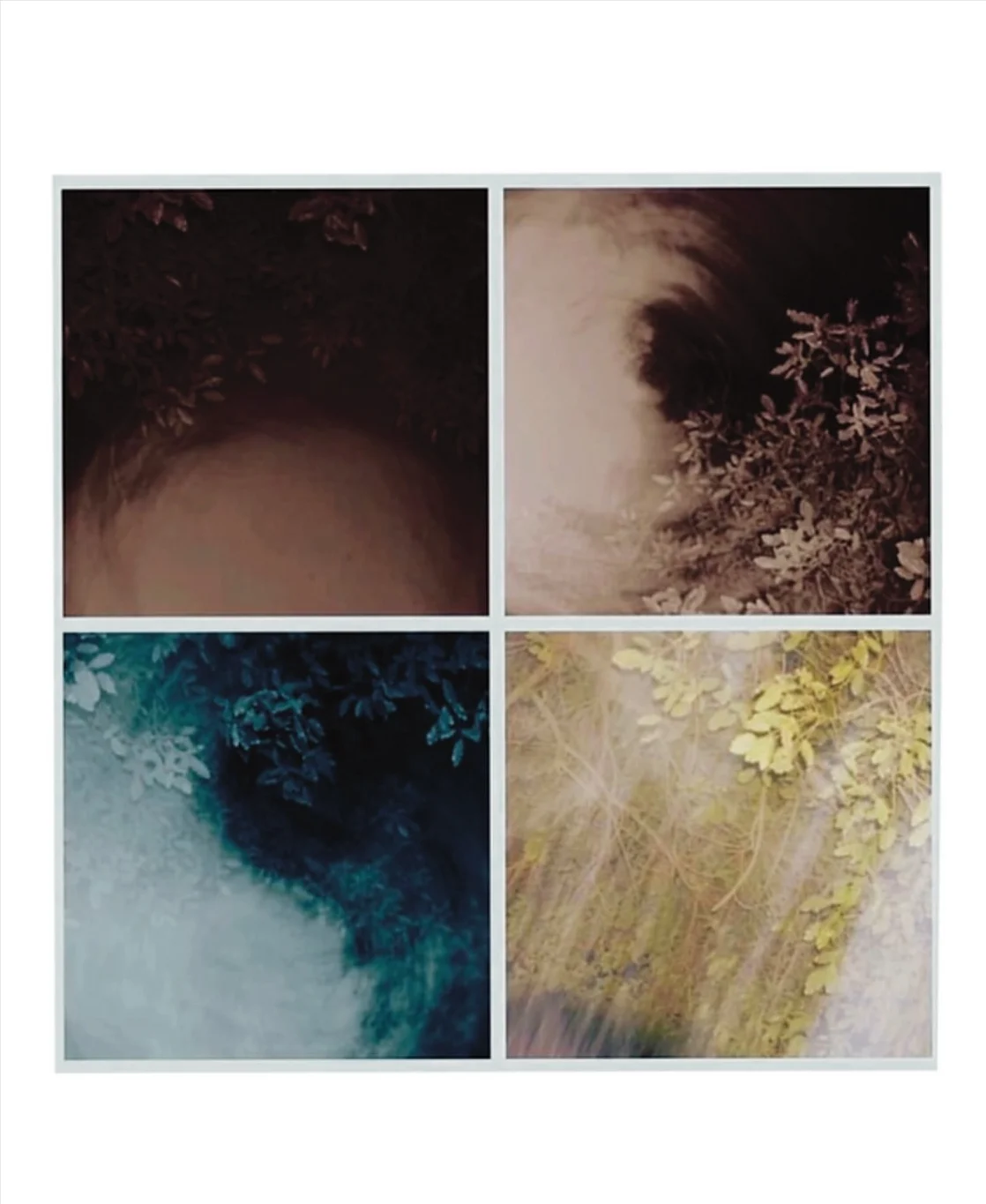
“Intentionally Left Blank (Sin Título)” reads as part memoir, part mythography, and part political echo as it explores a life lived across Chile, Korea, Russia, and the in-between spaces that have created a unique diasporic identity.
Written by Joonhee Myung, and appearing first in Culterate, the work braids the intimate with the historical: the ghosts of political systems and diasporas; the archaeology of teeth and stones carried across continents; and the language of companion species, who act as guides through grief, displacement, and fear. The writing finds its propulsion through a sensory archive of hair salons, earthquakes, cacerolazos, kimchi and marraqueta, culminating in an impossible image that captures the paradox at the heart of diasporic life: to be uprooted and still be growing.
— Raaza Jamshed for Guernica Global Spotlights
I Am Not My Hair
At dusk, a shadow dissolves into the dimness at precisely 6:58 PM. Time swells and slips, elastic and insubstantial. When night falls, the cries of tigers, wolves, and crows vibrate through mountains, fields, skies, and winds. Those who left were replaced by companion species. A lone wolf scaling the mountain, a tiger prowling the streets, a crow floating beneath moonlight. Darkness became my friend, eternal and intimate.
When my body quietly decays, forgotten by all, the wolf promises to carry me to a tree in the valleys of Inwangsan, where it will lay me down gently. I will return to the clouds, the winds, the stars. I never swung the wheel of fate, only circled endlessly, longing for those I loved. Time, infinite, finally halts with my last, quiet sigh of longing.
Dusk’s violet haze settles heavily, thick with dust. Somewhere in the sullen downpour, a fleeting rainbow reveals the silhouettes of the ones I miss. As a tree’s shadow, I embroider the path you tread, believing this binds us forever.
I wake in a room filled with the suffocating brightness of midday. 12:22 PM. A dream, a mere dream. In the mirror across from my bed, Mamita dozes under curling irons at the market salon. A local hairdresser, trusted and familiar, someone warm toward foreigners. “She’s kind, and the price is a fraction of Korean salons,” Mamita used to say. “They can’t manage Korean hair, but what can you do?” The stylist and Mamita talk with gestures, hands bridging the gaps in language. “Mi hija, my daughter,” Mamita beams through the mirror, motioning for me to greet the stylist. Groggy, I drag myself forward to kiss her cheek. “Thank you for taking care of Mamita’s hair.”
Salons have always felt foreign to me. The polished hair, tailored to perfection, seemed like a costume for other people. At home, I’d wash away their precision, letting my hair fall wild and natural. A comfort in disarray. These days, I call it “French” chic, others call it undone. I still wonder what the difference is.
On TV, floods and blackouts have swallowed a town. The stylist shakes her head in pity. Mamita, devoted to progress and diligence, grows somber over those robbed of basic rights. If beauty were a fundamental right, I’d gift Mama salon vouchers, her joy as essential as clean water and electricity.
Her freshly curled hair is too tight, too dark, too new for her. Once, short hair for women was scandalous. Cutting mine felt like rebellion, a plea for psychic relief. I failed often. My shaggy cuts and botched trims led me, desperate, to salons in university districts where fashion’s disciples gathered. “Why ruin perfectly good hair?” they’d ask. Walking into a salon meant exhaustion: resistance, persuasion, fatigue.
Now, it’s Mamita urging me. “Long hair makes you look older. Cut it, daughter.” My hair has always been a battleground. I fall back into dreams, clawing at peeling walls.
A wolf’s black eyes meet mine. A vibration shatters the silence: veins coursing, blood surging, the core of darkness pierced by radiant light. “Your blood reeks of histories: empires that devoured, nomads that wandered. Your stammering tongue, your wordlessness, are chains—ours to bear. You will live forever in this cave.” The hammer in my hand strikes, but the walls hold firm.
Asian Flâneuse
To walk unseen, to glide through streets like a ghost, that is the flâneur’s luxury. But I am no shadow here; my presence is like spilled ink on a white page, I disrupt the stillness. I am watched, weighed, measured. Fear coils at the base of my spine. What if I misstep? What if I invite danger by simply being?
Some days, though, something shatters the distance. A vendor selling mote con huesillo grins and asks, “Do you know BTS?” Her eyes sparkle when I say, “Yes, RM and Jimin.” She smiles. “J-Hope and V for me.” A small moment, a miracle, a bridge of laughter spanning the unknown.
Even so, I tread the margins, my feet pricking invisible lines, barriers that exist but cannot be seen. At 40, my strangeness still lingers, a whisper of otherness in every step. Yet, isn’t it always about fear? The fear of rejection, of exile, of never quite belonging? Or maybe, just maybe, it is about love, the kind that holds steady in the face of uncertainty.
I hope for more small incidents, small miracles that show us how we’re not so different after all. A love for Christmas, a childlike joy at the sight of snow, happiness in music, love for peace, the yearning to avoid war.
Teeth, Skeletons, and Archaeology
When a person dies, even if all that’s left are bones, those bones preserve stories. Thin, elongated bones whisper histories of migration, conquest, survival. A single fragment contains universes of possibility.
South America, with its rare minerals and ancient treasures, is a land beloved by archaeologists, anthropologists, and astronomers. My mother, a collector of stones, carefully brought them back to Korea, despite my father’s objections. In the 1980s, transporting such items from Chile to Korea, then to a small, remote town was no simple feat. She carried them across oceans by boat, packed among our belongings in heavy suitcases. I was too young and uninterested to grasp the weight of what my mother carried. The history she cherished, the memories she preserved in each stone.
Now, they are scattered, dispersed with each move. Someone else might treasure these artifacts while I dismissed them too easily. And regret lingers.
As a child, I lived in a village so small the bus came once a day, the grocery store was nothing more than a shack. I call this place my heart’s hometown. The elementary school, a single tiny building, felt vast.
One day, in a moment of carelessness, I used my baby teeth to cut the plastic tip of an ice pop. My front teeth shattered. Blood trailed all the way home. Thus began my painful entanglement with dentistry.
By the time we moved to Chile, then back to Korea, then to Russia, my teeth became records of fragmented healthcare systems. As an adult, financial independence brought its own constraints: I often skipped dental visits, relying on free clinics in emergencies.
Recently, a kind dentist told me, “Your teeth are strong, but they’re not what they used to be. Take care if you want them to last fifty more years.”
What will archaeologists say about my teeth? Worn down by sugar-laden foods, cracked from ice-chewing, uneven from years of neglect. They will study the stress fractures, note how chemical-laden civilizations affected me.
This inability to belong has shadowed my path.
Protests fill my dreams. I wake to the clatter of pots and pans—cacerolazos breaking the night’s silence, voices echoing against the walls of dictatorship. Women dance in defiance. Un Violador en Tu Camino goes viral. I want to join, to raise a spoon, a pan, but my body sinks heavier into bed.
Kimchi and Marraqueta
Childhood mornings demanded rice, soup, and kimchi, even if the kimchi was lettuce masquerading as napa cabbage. These days, with money, Korean food in Chile is no longer a fantasy, though napa cabbage remains rare and tiny. My mother complains, “Tell them to grow bigger ones next time.”
“You look so Korean,” a Korean-American friend once told me in Seoul. Yet, my childhood palate craves not just kimchi but empanadas, puré, marraqueta, and soup.
Memory tastes like these things.
A sudden sandstorm erupts, swirling the world into a single, raging vortex. What remains is only the glow of constellations—
the bed, the window frame, even the moon itself consumed into the storm’s great spiral.
The whirlwind, having devoured all the waters of the earth, drenches the land, gently releasing a single leaf to the ground.
I cling to its brittle edges, transparent, weightless, drifting through the streets. Past the asphalt veins of Seoul, across the endless plains of Mongolia, gliding over St. Petersburg’s Neva River, the towering Andes of Peru,
and at last, the solemn gaze of a Moai on Easter Island.
The vortex, the wind, the sky—it all returns me to a single fragile leaf. The leaf takes root in my body.
I become a tree.
A tree without roots.
“Intentionally Left Blank (Sin Título),” written by Joonhee Myung, and originally published in Culterate which describes itself as “a global digital art and literature publication based in Indonesia … committed to providing an inclusive platform for authors and artists worldwide regardless of age, nationality, or experience.”