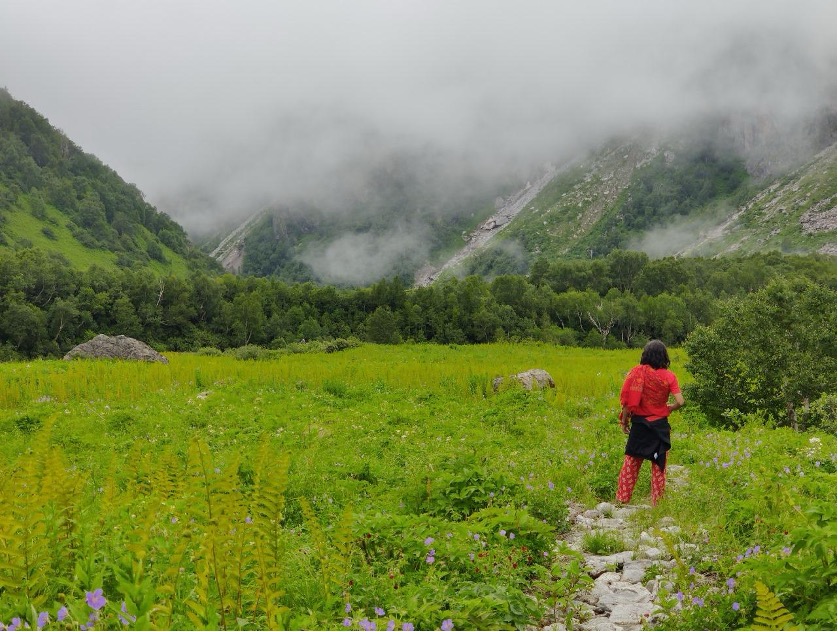
R had practiced contract shepherding as an ancestral livelihood from when he was five. His father had started at that age too, like his father. They say it was passed on for several centuries, from one generation to another. From late spring to early fall each year R lived in high-altitude meadows and pastures with the herd. He spent his entire childhood and early youth in the landscapes mostly veiled behind the soft blanket of mist, under the blue endless sky and unguarded land. The boundaries were blurred between one hill and another, between earth and sky, between land and water. He prized the company of K, his younger brother, over all else. R knew that although K’s desire to climb these high mountains alone never dulled, K loved to walk with him in the large meadows dotted with wild flowers and lie down on the grass for hours. When the rain trickled and the drops fell on their faces and necks, they would sit and wait for the sun to appear from behind the clouds and flood the meadows and mountain tops with its warmth and glow. When the rain ceased and the earth dried up, K would rise, and walk through the meadows nestled between rolling hills and deep forests. He loved the scent of lilies and tulips, followed the butterflies from one flower to another, and watched the eagles making circles into the sky.
The two brothers had unmatched sensibilities: R would get up at five o’clock in the morning and walk around without being moved by the twitter of birds, or the hum of insects. K would wake up late in the morning, touch the dewdrops sparkling on the leaves, and watch ceaselessly the horizons that separated mountains from sky. He would then chase the clouds that carried him across the streams and the fields until he arrived exhausted to meet R with tea and lunch. Often K carried his camera. R enjoyed using his brother’s camera too. His out of focus blurry landscapes with simple lighting were compelling. R imagined the landscapes rising above the ground, like a heron on slender stilts, ready to take flight and get lost in the clouds.
On several occasions, out of curiosity, K asked his brother, “Why blurry?”
R always replied, “That is how it was in historical imagination—undefined horizons fused together along the stream of time.”
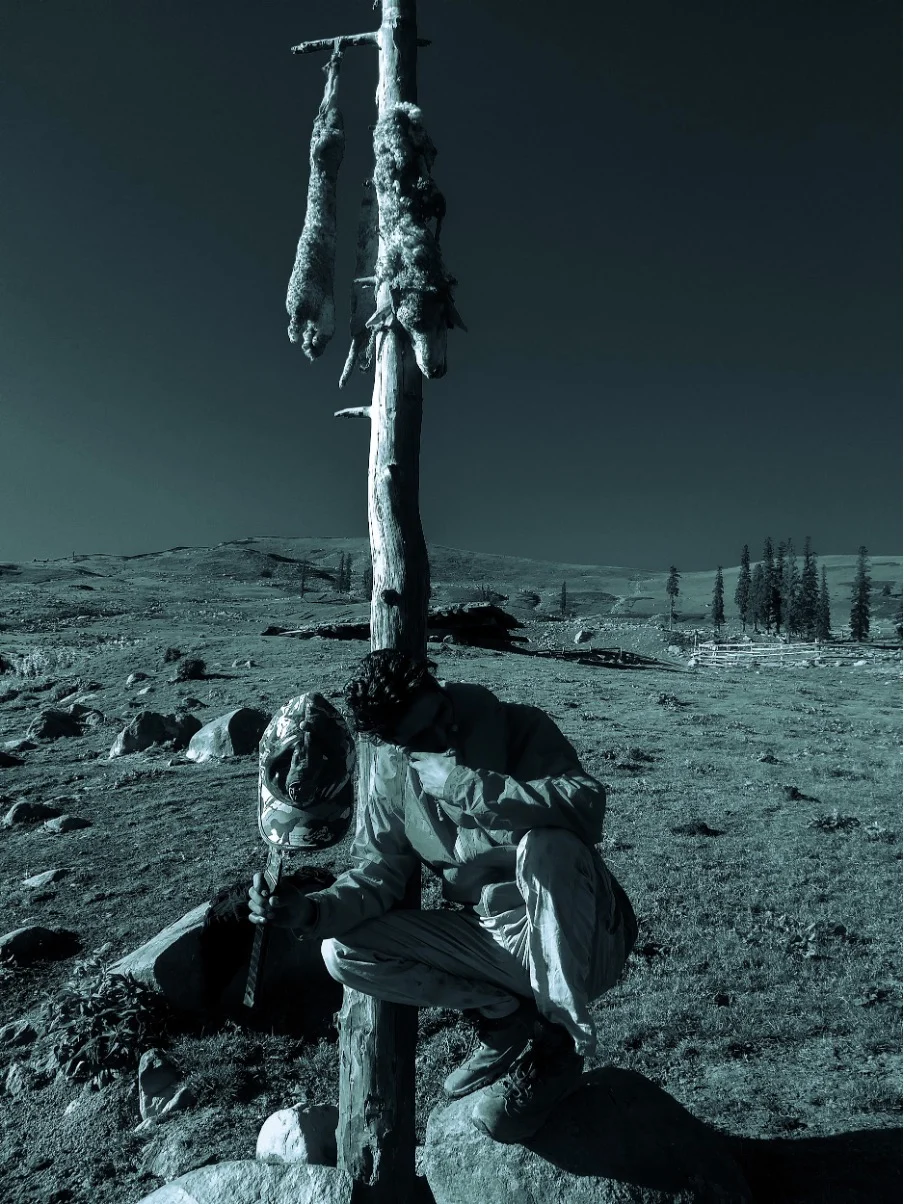
R tended nearly a hundred sheep every summer. His father would settle the contract with the village farmer and bargain the price. He was accountable if the sheep went missing. The missing sheep translated to theft, no matter how he tried to justify it. In the case of death, dead bodies were offered as evidence. A dead sheep was hung on the wooden staff dug deep in the ground. The birds foraged and fought at carcasses, making merry over carrion. The smell of the rotten flesh whirled across the meadows for days. That odour, that landscape of disgust, choked R. When the silence of the dead enveloped the dark of the night R’s heart would tremble. He suffered from vertigo whenever he watched K photographing the dead sheep, hanging by their tails and heads drooping down. Their eyes popped out, as if scrutinizing the earth curiously to examine what was erased after they vanished from the living world.
During the full moon nights, the silhouette of the dead sheep and the thousands of maggots feeding on its body camped in the labyrinth of shadows falling on the foliage. R felt the eyes of the dead follow him in his solitude, and he heard the dead whispering in his ears what was within unspoken and outside obliterated. In the daytime, when the sheep grazed, he would lift a lamb onto his shoulders and chase the butterflies until he stumbled, fell, and rolled cheerfully on the grass.
When the mountains appeared unmoving, the moonlight gleamed down white and silver upon the grass, slithering through the hanging bodies of the dead sheep. From a distance, R watched the head of the dead sheep, its mouth agape and its expression uncanny, and felt dread rise in him. K would take a closer look at their melancholic expressions that chained him to the abyss of uncertainty and reminded him of existence as unreal and imaginary in that landscape.
“The corpses are hung to clear off any doubts that they exist no more.”
“Death completes the circle and ends all the doubts.”
“Why make a spectacle of the dead though?”
“Maybe as a warning. The contemporary believers have a short-lived memory.”
“It’s irrefutable evidence that the sheep once existed, no matter how insignificant their visibility was!”
“Visibility is enigmatic.”
“Yet appearance preserves existence that nourishes the sense of continuity. Appearance is almost like a promise—it creates metaphors.”
“But what about the disappeared ones?”
“Disappearance ends all possibilities of narrating stories.”
Once a lamb went missing in the mountains. R turned pale. He was filled with horror. He knew the lamb had disappeared. The sun was hanging on the horns of the cliff, about to settle down. He told K. They both paused for a while, looked everywhere and decided to leave at once. R knew the track to the big mountain, draped with dry flower petals, lured the sheep. He beckoned K to follow the sloppy direction. R dwelled on his memories. The fallen flower petals had faded away. It was painful for R to tread along the way. He remembered how his beloved used to create ephemeral and seductive patterns from the dried flower petals in her love letters. Now here he walked past the memory and remembered how she vanished from his life without a word. Grief descended upon R. His eyes welled up with tears. The split images of the flowers, the grass, and the shadows of pine trees appeared as apparitions. As they began climbing higher, the ground beneath them turned into rocks. The slope sucked in the moonlight. K noticed how their footsteps had altered the muted beauty of the meadow covered with large swathes of daisies. R was growing impatient and irritable with the turmoil of his disillusionment. As the brothers arrived at the end of the mountain, the drops of night rain transformed into icicles that hit their faces hard, melting down their necks. Fading into silence, there was something ominous in the darkness around them. Suddenly, a fierce thunder followed by a flash of lightning unsettled the stillness.
“K, don’t you think that the beasts are roaring their resentment?”
“I asked you last time what the worst they can get by with is?”
“I have witnessed so many disappear,” said R.
“How agonizing it must be for the witness to live with the memory that envisages only necessary absence!”
The relentless rain began hammering the mountain slope. Streams of water and mud rolling down the hill swallowed the track. The air became heavier with the smell of decaying leaves and moss. It clung to their bodies and clothes.
“Do you remember how they disappear?” asked K.
“I imagine that over the years I have protested less. I loathe all my memories and I rarely come this way.”
“The dead may turn into ghosts and wander, but what happens to the disappeared?”
“It used to be a beautiful threshold on the track where we used to walk past. I remember vividly how the horizons would expand as the flowers, the grasslands, and the trees would be engulfed by the steeper cliffs. During the night the fireflies lit the path and there would be no nocturnal sound of footsteps.”
“Eventually the men in boots started appearing, and they knew we had no protectors.”
K was pulled in by the spell of the mountains. An emptiness came over him. He asked R, “Shall we come back tomorrow?”
“We would have to start all over from the beginning and take a different way.”
“I know the story of the disappeared.”
“Do you know the geography?”
“Should we try going backwards?”
“I remember how we crawled and soared high in those mountains! My memory through those steep edges guards my nostalgia.”
“There was an unfinished cliff that overlooked the valleys. Slowly it shifted itself elsewhere. It was a time when one could still embrace the reason to exist in between the lines.”
“It is evident now. We own nothing, not even a flock of sheep.”
There was a long lull. Lavender wafted as the ashen fog floated. Everything disappeared. R and K made their way back.
The sun was up. After walking for a couple of hours both brothers stopped for a rest in the open land, whose vastness added a sense of freedom for R and boredom for K. They were tired. K ran his fingers through his long hair, now drenched in sweat. He opened the knot of the cloth around his waist and tied it on his forehead. ‘If only you trusted me with my skill with a haircut…’ K laughed out loud before R could complete his sentence. They ate lunch and fell fast asleep. K remembered walking up the mountain while his eyelids drooped and he was climbing with an iron clock hanging by the rusted chain around his neck. He heard R calling him from behind. As K was about to turn back, he slipped into the honeycomb. The earth began disappearing underneath his feet. The threads of rain were let loose. The green border began disintegrating as the moths began slipping from the leaves. An invisible landscape buried in water appeared and began rising upward, slowly, glistening in the sunlight. The hanging cascades spun a cage around K. He took the death ride on the back of a dragonfly that veered upward. With no time to flutter again, it fell off the cliff. K coiled along the tattered rope threaded by the broken time. He was held in the grip of the scream. The white mist submerged the hill, bundled it up, and in a moment the haze trapped K. He became invisible and ubiquitous. Streams of silence descended from the mountains. K lay naked, gliding over the dead bodies. Echoes were chasing him away. A stranger bent over K was examining his face in precise detail until their foreheads touched.
K then opened his eyes without moving. His heart was racing. The stranger’s wide eyes were digging into his face. As the stranger pulled away, K saw himself rising alive from the deathbed. He became aware of his hands touching the grass, and nudged R who was still fast asleep. Both stood to their feet in no time. Both had to play their roles. R was caught between falling and holding on his feet. K stood firm. The young army colonel was standing alone, confident. The joyful expression he wore on his face while touring in the mountains revealed that he was a fresh recruit. R could not place him, for he was familiar with confrontations, stand-offs, and heated arguments with these men in uniform. However, something unfamiliar about this young colonel was his curiosity to engage in conversation. The colonel was new to the mountains and did not yet know which line separated one mountain from another.
“Where is this?”
R felt the urge to laugh, but the fear rising up inside stopped him. “Mountains are a place of indivisible existence: imaginary, real, connected, distinct, scattered, invisible, intersecting…”
“The landscape that is visible here is completely different from the landscape that I had imagined.”
“In that sense, nothing said of landscapes is true.”
“Your vocabulary is inflected with proverbial clichés.”
“We are paying the price of surviving.”
“Have you ever thought of doing something else? How obsolete to die for a landscape that doesn’t exist yet.”
And in a hurried move, the captain turned to K.
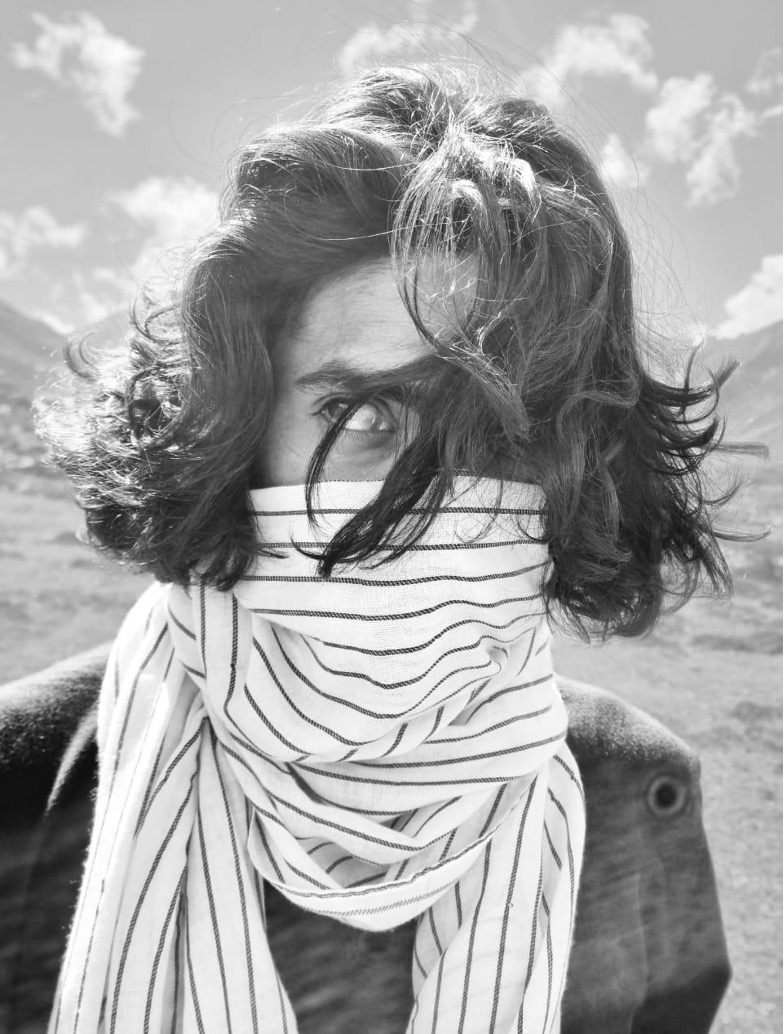
“So, young man…Let’s see what you are hiding behind those tresses…Your calmness shows you possess imagination.”
K’s mind was blank. His eyes narrowed, and as he looked down on his chest, he became aware of the graffiti on his t-shirt. He rested his left hand near his heart and drew a long breath. The colonel didn’t take his eyes from the graffiti.
“don’t you recognize the irony in these symbols of revolution—turning into the vicious cycle of what it stands against?”
“This is an oversimplified perception,” K said.
“How do you understand these symbols and the song of revolution?”
“It is what defines our existence.”
“Illusions do not define perceptions of reality. Icons manipulate playfully.”
“It is the trade of being in love…witness to the ephemeral and the fragile patterns of life. Without it, we would not be!”
“Ah! The poster boy of revolution is a lovable rogue! It persistently misrepresents your problems. Their dream was seductive. Your struggle is paranoia.”
“Our struggle is best defined by our ability to live with political uncertainty. Some struggles become a way of life only with the passage of time.”
“Sartorial politics do not create nations.”
“There is a rarer privilege to exist in lightness. Imagine a landscape hanging in between the mountains over the void, bound to the crests with the spider web.”
“Is this spider net the foundation of your imagination?”
“There are two: one I can only speak of, and another that exists in the lack.”
“And how long will the net last?”
“There are numerous horizons.”
“Where do you belong?”
“I am a trapeze artist.”
“Do you think a guerrilla can become immortal?”
“A guerrilla scripts his mortality.”
The colonel laughed, and put both his hands on K’s shoulders. “Boy I think you need a haircut. And after that, you may claim your camera.”
The colonel tucked a lock of hair behind K’s ear, picked up the camera and walked away.
K stomped his foot on the ground where the colonel had been standing. R turned around and rolled his shoulders. He clasped his hands behind his back and shifted from one foot to the other. Clueless, he thrust his fists in the air.
Early fall, the sun made its way between the tiny branches surreptitiously. The shadows of the leaves encased R who was standing in the middle of the room. It was ten o’clock in the morning. The shop he recently set up was already open. He started clearing up, though there was really nothing to be cleared away. He picked up a rag and started scraping the rust from the windowsills.
R had rented an old space at the edge of the village. The shop was small but clean and affordable. The walls finished with mud plaster had a soft feel. R had worked the walls in deep browns and hay yellow, which gave the room an earthy fragrance and tone. The ends of straw jutting out created an uneven texture that R was trying hard to get rid of. The floor—
a series of stones chipped at the corners and sunken in the middle, uneven and scabrous—
gave an illusion of mountain meadow. The wood ceiling supported by the pine beams was covered with lightweight, translucent rice paper covering up the cracks. A hollowed-out rusted lampshade hung from the ceiling with a withering metal string in the middle of the room. It shielded the dim light from spreading out or from lighting the dark corners of the room. Between the two stained, broken windows, there was a creaking, rickety wooden door, off its hinges. A frayed piece of rope looped through a broken handle was tied tight to a nail hammered into the warped doorframe. The dark wood from the outside splintered and crumbled. The stone steps to the door were green and slippery. Inside the shop, the large looking-glass hanging on the wall stood right in front of the door. Anyone who entered the shop was greeted by their own reflection.
As the sunlight entered the shop through cracks and holes, the place was flooded with numerous patterns. K was seated on a wooden chair, with adjustable head support, intensely examining the long-awaited haircut. R had almost finished snipping with the scissors. He was happy to have inaugurated his new shop and career. He was trying hard to cheer up K. ‘I shall shave you clean to the skin.’
K got up from the chair. He loosened the white cloth from his neck, turned around and stood in the middle of the room with the large mirror behind him. The room in the mirror swirled like ripples on a pond – shifting proportions in all directions. Forms swayed from one side to another in a slow dance. The faces elongated, cheeks bulged, eyes blinking slowly, lips melting downward deepened the grieving process and sharpened the grotesque conditions of existence. Under the mirror, the clean wooden shelf covered with combs, scissors, razors, a box of wax, powder puff, a bottle of perfume diluted with water, and a towel hanging from a nail breathed faintly like drifting thoughts. On the left, a wooden bench, fixed for the customers to sit, waiting for their turn, was carrying the weight of emptiness on its curved legs. The soft sunlight filtering through the cracks in the windows made circles on the floor reflected in the mirror, hanging from above by invisible threads.
The room was drowned in light as the door flung open. The colonel stepped in. A slight tilt of his head set the lampshade into oscillation. R was standing slightly to the right side, yet looking into the mirror. As he stretched out his arm it was drawn into a long, thin branch, struggling to reach the door. The light now entered from the open door that washed the shop in a trembling glow. The shop lost its fixity. The colonel’s gaze in the mirror met an improbable symmetry. His body, hunched forward, appeared to have been carved from a cracked marble. The buttons on his uniform dripped like droplets of mercury. His eyes were flickering in soft chaos. Everything lay beyond his grasp, furthering his sense of detachment. The shadows were floating in the mirror. K stood still in a timeless warp.