The Wild Bird Fund is nestled in the 80s on the west side of Central Park. It is cramped, chaotic, and coops up its volunteers—some disillusioned, many bright-eyed—who are eager to tend to their injured avian neighbors. Notes of public pools, Brighton Beach, and the various fluids that frequent subway platforms waft through the air. Each shift begins with the thud-thud of feet down the stairs to the basement, where we play housekeeper to pigeons: visiting each kettle, replenishing grain and water, swapping out soiled, floor-lining headlines for fresh bad news they can shit on for posterity’s sake. Birds have always been smarter than us—symbols of liberation, teaching us for centuries that we can do better. Defiling updates on deportations and other forms of abject government cruelty, they teach us still.
The pigeons live in rows of “hotel rooms,” stacked floor to ceiling, purring and cooing their days away in captivity, interrupted only by a few indulgent hours of free-range wandering and pampering. We roll them up in towels like burritos to administer DMSA to bring down their lead count, and dress their wounds with gauze and manuka honey. Those further along in recovery get physical therapy—wing extensions, bicycle kicks, and “fly practice”—before eventually returning to their metal-walled suites. I say “eventually” because pigeons are clever. They will taunt volunteers, deploy decoys, and exhaust our every instinct before letting us win.
Upstairs at the facility, there’s an even bigger circus. Ducks and loons splat-splat across their fiefdom, splashing water on us during swim practice in a bathtub that takes up a fifth of the floor. In the back corner is our break area: one round table, just big enough to hold a single cup and bowl. There, I drink my boba, eat my dumplings for dinner, and kick it with the swans resting near my feet—bobbing for greens and cereal in their bowl, pressing into the ground with technicolor bandaged feet that give the Happy Feet Sock Company a run for its money. Occasionally, a quail might escape from its cage and rocket past me, as if it needed to be somewhere urgently. Entirely unbothered, these feathered menaces run the show at the aptly-named Wild Bird Fund. It’s kind of like the scene from Snow White where the birds sing sweetly and make themselves useful, only in this iteration Snow White drops a whole lot of acid and tends to them instead.
I love birds, man. I love birds so much that my hardwired fear of rodents is eclipsed by my love for them. Now, that’s deep, faithful, and abiding love—because rodents have snouts and tails that make me want to freeze mid-jump until they’ve scurried several zip codes away. You may wonder how I came to this realization. I’ll tell you. One time, a barred owl came into the Wild Bird Fund with head trauma. I was tasked with feeding the poor guy. So, I cut up three baby mice, thinking the entire time, “Hantavirus, hantavirus; dear God, not me in close proximity to hantavirus!” Blame my father for my neuroses. He’s a microbiologist. And I? I hang on every word (although, for the record, I’ve never once worried about influenza while tending to waterfowl, despite being told by him that they’re major carriers). I listened to the bones crack as I clamped the scissors down through their listless murine bodies. I wiggled the blades back and forth until they ripped through flesh and fur, pieces finally falling into a bowl where I mixed them with vitamins and gabapentin. Ordinarily, I would’ve died on sight. But it was for the birds. And so I lived, so I could feed them.
I love birds more than I hate my least favorite chore. In that basement of loud patrons, I spend hours washing bowls for songbirds, pigeons, and waterbirds—small, medium, and large, always in that order. During this task—a task I end my shifts with—pigeons flutter my way, wings sounding like Windexed rags on windows. They land on my head and cock and bob while I, their dutiful subordinate, complete a task I shamelessly avoid in my own home.
Before Rita McMahon founded the Wild Bird Fund, there was a point where she housed sixty concussed and wounded birds in her apartment. Love can make you do almost anything.
I love birds because otherwise, I wouldn’t know what else to do with myself. Birds are utterly astounding and totally ridiculous, all at once. Like this one time in Prospect Park, when I saw a squirrel run up on a red-tailed hawk perched in a tree. The hawk panicked, flapping its wings, fighting for its life to maintain balance. I looked at it genuinely concerned, like: Sir, did you forget that you’re a hawk?! That same day, over by the feeders, a blue jay decided to cosplay as a red-tailed hawk. It let out one scream, and the warblers and chickadees dropped their food and bailed in terror. The jay surveyed the now-deserted feeding station, landed on the tallest feeder, did a smug little du-du-du, and bounced. I don’t think it even wanted food, just the sweet thrill of disruption. Like a petty tyrant in blue—a chaos muppet, through and through.
I love birds more than I love method-acting the stompy New Yorker. When I’m out weaving through a barrage of tourists in the glass, concrete, and steel of Manhattan, muttering impatiently under my breath, I might spot a song sparrow—0.06 pounds, three inches tall—hopping, twitching, and clanking out a song hundreds of feet big. Then I stop in my tracks. And I become the very imposition I was hating on, people shoving past me as I shout back to the sparrow, “Ya, I love you! You are my whole heart. You know that?” in the same high-pitched chirp.
I love birds the way zealots preaching in the streets love the gospel. I tell fellow Muslims that we learned how to ritualize grief when God sent a crow to show a haunted, bloody-handed, and bereaved Cain how to bury his brother, by scratching at the earth beside him before he knew he was worthy of redemption. Later, when a tyrannical king threw Prophet Abraham into a fiery pit, a little bird zipped over in a frenzy, spilling drops of water from her beak to try to put it out—teaching us that we must do our best to love and protect one another.
I make everything about birds the way people who really love Jesus make everything about liberation theology. I tell people that greater anis live in communes, building and laying eggs in one big, shared nest. No one knows whose baby is whose, and it seems like no one really cares. When the eggs hatch, it’s all hands on deck. If there was a word for reverse-anthropomorphism, I wish Congress could embody it—in the spirit of the greater anis. Because a nation that won’t fund pre- and post-natal care at home but will bankroll the bombing of Palestinian, Lebanese, and Iranian maternity wards, schools, and homes abroad has a long way to go in loving humanity.
Birds steadied the hearts of my favorite writers in times of deep deprivation. James Baldwin, living in exile, found solace in them. In “Munich, Winter 1973,” he calls to a lover and makes a bid for connection as he watches birds circling—birds that “have wings and voices / are making choices,” and birds that “are aware / that, on long journeys, / each bears the other, / whirring, / stirring / love occurring / in the middle of the terrifying air.” Toni Morrison, living in a boathouse along the Hudson, loved it best when birds visited her. The journalist Sandra Guzmán, who spent time with her, wrote that birds became a “spiritual wonder” and “darling beings—friends, even” to her—proof that when you watch a beloved love something beside you long enough, their eyes become your eyes. Many people don’t know this, but even bell hooks, best known for her incisive, scathing takedowns of intersecting -isms, wrote ten poems about birds in Appalachian Elegy. All of them are about the great lessons these “small yet mighty” creatures teach us.
And if I were to stop hiding behind trivia, I would tell you that I love birds because they saved me too. On one of the hottest days of the pandemic in 2020, I spent a couple of hours walking the misty marshes of Jamaica Bay Wildlife Refuge, immersed in birdsong. Then I came home and slept for three days, waking only for a few hours, my mind awash with fog. Drifting in and out of consciousness, my vision blurry, I stumbled through the hallways of my apartment, my hands and shoulders hitting the walls to keep me from falling, drank cups of coffee to no avail. That spell of severe sun fatigue—a hallmark symptom of lupus—finally led to my getting a diagnosis after years of bouncing around from specialist to specialist, trying to piece together what was wrong with me. But I got worse before I got better. Bedridden, I waited months for the Plaquenil to build up in my body so I could get my life back. From the corner of my room, lonely and afraid, I watched birds perch on the branches that brushed my window. Sometimes, they featured as shadows on the drawn curtains that shielded me from the sun. Days passed like that. I listened and watched as their silhouettes shifted throughout the day—mourning doves, blue jays, and cardinals quieting my heart.
When I regained mobility, I immediately applied to volunteer at the Wild Bird Fund. My father campaigned against it, fretting that I might catch Covid from the enclosed air. He painted the birds as villains that would give me a host of infections to my great peril. But I was eager to make up for lost time, for all the experiences I could’ve had, had I never fallen sick. My mom, a psychiatrist, agreed with me, talking all heart as she sometimes does, saying how nice it would be for me to heal another living being after my loved ones and medical team had worked so hard to heal me.
Have you ever felt adamant about doing something in the moment, only to be struck by an understanding of why, much later? A couple of years after I began volunteering, I realized I was hell-bent on healing birds because they, too, had healed me, in more ways than one. My lupus flares are stress-induced, and hummingbirds gave me the antidote when a friend gifted me a small book about them, when I lost most of my mobility. They are known for being the zippiest, zaniest birds—did you know they spend half their lives resting? Small but mighty, they’ve even been known to step to hawks. Imagine. They are also relentless chasers, drinking half their weight in nectar daily, and rejecting any flower that doesn’t sustain them. During the moments of my illness when I just about felt like giving up, the hummingbirds nursed me back to health by example. They taught me to be relentless in my pursuit of sweetness, wherever it might be hiding.
Birds are sage, y’all. While we’ve bumbled around on the ground for ages, they’ve ditched organs like bladders (frivolous, if you ask me) to propel themselves beyond the reach of all the things that hold us back from our dreams. That’s probably why we turn them into emblems for our most cherished ideals. And we could stand to be more like them, too. When winds flurry with great force birds have a way of giving in to them instead of fighting them. This act of relinquishing control lets them gain total freedom of the skies, to get to where they need to go. This paradoxical wisdom—that letting go can liberate us, if only we let it—is a perspective I hope to spend the rest of my life learning from.
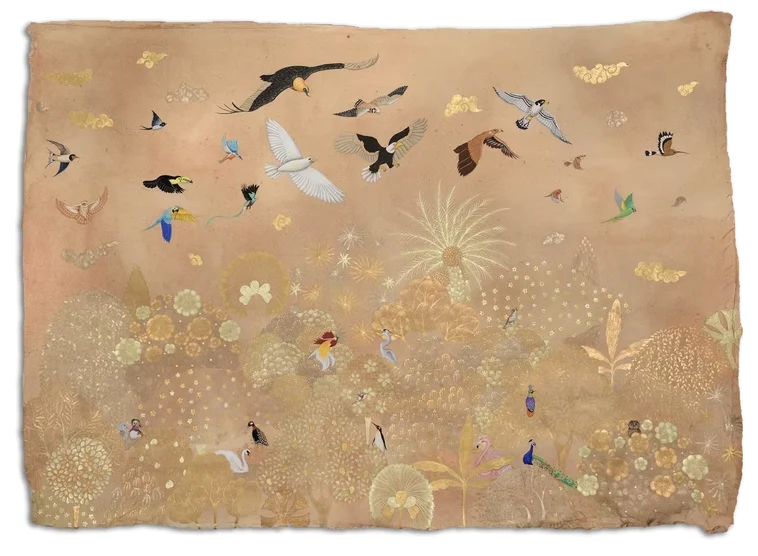
In my mid-thirties, standing at the precipice of what feels like the halfway mark of my life, I feel more palpably than ever before that time is slipping away. My loved ones are changing. My parents, though dogged in their belief that they can do everything themselves, aren’t as invincible as they once were. And I’m not either. But loving birds has been a grounding practice, a reminder that some things do prevail. Ever since I became the weird bird nerd who evangelizes about them loudly, weaving them into conversations of depth and levity, my loved ones have been loving me back through them, too. My parents wrapped me in a Kashmiri shawl that was hand-embroidered over years with nightingales, peacocks, and cranes; they said it was my fortieth birthday present, given early because they can’t keep secrets, and it’s too nice for an upcoming non-milestone birthday. My best friend got me a soap dispenser shaped like a pigeon that poops suds to commemorate my decade as a New Yorker. Loved ones send me photos of hoopoes, macaws, and flycatchers from their travels, letting me tag along from afar.
Squawking, chirping, lilting their way through the history of humankind and into the contemporary world, birds spill across the sky in swoops and sweeps, and somehow manage to still my heart. Birds are my way out of isolation. Their noise yanks me out of the closed, spinning loop of my mind’s nervous imagination and back into the world around me, reminding me that I’m not the only one stumbling through the day. There are other small, frazzled creatures just like me, trying to survive in the same unthinkably vast cosmos. Once I’m out of my head, the world feels less like a private catastrophe and more like a brimming, ongoing joke I get to be in on. I exist among other lives I’m meant to notice and commune with, the way birds do.
It’ll never cease to amaze me that the same beings who walk this earth beside us can lift into the heavens and know the secrets under the sea, teleporting through and between realms only to find their way back to us again. So, while we still have time on our side—fleeting as it may be—let’s love birds, love them madly, take that love as instruction, and extend it to loving one another, too.