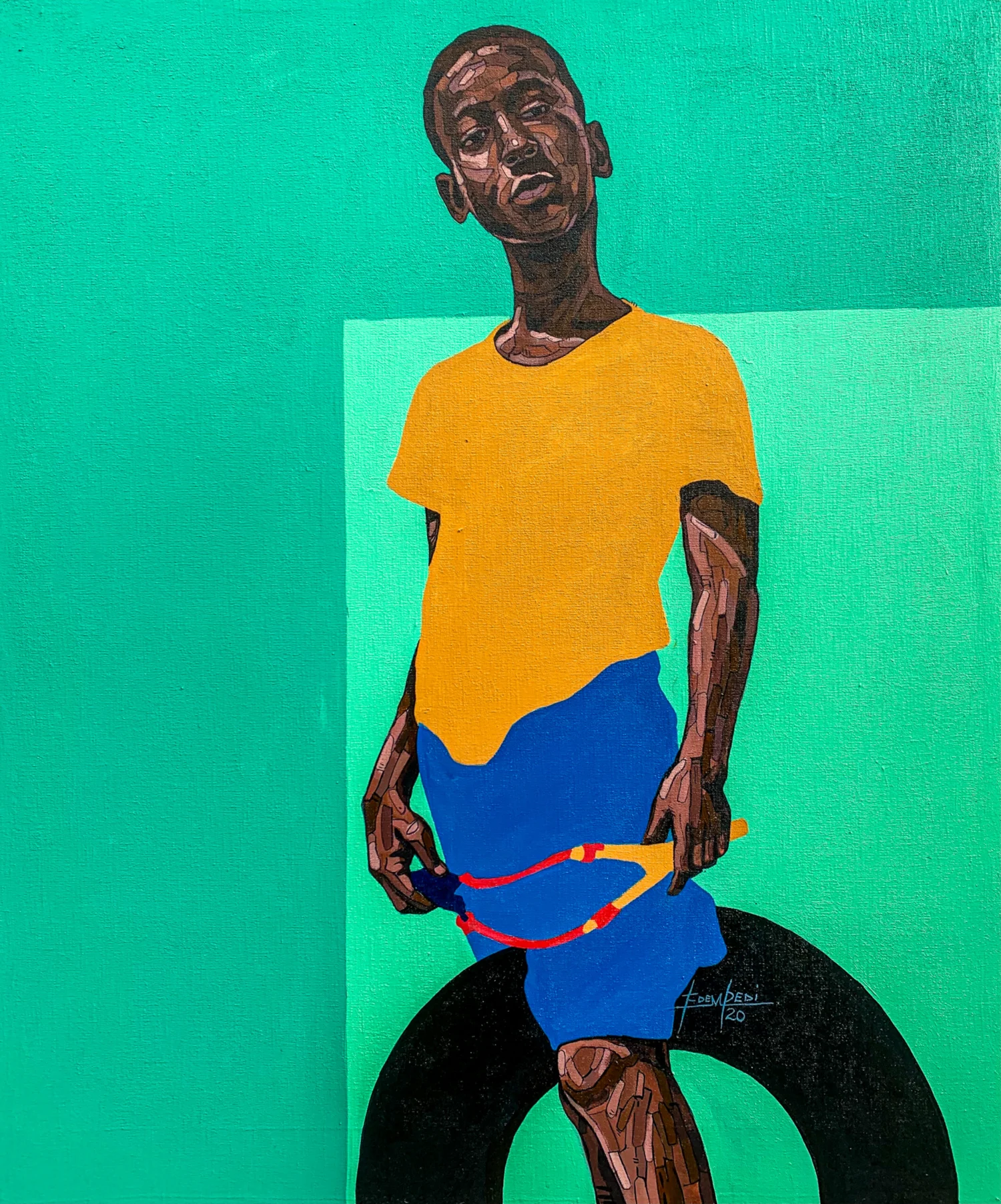
Who loves God fears no evil, our mothers say.
What we mostly did on Saturday evening was play games: hide-and-seek, football, King-and-servants, God-and-devil. Sometimes we would hunt lizards and birds, or push our tires around the village laughing and screaming, or climb the guava tree and move on the branches like the grandbabies of monkeys, or drive the pickup that my father abandoned – our playhouse – and pretend it was moving, and running past every car on the highway. But this Saturday, we didn’t want to do our regular things. We wanted to act out an American movie and shoot and shoot and shoot and shoot. We wanted to burn down the world like American actors. We wanted to shoot guns that had tender and dangerous sounds like the guns of the American actors. We wanted to scream, “fuck you, fuck you, fuck you, fuck you.” We wanted to be fearless and crazy like American actors, we wanted to waste humans so that their blood would splash on our bodies like rain.
After throwing cooked rice and beans to our eight lizards, through the little holes we carved on top of their house, an Oxford Cabin biscuit carton, we chose our roles.
“Ebube! I will be the one to kill everyone,” Dumdum said.
“You won’t kill me,” I said. “You will kill all my men.”
“But we can’t have two last men standing.”
“I don’t care. You will not kill me.”
“We – have – two – last – in…”
“Nnaa don’t talk. Ebube, if you don’t want to act in this movie, say it now.”
“Did you forget that this game was my idea?”
“If it was your idea, so what? It doesn’t matter.”
“It matters. Why didn’t you think of it first?”
“You are selfish. Do you know how many games we have played that were my ideas?”
“I won’t argue with you. You won’t kill me.”
“What about – about – me?”
“Nnaa, you will be . . . you and Otubolo will be the ones to watch us. We can’t have three gangs. That is why I want to kill Ebube and his men and be the last man standing.”
“Did you see the shape of your mouth just now? You can even kill everyone in this world, but you will not kill me.”
Nnaa laughed.
“Let’s do it this way – we will just fight like the Americans and set the whole country on fire.”
“Better. Let us set the country on fire.”
“I – I want – want – to see the – the country – the whole country – burn,” Nnaa said and demonstrated with his hands as if to show us his love for the bloody movie we wanted to act out, because he must have thought that his stammer made it look like he was lying, or didn’t believe in our acting and actions.
“Otubolo will be very happy to see the country burn down,” Dumdum said.
When Otubolo was alive, he loved all the games we played: police-and-thief, hide-and-seek, spirits-and-angels, football, God would blow his fat trumpet and I would still be counting. He would enjoy watching us act out an American movie because dead people didn’t watch films in hellfire, heaven, or purgatory. Hellfire was where God roasted the people who did not remember to keep all his commandments. Heaven was where the chosen ones danced and worshiped Him. Purgatory was for people with small sins. We heard after God sent people there, he would give them razors to cut down giant-giant trees. We heard he would watch his creatures suffer-suffer and say to them “I warned you, but did you listen? No.” People in these places didn’t have time to be watching anything called a film because they were surviving the torment of the afterlife. Otubolo would laugh today when he saw our actions and shootings.
We picked up our catapults on the dashboard. Since my father gave up on the pickup, whenever we played in the pickup, jumping or screaming or dancing or shooting, what I saw on the dashboard was not our catapults. I didn’t even reimagine the photos of the frowning terrorists and their red eyes, in front of the newspaper that decayed with the shits of chickens, whose guns were long and fat and alluring like the guns of American actors. My eyes kept showing me the things in my mind: the newspapers and files and diaries my father would spend most of his mornings arranging on the dashboard, so that they looked like wrappers stacked on top of each other.
The mad chickens that slept in our playhouse shit on the rubbers of catapults. Tiny maggots swam in the shit, celebrating life and the privilege to exist in shit. We wiped the smelling shit under the rust seats of our pickup, wore them around our necks, climbed out through the driver’s window one after the other, held the back of our shirts, turned the key of our imaginary Mercedes, and started running to Nwanganga’s shop where we would carry one of the many dead televisions for the movie we wanted to act out. We would act out our movie behind the TV, and Nnaa and Otubolo would watch us and pretend that we were on the TV. They would scream and laugh when we shot each other. We increased the gear of our Mercedes to 4, vummmmmmming and mmmmmmmmming with our mouths and throats.
We drove past family houses where rituals never evolved: fathers praying with kola nuts, men listening to the news, shaking their heads, waiting for the radio to start making shhhhhhh noises so that they could argue about the headline or call our president “a goat” again, mothers holding the lower jaws of their babies, scooping and shoving the pap they made without sugar into their mouths, women fanning or kneeling to blow the fire in the makeshift stoves their husbands built for them, children submerging their feet in wet sand to build houses that would have the shapes of their small feet, dogs moving around siblings eating garri and ogbono soup hoping one of them would throw a bone of fish so they could dive the bone, grandmothers singing for their stubborn grandchildren and designing their faces and buttocks with Dusting Powder, grandfathers retelling stories about the war and their youths that they had told multiple-multiple times, men smoking weed and whispering to the wind and smiling-smiling like they would never cry for death in this lifetime, and naked children pouring sand on their heads and shouting and jumping. Their fat navels shook like they would drop and burst like eggs.
Wooden kiosks stood in front of a few houses. Their shapeless outlines floated on the road like the sketches of branches and birds when they fidgeted in Ogbunnaga River. Sachet Cowbell, sachet Milo, OMO, and gin hung on the ropes nailed to the edges of the windows facing earth, supported by the beams resting on the windowsills. Tired lanterns, looking hungry and thirsty without fire and smoke, hung from the wires descending through the jagarajagara tarpaulin ceilings. Three kiosks were almost empty. They had only boxes of pencils, sharpeners, blue biros, packets of exercise books, drawing books, clear plastics containing boiled groundnut, bitter kola, and kola nut. In Mama Bongo’s kiosk, there was a dark human shape stretching over the boxes of pencils and packets of exercise books. The dark thing was the silhouette of Mama Bongo who was lying down on the carpeted floor of the kiosk. She was pregnant. She was always pregnant. Mama Bongo was always sleeping in her kiosk. She would sleep, wake up, sleep, wake up, sleep, wake up, as if sleep belonged to only her. The way she slept all the time, and didn’t enjoy life, made me angry. We pushed our gears to five. The wind started blowing trumpets in our ears.
Three bald men, including Otubolo’s father, were sitting on the rubber chairs in front of Kurency Bar, laughing and teasing themselves. Glasses of thick palm wine assembled on the small wooden table in front of them, vomiting white foam. About five flies moved around the glasses singing. Behind the men, bushmeat was smoking on an iron net over a steel drum signed AWA GOD PAS MAN with red paint. The oil dripping from the bushmeat and flooding the embers in the drum was making a sizzling noise like the sound of rain in tree branches. If Otubolo’s father knew we were on our way to carry a TV at Nwanganga’s shop for the American movie we wanted to act out for his son, buried in the desert, he would shake hands with those men and follow us.
London, Mama Tomtom’s hungry thin dog, wandering in front of their house, barked at us. Dumdum yelled at the useless dog. We laughed. The dog continued to bark at us as if an ant was hanging on his throat. We laughed at the way his lungs deflated and inflated when he barked and entered gear six. The stupid animal continued screaming like he had become mad all of a sudden.
We overtook a few mothers returning from burials, traditional marriages, weddings, farms, markets, and ministries. Ogene, Chibobo, and Chinchin, pursuing each other like rats because of their rubbish police-and-thief game, wouldn’t stop laughing. Our tears blurred the movement of goats, plantain trees, laughter, kiosks, and motorcycles, so that it seemed like they started melting.
Our Mercedes jerked and jerked and jerked and jerked in front of Nwanganga’s shop. We rested our hands on our knees and opened our mouths before we fainted. The entrance area was piled with different brands of televisions that Nwanganga wasn’t able to repair, televisions he had declared dead. The evening sun glittered on the screens so that it looked like the televisions would display beautiful actors anytime soon. The board marketing, NWANGANGA TV WULD, with its rope tied around one of the beams supporting the tarpaulin over the entrance, danced in the wind. A gigantic TV occupied the table on the veranda. There was a board in front of the table with the writing, 4 SELL, written with charcoal instead of white chalk.
Littered inside were people’s TVs Nwanganga would declare dead soon. If there was light, Nwanganga would turn on some of those TVs, and the people in them or whatever they displayed would dance like water, blurry, making a shhhhhhhh noise. Nwanganga was resting his bald head on the wooden table crowded with different shapes of screwdrivers and bolts and things from the televisions he had scattered. Maybe he was sleeping or dead or praying; he was probably praying because he loved God more than his only son, Jesus Christ. The walls advertised different posters of Jesus: when Jesus was crying and dying on the cross, when he was eating bread and enjoying wine, when he was walking on water without shoes, when he was flying to heaven without wings, when he was bleeding from his belly, when he was blessing fishes and bread for a hungry village. It was as if Jesus was the one helping Nwanganga to repair the televisions he dismantled, or as if Jesus was his apprentice or whatever.
The mango tree opposite Nwanganga’s shop gave half shade to his shop. Behind the shop, coconut trees, guava trees, mango trees, and ukwa trees rose from different compounds. If this was harmattan season, when most mornings bled mist, the mist would swallow the branches of those trees so they seemed connected to the sky. Children were screaming and crying in the houses surrounded by the trees, while the mothers in the compounds discussed the coming farming season and price of manure.
Nwanganga’s shop wasn’t in the center or front of the village where most shops were. It was on a lonely road in the village. There was a container opposite his shop, a chemist. On the left door of the black container, PAPA EJIMA KLINIK, was nonsensely written with faint blue paint. Papa Ejima usually opened his chemist shop at 8:00 pm. He would be at Last Card Bar now, drinking palm wine, rubbing his fat belly, laughing like a toothless baby. A tall cashew tree stood opposite the container, giving shade to the container brewing heat. After the cashew tree, different sizes of fences built with bamboo and ogilisi trees lined up chaotically. No shops. No kiosks. No saloons. No bars. No dogs and goats. Nothin-nothing. It meant that the talkative women who knew our mothers wouldn’t see us and report us to our mothers that we came to Nwanganga’s to carry a TV. Our mothers and their friends didn’t like seeing us do things that would make us happy the way their love for Jesus made them dance every time. They were overprotective like the mothers of chicks. They always wanted us to do things their own way.
Dumdum bent to carry one of the televisions, a black and white television, judging from its wooden body. He tried to lift the television and let out a long moan and farted in our faces. Nnaa and I ran immediately and pulled our shirts to our noses.
“Dumdum, are you stupid? What did you just do?” I asked.
“It was a mistake. I swear to God.”
“Liar. Liar. It was not a mistake.”
“I am sorry. I swear with my life, it was a mistake.”
“Your fart smells like a dead rat!”
“My fart doesn’t smell like a dead rat! It smells like a good fart,” Dumdum said. “Will you and Nnaa help me carry this television or not?”
“E – Ebube,” Nnaa said.
“I won’t move from here until the smell stops,” I said.
Dumdum sat on the television. “If you don’t want to act out the movie anymore, I will go home. Everyone farts. I don’t have time for nonsense today.”
We let our shirts slide off our noses and moved to help him, spitting and spitting and spitting because it was as if the smell of his rotten fart had saturated our tongues. We bent, grabbed the parts of the television that our tiny hands could hold, tried to lift it, and moaned in unison. We couldn’t lift the television. We tried again, we lifted it to the level of our knees and dropped it. We spread our legs wider, our buttocks jutted like the red buttocks of old turkeys. We gritted our teeth and moaned. This time, the fart escaped from Dumdum’s red buttocks like a storm. Nnaa and I left the television and ran. Dumdum laughed.
We covered our noses with our palms, “Dumdum, I don’t want to act anymore,” I said.
“I am sorry, Ebube. I don’t know what is going on with my buttocks today.”
“Nnaa, you can have my role. I am not acting anymore.”
Nnaa shook his head, “Thank you. I don’t – I don’t want to – act.”
“I am sorry. I will control my buttocks now.”
“Swear that – you – you won’t do – do – it – again,” Nnaa said.
Dumdum touched his index finger on the ground, touched it on his tongue, and pointed it to the sky, “I swear with my life, it won’t happen again.”
“You will die if you fart again,” I said.
“I will die if I fart again.”
“I swear, if you fart again, I will go home.”
“Me too. I – I will go – go – home.”
“I won’t fart again. I will tighten all the muscles in my buttocks.”
I raised the bottom hem of my shirt and buried my face in my shirt and freed it. Nnaa repeated what I did. We looked like tiny masquerades. We moved toward Dumdum. He stood in the middle of the televisions, arms akimbo, like a confused new madman.
Yankee passed through our shadows unfolding and swelling in the dirty grass by the road. He was smiling and chewing his teeth. He always chewed his teeth. We wanted to laugh at his pointed shoes, but we raised our heads and pretended to watch the birds in the moving sky. Since he was deported from America, he roamed the village more than Udene, the funny madman. The men said the injection the white people gave him before deporting him would make him walk and walk and walk without getting tired. They said he may die walking up and down. We often wished we were Yankee, who had lived and enjoyed half of his life in America. If we could live in the Statue of Liberty for just ten minutes, we wouldn’t care if Americans gave us the injection. We wouldn’t care if they deported us, even though we wouldn’t go to America to sell cocaine like Yankee.
“We don’t even need that fat television.” I pointed at the small SHARP TV, almost the exact size of the TV that my father had brought from Abuja during one of his journalism jobs. “The TV over there will do.”
“I want us to carry this big TV since Otubolo will join Nnaa to watch the movie,” Dumdum said. “And why do you two have your clothes over your faces? I told you, I won’t fart again.”
“Leave our clothes. But we don’t need this big TV. Otubolo is a ghost. He doesn’t need a fat TV to see us.”
“It is true. Otubolo doesn’t – doesn’t – doesn’t need a fat – fat – fat TV to see us,” Nnaa said.
“But a fat TV will make the movie sweeter,” Dumdum said.
“But we are not able to carry the fat TV,” I said.
We stared at the TV, sad that our tiny hands couldn’t lift it.
When we wanted to carry the fat TV again, we saw Philo approaching. She was smiling but wasn’t chewing her teeth like Yankee. It was as if Philo and Yankee planned to take this road to wherever they were going this evening. Yankee was not a problem. We liked him because he had lived in America, and didn’t beat children. Philo was a threat to happiness. She wasn’t a happy woman. She enjoyed punishing, or chasing kids doing what made them happy like dancing or singing or shooting or screaming or fighting. One afternoon, she flogged Akara because he was dancing in weak rain that was not even bending pawpaw trees and knocked Somsom who forgot to greet her. Akara and Somsom’s mothers blocked her on the road, pointing their index fingers to her fat lips swamped with red lipstick, they assured her they would beat her together if she mistakenly beat their sons again. Philo had not flogged Akara or Somsom since then, but she didn’t stop flogging children. She wouldn’t miss any opportunity to flog a child.
“What is happening there? What are you doing in the middle of those televisions?” she asked.
Philo came back pale from Ashanti, Ghana, last year. The veins in her skin were green. Our mothers said she wasted her life in Ghana doing night work. They said her veins turned green because she had a sickness that would kill her soon. They said she returned home to die. They said she was a candidate for hellfire. Philo would often spend her mornings, or afternoons, or evenings at Eliza’s kiosk or Makilicha’s salon talking like an old parrot and laughing at her jokes. She was a jobless woman always looking for kids to flog.
“Are you not the ones that I am talking to? Are the three of you deaf?” her voice vibrated in Papa Ejima’s container.
Nwanganga walked out looking confused. He looked at us and then turned his head to Philo. He looked at us again and rolled his eyes toward Philo. He repeated it one more time and moved his eyes permanently in Philo’s direction. His long beard was pressed like it was ironed due to the way he had positioned his head on the table.
Philo bent to find a cane. Dumdum rushed to lift the small SHARP TV, but he couldn’t. He tried again. What he released shocked Nnaa and I. It sounded like the voice of thunder when it tore the sky and vibrated his shorts. The smell could wake up a sleeping dog. He left it and ran. Nnaa and I removed our shirts from our faces and ran behind him.
“You could have waited for me to find a cane,” she yelled. “Idiots.”
I turned my head, Nwanganga was now moving toward Philo, smiling like a baby that tasted sugar for the first time. Philo’s smile looked like the smile of a burnt goat. Her kind of ugliness was supposed to be a big taboo on earth. I didn’t know why they started smiling. I didn’t care. I turned to catch up with Dumdum and Nnaa who had taken the three-road junction leading to the desert. Even Philo’s evil heart wouldn’t stop this movie we had planned to act out. The trees were speeding past us, but they weren’t moving, so that it seemed like the wind from their branches was cuddling our smiles and bodies with grace and tenderness. It was as if the wind was a person today: a mother. The trees whose branches were green, red birds circling and poking their wings in the quiet green, and the ones that lost their branches to fire, looking bare and sad, continued outrunning us. We continued trying to outrun our shadows.
The desert had the calmness of our village after the storm invaded, but the tweets of birds kept poking its quietness like pins. The sun conquered the sky, splashing over the palm trees, so that it looked like their long branches soaked the yellow color. It was overflowing over the cassava trees, bamboo, so that it looked like it was spilling through their green leaves and dissolving into their bodies. When the sun was this gorgeous, I always imagined it could scream or yell. I always imagine it could drag our Otubolo out of his grave the way Jesus dragged his friend, Lazarus, out of the darkness called grave. I would never forgive Jesus for the partiality. He saved only his friend and abandoned all the dead children like Otubolo after saying that children should come to him because his father’s paradise was ours alone. The new ixora flower we planted on Otubolo’s grave had withered, but we had not uprooted it yet. We were hoping it would come back to life. We watered it every evening and poured chicken and goat shit on it every two days. We were also hoping the water we poured on the ixora flower would reach Otubolo inside the grave. Our friend would be thirsty and tired from death.
Dumdum squatted beside Otubolo’s grave. “Otubolo, are you sleeping? Wake up. Ebube and I want to act out an American movie. You and Nnaa will watch us.”
“Have you ever thought that maybe Otubolo doesn’t hear or see us? He is in the world of the dead,” I said. “We are in the world of the living.”
“If he doesn’t hear or see us, why does he often come to play with us in our dreams?” Dumdum asked.
“He – he – is – a spirit,” Nnaa said.
“Exactly,” Dumdum said. “Spirits see us, but we can’t see spirits. That’s what my father told me.”
“But isn’t he supposed to be in heaven? Dancing and singing for God?” I asked. “Remember what Prophet Fire-fire said. He said that immediately after someone dies, he or she will go to heaven to face the judgment throne. After the judgement, the person will be accepted in heaven if the good things they did on earth were bigger than the bad things they did. He also said that the people who are accepted in heaven will sing and dance for God forever.”
Dumdum stood up. “Do you believe what that useless Prophet Fire-fire said?”
“Yes. My – mother says – the – same – same thing,” Nnaa replied.
“Prophet Fire-fire is talking nonsense. So, God created us to live, suffer, die, and return to heaven and dance and sing for him forever?” Dumdum asked. “Ebube, the next time you see Otubolo in your dream, ask him why he is not in heaven dancing and singing for God. Nnaa, you too. Ask him if he is tired of dancing and singing for God. I will ask him, too. Maybe heaven is where one goes to become Michael Jackson.”
Dumdum grabbed his penis and screamed like Michael Jackson, or rather, like a monkey. Nnaa and I laughed.
Nnaa sat beside Otubolo’s grave and pretended to watch an invisible television. He looked to his right and believed Otubolo was sitting and smiling at him. He pointed at Dumdum and said, “I think – think – the – Ameri – American that is – black – black will finish – finish the American that – that is – is white.”
The white American was Dumdum because of his fair complexion.
Dumdum jumped from one cassava ridge to the other, positioned his hands as if carrying a gun, and started shooting my men with the imaginary gun. Kpokpokpokpokpokpokpo, his mouth played the music of the gun. My men began falling and dying and vomiting blood and bulging their eyes. I screamed like Otubolo, dove by a cassava ridge and rolled and rolled and rolled and stopped by the dead body of one of my men holding a black and white photo of his grandmother. The dead body was a cassava stick. I dragged the neck of his shirt with my left hand, gripped his neck with both my hands, pushed him up, and slid under his body, so that he became my bulletproof. His head dangled when the bullets from Dumdum’s gun entered his buttocks and shoulders. He opened his mouth as if he wanted to give me a message for his grandmother, but his front teeth and blood arrived in my mouth. The blood tasted like sweat or salt or urine. I spat everything to his beards. When Dumdum stopped shooting my men to put bullets in his gun, I left the neck of the dead man and kicked him in his belly before he could land on my face. His head hit a rock and opened. His ears and nose spilled blood. The blood covered the head of a dead bird in the grass. I jumped on the cassava ridge in front of Otubolo’s grave and started shooting Dumdum’s men with my imaginary gun. He lay down behind a cassava ridge, and screamed, “fuck you, fuck youuuuu, yo fuck youuuu.” I opened my legs like the American soldier we had seen in a movie, careful not to march on Otubolo’s grave, and continued firing on his men – kpumkpumkpumkpumkpumkpum. “Fuck you, fuck you, fuck youuu,” I screamed. His men were falling right and left in my imagination, screaming.
Nnaa started clapping. “Otubolo, I – told – told – you the – Ameri – American that is – is black will – fini – finish the American that – that is white.”
My bullets finished. I hid behind the cassava ridge by Otubolo’s grave to pack bullets in my gun.
“Come out and face me man to man,” Dumdum yelled.
I peeped, he had thrown his gun. I stood up, threw my gun, marched forward. Nnaa was rubbing his fingers. He was tense. Dumdum rushed and held my right leg and tried to lift me. I hit my elbow on his back.
“Jesus!” he yelled. He knelt with his right knee and grabbed my right leg and moaned. I stood tight. He moaned again and farted. I gave him a knock on the center of his head. He stood up and held the neck of my shirt with his left hand. I held the neck of his shirt with both my hands. Nnaa stood up immediately. He knew the acting had turned into a real fight. The smell of the fart was choking everything in me.
“Why did you knock me like that?”
“Why did you fart while we were acting?”
“Bend your head, I will knock you back. If I farted, did I stop you from farting too? Bend your head now.”
“Let me tell you, Dumdum, you are talking nonsense.”
“Otubolo is – watching – us,” Nnaa said. “Don’t – don’t fight.”
I wondered if Otubolo was standing behind me, or behind Nnaa, or if he was in our middle begging us not to fight around his grave.
“Stammerer. I don’t care if God is watching us,” Dumdum said, left my shirt, and raised his right hand to knock me. I immediately left his shirt and held his hand, and we struggled and rotated like two birds drinking water from a river. Nnaa was nervous. He was moving around us, unsure of who to hold, unsure of how to separate us, unsure of what to do. He was conflicted like a goat that had grass and a bone in his mouth.
“Bend your head for me let me knock you back!”
“I will not allow you to knock me.”
Dumdum stopped trying to knock me and held my shirt with both hands. While trying to maintain his balance, I punched him in his belly and pushed him. He fell on the flower on the grave and remained there. We remained silent and, in that moment, everything in the desert became new and sharp. The beaks of the birds chirping on the tree branches were yellow as if they poked the evening yellow sun. The leaves started changing to red as if fire was consuming them, then they became golden in seconds instead of ashes. They molted their green like snakes. The wind patting our legs was gentle as if it learned gentleness from blowing the grass and trees. The sky was rust like the color of water after nails decomposed in it, but almost golden. The yellow in our eyes was raging, like yellow tears would roll out of them if we cried. Even the houses on the hill that stood across from the desert like the Wall of Jericho Prophet Fire-fire used as an example whenever he talked about worship and faith, seemed to be moving or contracting or perishing or growing in the sun that rested behind them. Their shadows lay on the hill like pregnant goats, swaying over trees, bamboo, birds, women returning from farms, and boys running after grasshoppers because they didn’t have a friend in the grave they should be doing things for. Anyone in my village, Igbu, whether in their kitchen or compound saw what happened up there in Umunya. Silhouettes of children pushing tires ran past one of the houses. Someone had started a fire somewhere in the desert. The smoke was wrapping the birds, chekeleke, flying in a circle in the sky.
I lay down on the left side of the grave, and Nnaa lay down on the right side. We closed our eyes and pretended we were dead. This was the only way we could ask Otubolo to forgive us for killing the flower we planted for him. Although we would plant another flower, it was necessary we showed him we were sorry; we wanted him to know that we were not happy that we killed the flower playing a stupid game that led to a fight. Pain could also be a beautiful thing when expressed in silence.
After Otubolo was buried, we came back to the desert the following day, lay down on his grave to let him know we were still with him, still his friends. When the rain fell and reduced the height of his grave – washed away the sand – we laid down on his grave to console him. When the first ixora flower we planted on his grave withered, we laid down on his grave because we have souls that will never wither like flowers, souls that connect us to Otubolo. We could feel the texture of the sun, like thick-thick smoke, on our faces. I could imagine Otubolo dancing and singing for God alongside all the dead people in this world. I swear, Otubolo was tired of dancing for this wicked God. Like our mothers say, who loves God fears no evil. We loved God but dancing for God forever, after we die, was an evil we feared.
We opened our eyes. The round yellow sun was shrinking. Our silhouettes were decreasing as the sun was reducing. The sky regained its color before the sun appeared: the color of a roasted chicken.