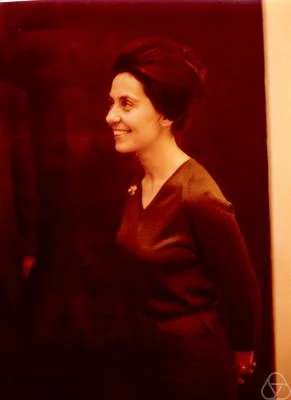
I met Alexandra Bellow for the first time at the University of Chicago’s exclusive Quadrangle Club. She must have been eighty-four years old. I was twenty-nine.
A friend from grad school had asked if I could take over from him as a tutor for a student. He explained this wasn’t a typical student, but an older woman who wanted to read Don Quixote, Miguel de Cervantes’ masterpiece. I was intrigued and quickly agreed, welcoming the idea of some extra cash. That day at the Club was my first meeting with Alexandra. It was also the first time I had ever been inside the Club. With its dimmed interior and wood-paneled walls, it had the aura of another era.
Over a glass of wine, Alexandra and I discussed the terms of the tutorship. We would meet for lunch once a week. After eating, we’d read exactly three pages of the novel out loud; rather, she would read, as she wanted to practice her Spanish pronunciation. (Later, she would scold me if I didn’t correct her mistakes). My role would be to guide her through the reading: explain context, translate unfamiliar words, and lead our discussions. The perfect side-hustle.
Alexandra had been learning in this way for years. Long before I met her, she had approached Paolo Cherchi, a former professor of Italian in the university’s Romance Languages Department, during a party. She had asked if he knew any doctoral students working on early modern Spanish literature, who might be interested in tutoring her. Like the friend who introduced me to her, and the student who followed after me, I was one of the lucky ones.
I knew from the beginning that this tutorship would be special. Alexandra bore the last name of Saul Bellow, the world-famous writer and a Nobel laureate no less, so I assumed she would have stories to tell. Notorious last name aside, I was astonished by what a quick Google search revealed: the daughter of two pioneering Romanian physicians, she had grown up under a brutal Communist regime and was the first woman to become a full professor of mathematics at Northwestern University. Her mother had been persona non grata under the Communist government. This was certainly no ordinary student.
But perhaps the most surprising thing for me was her unwavering enthusiasm for Don Quixote. On that first meeting, I asked if she wanted to read more than three pages at a time. I was happy to read a chapter a week or so. “No, thank you,” she said. Would she like to read something else in addition to Don Quixote, then? Perhaps I could introduce her to Sor Juana Inés de la Cruz, the seventeenth-century poet who championed women’s education? She smiled; I thought she seemed interested. But she said, “No, thank you.” At the time, these responses seemed to reflect the character of an older woman set in her ways. But I understand now. Her insistence on focusing on Don Quixote, dosed out three pages at a time, was a sign of her deep love for the novel.
Alexandra retired from the Mathematics Department at Northwestern at the age of sixty-one, relatively early for an academic. When I asked why, she explained that living under a dictatorship had deprived her of so much—books, films, and experiences. Growing up, she hadn’t even been familiar with the Bible. She arrived in the West with voracious curiosity, determined to make up for the time lost. After earning her doctorate at Yale and holding positions at prestigious universities across the country, she retired from teaching not to rest, but to become a full-time student. Reading Don Quixote was one of her learning projects.
Under the Communist regime, culture was subjected to intense censorship. Alexandra told me stories of how a friend of her mother would smuggle novels from the West, distributing loose pages among trusted circles. Her mother, Florica Bagdasar, would hide the pages beneath a floor tile. They would take turns reading them in secret — always out of sight from their maid whom, they suspected, reported to the Securitate, Romania’s infamous Secret Police agency. Florica, the first woman to lead a ministerial cabinet in the Romanian government, earned enemies after establishing relations with the West during her tenure as Minister of Health. Both she and Alexandra were harassed, surveilled, and ostracized for years, so their maid spying on them was a real possibility. “Feeling like you could not trust someone so close must have been terrible,” I told Alexandra. She shrugged, letting out a chuckle. “Well, she might have been a spy, but she was actually really nice. I liked her.” That reply was so characteristic. Alexandra saw people in all their contradictions, giving them the benefit of the doubt even if their actions were hurtful.
I like to imagine that Alexandra’s secretive mode of reading taught her to savor every word. Perhaps she learned the pleasures of slow, reflective reading while waiting patiently for the next chapter to arrive over the weeks. And perhaps this was why she insisted on reading only three pages at a time, too, with Don Quixote. Indeed, after our Saturday meetings, she would go home and go over the pages again — sometimes to ensure she had understood them thoroughly, sometimes just for the pleasure of rereading. I am not sure if she had always read in such small quantities, or if it was something she started doing as she got older and tired more easily. Still, her insistence on reading just three pages was in keeping with how she lived the rest of her life, as far as I could see. Little sips of wine; small bites of food; three pages at a time. Thoughtfully, patiently savoring each little thing, she lived with a quiet and unassuming intensity.
Alexandra would call me her “maestra,” her teacher, though I never believed I had much to teach her. I felt embarrassed every time she introduced me this way to her friends or to the servers at the restaurants where we met. In truth, our sessions felt more like conversations between two friends bound by a shared love for an old book. Yet she insisted I had something to teach her. She trusted my knowledge and was always interested in hearing my takes. She asked endless questions about the narrative’s smallest details — for example, the words used to describe the characters’ clothing — and diligently took notes, the pen shaking in her fragile hand. She treated me with great respect. Our age difference, the difference in our backgrounds — they never seemed to matter to her. I was a student navigating an institution notorious for its sometimes-cruel rigor, in a professional field full of hierarchies. But Alexandra’s trust and desire to build a bridge between us were beautiful reminders that knowledge could be made in community.
During lunch, we often discussed politics. She was passionate about it and always eager to hear my opinions — sometimes almost quizzing me on that week’s news (which, I confess, I sometimes reviewed while on the train to see her). I found her interest remarkable. She worried deeply about the world, even as she knew she wouldn’t be in it for much longer. Much of what was happening painfully reminded her of the past. “Ay, ay, ay, querida amiga,” she’d always say.
When the pandemic hit, and Alexandra’s beloved sense of liberty was upended by lockdown, she wrote to me: “I am reading and rereading Cervantes. It is no doubt a marvelous antidote for today’s craziness and public hysteria.” Much like the ingenious gentleman of La Mancha, Alexandra lived in pursuit of freedom. In the novel, the ordinary man Alonso Quijano becomes the adventurous Don Quixote, only to transform into the Knight of the Sorrowful Figure before, ultimately, returning to his original self. “I know who I am and who I may be, if I choose,” Cervantes famously wrote. With these words, Don Quixote declares himself the only author of his destiny. His imagination and willpower give him the radical freedom to be whomever he wants. Alexandra, too, morphed by her own resolve: she was born a Bagdasar, later became an Ionescu-Tulcea, and died Alexandra Bellow. I do not think this was just a simple case of a woman taking on her husbands’ surnames. Rather, I think she was choosing, reinventing herself as needed every time. She even kept Bellow’s name after divorcing him and remarrying, transforming it into her own.
As time passed, our conversations shifted beyond politics to include our personal lives. She was a rather private person, but slowly opened up to me. Little by little, she shared stories about her life in Romania, her family, and her marriages. She talked about the night she met Saul Bellow at a party in Hyde Park. Saul, then at the peak of his career, approached her confidently. “Have you read any of my books?” he asked her. “No,” she replied cheekily, “have you read mine?” She also told me about their trip to Bucharest in the 1970s to visit her dying mother. After this, Saul would go on to write the novel The Dean’s December—in which a Chicago intellectual accompanies his wife, an internationally-acclaimed astronomer, back to Communist Romania to bid farewell to her sick mother. Bellow was notorious for fictionalizing realities too close to home, turning the people in his life into barely-disguised characters. I was not happy to see his version of my friend on the page: Minna, an elegant and brilliant scientist who is, nonetheless, condescendingly described as a “schoolgirl” and “gold-star pupil” for her dedication to her work. But Alexandra was generous about this. “He had to. He was a writer. That is what they do.”
Eventually, I also came to understand her love for Don Quixote. Her third husband, the Argentinian mathematician Alberto Calderón who had passed away suddenly in the 1990s, had also adored the novel. Alexandra spoke of him often. By the look in her eyes, I could see how much his death hurt, and how much she still loved him. In a rare moment of emotional intimacy, she once told me that reading Don Quixote was her way of keeping him close.
Alexandra had come into my life at a crucial juncture. My own young marriage was brittle, and my home, not always a refuge. So my time with her felt like an oasis. Even on the coldest of days, I would take the train to see her, leaving close to noon while my husband was still asleep in bed. In the hour it took me to get to the Northside, I would desperately call my mother to ask for advice about my relationship. Or I would reread the pages for that day, or simply let myself drift from the responsibilities of writing my dissertation. I preferred the loud, chaotic, and crowded cars of the Red Line — even the frigid gusts of wind each time the doors opened — to being at home, where the silences between me and my husband were growing longer and harder to break. We had married after being accepted into the same doctoral program, shortly before moving to Chicago; colleagues and partners, we shared classrooms, professors, and friends. But under the pressure of starting graduate school in a different country, we had begun leading different lives under the same roof. I was excited for everything ahead of us: the conferences and trips, the new people and projects. Whereas he preferred to remain at home, reading and working in solitude, smoking, wrapped in silence. He believed I was neglecting our relationship. I believed he was taking it for granted.
It was difficult to picture a life without him — my college crush, best friend, and long-time intellectual confidant. Yet I could not reconcile the path I felt drawn to with the life he envisioned for us. Somewhere in the back of my mind, I knew our marriage was ending, but I was too afraid to confront this painful reality. Perhaps that was why my dates with Alexandra felt like a window into possibility. Here was a woman who had lived through a dictatorship, been through three marriages, and built a brilliant career in a relentlessly male-dominated field. And she was happy. She was radically independent. She loved life. That I found such vitality in an eighty-something-year-old woman was a lesson for me. So I tried not to ever cancel on her, even when the workload of graduate school felt overwhelming, or when I was not at my best after a late night of too many beers. Eating and reading by her side often felt like the best part of my week.
We met religiously every Saturday. Alexandra was a woman of habit, and we had our favorite spots and menu items: Francesca’s in Edgewater, where we would share a creamy tiramisu; Ascione’s in Hyde Park, where we loved the delicate crab cakes and beet salad; Athena, where we always started with skordalia and taramosalata; Alvi in River North. Seeing her each week — elegantly dressed in her beautiful, colorful scarves, wearing her quirky socks, bright lipsticks, and bold jewelry, smiling even on the most brutal days of the Chicago winter — brought me deep hope. She offered me words of comfort now and then, but actually, my greatest comfort was simply reading with her. She radiated vitality and a joyful kind of strength, so being in her presence made me feel that I could embody those qualities too, even when it felt impossible. She never complained about the cold in Chicago; on the contrary, she adored the city. She always insisted that I order dessert, claiming she was too full but still never failing to have a taste of mine. Before she got sick, she always ordered wine — even if she only took the minutest sips from glasses that always seemed to stay full. She laughed a lot, particularly at Sancho’s mishaps, sighing in satisfaction after reading our three pages. “¡Qué divertido!” she’d say with a chuckle.
Like me, Alexandra was especially fond of Sancho, Don Quixote’s loyal squire. She delighted in his irreverence and particularly loved his wise and sometimes-cryptic proverbs. She would often write them down in an effort to learn them (and she would). Her Spanish was phenomenal. I could be wrong, but I believe she learned it during her marriage to Alberto. I always had the sense that in keeping the language alive in her mind, she kept Alberto’s memory alive. They must have loved each other in Spanish.
Don Quixote was likely one of the few readings I did for pleasure during my doctoral years. Reading it in company and out loud — precisely how Cervantes’ readers would have read it in the seventeenth century — constantly reminded me that literature is at its best when shared. Books bring people together, and their meaning only shines through when they are read in community. When we make them part of our relationships, they come to life, turning into objects that sustain us. Like her beloved errant knight, Alexandra allowed herself to be transformed by the stories she loved.
Like Sancho’s and Don Quixote’s, ours was an unlikely friendship. Sancho is a humble and rustic peasant, while Don Quijote believes himself to be an honorable knight. Sancho has one foot firmly set in material reality, while Don Quijote conjures a world of his own. And yet, they need each other, learn from each other, and evolve together. Alexandra and I might have been divided by age, our differences in upbringing, and our cultural backgrounds: she, a cosmopolitan Romanian, and I, a recently-arrived student still finding my feet away from Mexico. She was a scientist, and I, a humanist. Often, the servers at the restaurants would look at us puzzled, unsure of the nature of our relationship: was I her granddaughter or caretaker? Was she my teacher? But none of our differences mattered at the table. I was a struggling graduate student with a half-written dissertation and a crumbly marriage, but Alexandra imagined me a wise teacher and worthy friend. And just as Sancho gradually enters the world Don Quixote created for himself, I, thanks to her, came to believe it.
At the beginning of the novel, the relationship between Sancho and Don Quixote is practical. Don Quixote hires Sancho as his squire. But as the novel progresses, we witness their relationship evolving from one of utility to one of intimacy. This happens through constant conversations where their opposing worldviews rub up against each other. It took some time, but my teacher-student relationship with Alexandra, similarly, evolved. Slowly, she began to trust me. She allowed me to hold her arm as we crossed the street. She accepted my help to cut her food. (Perhaps she came to see that vulnerability, too, could be a form of freedom.) Increasingly, I felt uneasy about receiving compensation for what I saw as just spending time with a dear friend and a dearly loved book. I once tried to refuse her check, only to have her look at me dead serious: “If you don’t take it, I won’t see you again.” There was no arguing with that.
Over the course of five years of conversations and countless to-go boxes of food (she always ordered too much), we got to know each other, three pages at a time. Alexandra was reserved with her emotions and prudent. For years, she had spoken to her mother only in banalities, out of fear that the Securitate was listening. Perhaps that is why she was so discreet with her words. But she also had a dark sense of humor (in her own words, a “Romanian” sense of humor), a sharp wit, a critical eye, and a tender heart. She never spoke ill of anybody (except politicians) — though I could see she relished my occasional mean jokes.
I left Chicago in 2022. With graduate school and my marriage behind me, the future felt wide, even though I carried that grief that comes with moving on. The city had become my home; had witnessed my loneliness and my becoming. Saying good-bye to Alexandra was one of the many reasons why it was difficult to leave. Our meetings were woven into the fabric of my life, and leaving also meant saying good-bye to Don Quixote.
In one of my recent visits to Chicago, during one of the last times I saw her, she told me: “I hope I can finish Don Quixote before I die.” It broke my heart. Her health had begun to deteriorate and she undoubtedly knew that with her age, that goal would be difficult to attain at three pages a week. Nonetheless, she never rushed, never disturbed her routine. She lived at her own pace, somewhat stubbornly. She never read Don Quixote to check it off a list. Don Quixote was a structural part of her life that had accompanied her for decades, and rushing to finish would have meant rushing to live.
Months later, when I learned she was dying, I asked her grandson Miguel if I could send a voice recording of myself reading her the last chapter of Don Quixote out loud. I wanted, perhaps foolishly, to help fulfill her wish of finishing the novel. In the end, Don Quixote snaps out of his madness, realizing all his adventures were rooted in his bookish imagination. He returns to being Alonso Quijano and comes to despise the chivalric novels he once lived by. When he is on his deathbed, a weeping Sancho begs him not to die: “Look, don’t be lazy, but get up from that bed and let’s go to the countryside dressed as shepherds, just like we arranged: maybe behind some bush we’ll find Señora Doña Dulcinea disenchanted, as pretty as you please.” It is a shattering but beautiful moment between two friends who are about to separate forever. Sancho — who constantly refuted his master’s fantasies — now clings to them, refusing to accept the reality before him. At the heart of Sancho’s plea is a painful truth: this time neither books nor imagination can upend the reality of death. In hindsight, I see now that my recording was less for Alexandra and more for myself, a way to say goodbye to her. Like Sancho, I wanted to return to our shared past, perhaps hoping we could read three last pages. It was my way of telling her to stay, even as I knew she was ready to go.
According to what her grandson later told me, Alexandra refused to listen to the final chapter. Maybe she was too tired, or maybe there was simply never a right moment amid the routines of her final days. But her refusal now seems so poetic, wise and intentional — so Alexandra. In that chapter, Sancho tells Don Quijote: “Don’t die, Señor; your grace should take my advice and live for many years, because the greatest madness a man can commit in this life is to let himself die, just like that.” Alexandra did not die “sin mas ni más,” “just like that.” She certainly did not “let herself” die either. I like to imagine that she obstinately protected her freedom until the very end, like she always had done. That she chose to go on her own terms after living a remarkable and beautiful life, just as determined and stubborn (porfiada, Cervantes would say) as the protagonist of her favorite book. She left this world with Don Quixote’s dreams intact, never having witnessed the unbearable sadness of his ending.
My copy of the book is worn now, full of post-its and scribbles. A material reminder of a friendship I could not have imagined. Next year, I will teach an entire class on it for the first time. How will I bring some of the joy I found with Alexandra into the classroom; the delight of reading aloud, of letting a book stitch lives together? Who knows, perhaps three pages at a time?