What is seen can be abolished by the eyelids, can be stopped by partitions or curtains, can be rendered immediately inaccessible by walls. What is heard knows neither eyelids, nor partitions, neither curtains, nor walls. Undelimitable, it is impossible to protect oneself from it … Sound rushes in. It violates.
– Pascal Quignard, “It So Happens that Ears Have No Eyelids” (from The Hatred of Music)
1
On the first page of this notebook, I had copied a quote from Gherasim Luca: “A revolutionary thought must reject with indignation any attempt to be closed in a certainty, no matter how fascinating.”
2
Sound, itself, is not definitive— sound waves continue moving even after they reach us, losing velocity along the way. According to the notebook I kept during the summer of my twentieth year, a mother’s scream drifted past the playground and hovered near the bus stop in Bucharest just before a friend said maps would not help me understand what I saw. Nor would speaking the language. Pigeons moved back and forth between the green park benches as we spoke. “You grew up in Disneyland,” this friend added. He was a philosophy student at the nearby university.
3
“Recordings deal with concepts through which the past is reevaluated, and they concern notions about the future which will ultimately question even the validity of evaluation,” wrote composer Glenn Gould in April 1966.
Eleven years later, Ion Grigorescu created a short, black-and-white film titled “Boxing.” In it, a naked man ‘shadow-boxes’ with his own shadow in a small studio apartment. Divided into three one-minute boxing rounds, “Boxing” borrows this convention from the sport of boxing. Grigorescu made it by first exposing the film as he boxed in one direction, then again as he boxed the other.
In the disciplinary practice known as “boxing a child’s ears,” an adult uses their hand to apply physical force to the part of a child that hears the world.
A game keeps score. A boxing match sets itself up as a game which can be won or lost. Is “Boxing” a game? Is a game always a performance? How does the performance of a game implicate players differently from the performance of an image? Is the artist struggling with an image of himself or an alter ego?
The only sound in Grigorescu’s film involves a brief crackling at the outset.
4
Pigeons carry one twig at a time to build their nests, which they refuse to leave even during fire. The words in my notebook would later resemble a nest, intended to nurture a creation, a being, a life. Even as the branch beneath the nest died, I stayed with the thing I was building, hoping something might hatch from it.
In a Romanian city that was not Bucharest, I sat in a plaza surrounded by buildings, one of which was an Orthodox church. I remembered Lev Tolstoy describing music as the shorthand of emotion, and it was music which could have described the strange light on this plaza— music which could have carried its complexity more effectively than words. I’m referring to the posthumous orchestration of Gustav Mahler’s 10th Symphony, and how its brightness conceals the silences written by Mahler’s death. Light is the lie which imprints negatives that may later develop into revelations.
A woman in black pants and leather sandals had paused near the statue of the saint. She assumed a humiliating position: her back hunched over a small, dark dog, knees pressed into the cement, among the cracked concrete interspersed with pebbles. A stabbing pain wrote itself into my own scarred knees. I suspected the woman was actively leaning into pain as she crouched over this dog’s head, hiding her face from us.
“She’s not new to the plaza,” said my friend. He called her the woman crazy with dog. To be with-dog seemed different than being with a dog, or being with the dog, and so I wondered if the woman was also pregnant—or if being with dog indicated a sort of exclusivity which prevented the woman from being with child or being with family.
The woman didn’t appear pregnant. She was too slim, her small hips frozen over the dog’s torso like an awning, or a violin bow I once saw broken. Broken, I had loved the man who held the bow, and who broke the bow over my knee, and whose face turned the color of eggplants ripening in the sun under a tree.
In Disneyland, we overcome things. We conquer them and collect trophies. We can’t watch anyone suffer without making a video of it on our i-phones and sharing that video on social media. Thus did I feel called upon to reach out to the woman, creating a bridge between my life and hers, as I walked away from my philosopher-friend towards the center of the empty plaza where the statue ruled over a woman and a dog at its feet.
The woman looked up at me, but kept her palm over one eye when speaking, explaining that she was visiting this place with Radu, her dog. She spoke very quickly, smiling, looking down at the dog and then back up at me with the hand covering her eye. She said this place was special to both of them, to her and to Radu, whose name was special in a different way—and whose difference did not diminish the quality of specialness which applied to both. “You can call me Radu’s mother,” the woman said, before comparing her son’s name to an empty crypt, particularly Walter Benjamin’s cenotaph on a Spanish hill near the sea, but also the cave vacated by Christ, according to three women which History has chosen to believe.
Radu’s mother rummaged through a plastic rucksack as the dog tried to lick her hand. Someone was listening to a radio show on a nearby balcony, and the voices in conversation resembled a sportscast with the rising intonations and suspenseful shrillness of losing, of winning, of scoring, but the theme was national history. I half-listened as Radu’s mother rummaged through several books, opening each one flipping through pages and closing it until finally lifting a piece of paper from a book, holding it above Radu’s head so he could not bite it or lick it, and looking at me.
The faded, black and white photo depicted a couple standing near a monastery building—the woman’s long, wavy hair covered half her face, revealing one sultry eye; her torso leaned into the chest of the man whose hands were in the back pocket of her jeans, as if the two had just had sex and were considering doing it again. Before I could ask, Radu’s mother flipped the photo and pointed to a faint, handwritten word in the corner, in cursive: Radu.
“The one with long hair is my mother,” she said, “but I don’t know who this Radu was. My mother is dead but there was a man who took many photos of her and I do not know where he lives or what they did. Since finding the name, I’ve been a pilgrim, a visitor to each site where Radu took a photo with my mother. And I have watched Radu closely in case he senses something.”
As she shut the photo back inside the book cover, I noticed (again) how her mother’s hair covered half her face, and the correspondence between the photo and Radu’s mother as she looked up at me from the closed book with one hand over her eye. Only at this point did I realize I’dmissed something: she had not covered her eye when showing me the photos, and it was I who had failed to look at her eye, when given the chance. I had missed the opportunity to draw a line between the eye hidden by her mother in the photo and the man whose name now lived in the small black dog licking the woman’s toes.
She had named her dog after her dead mother’s mysterious lover.
Radu’s mother laid her face against the knotted black hair of the dog’s back and murmured something for which I was not the intended audience. My head spun from the unfiltered sun in the treeless plaza, with its demanding pitch of light, as when one has been sitting near a swimming pool for hours without drinking water, the brain pulverized by historical sports on radios in the background, and no sense of what to do next.
5
“Writing is a game to me,” I told my philosopher-friend as we shared a lukewarm Ursus, a beer named Bear. “Writing is a game that cannot be won, and there is no end to it. Those who believe they can win it with a bestseller are playing a different game. . . a Disneyland game.”
Disneyland didn’t yet exist when Arthur Schopenhauer found it “noteworthy, indeed marvelous, that we human beings always lead a second, abstract life alongside our concrete life.” Glenn Gould’s favorite color was “battleship grey.”
6
During the 1970’s, as Ceaușescu’s regime rode Romanians towards starvation, Grigorescu used his own body to probe the distance between performance and recorded image by staging a series of intimate experiments secretly in his apartment. He created the film alone, and this solitude, this extraordinary confinement, is palpable in the way the subject slips between a character and a self-portrait.
After taking multiple screenshots from Grigorescu’s film, I study them closely, seeking to glimpse the future anterior —the future already folded into the past — in them.
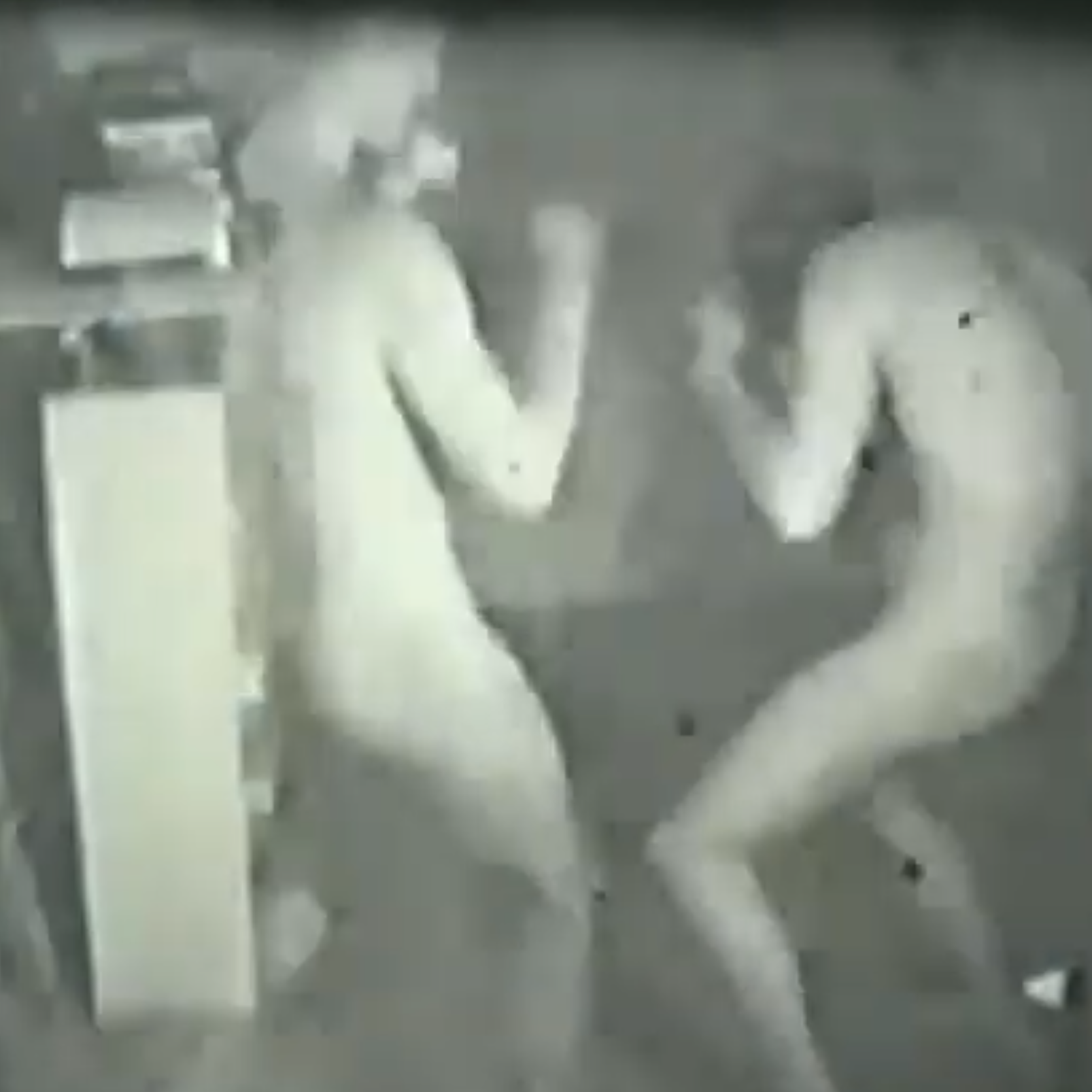
I assume the alter ego is the boxer on the left because he is slightly less dense and shadowy than the boxer on the right. The boxer on the left fades with each round. By the final round, he resembles a translucent shadow. But it is then, when he is least visible, that the boxer on the left seems stronger and wins the match.
“A stopped frame outside of a movie isn’t anything, not even a photograph,” wrote Michael Wood in Film: A Very Short Introduction.
7
According to my notebooks, in Ovid’s Tristia manuscript, the Stygian waters become Scythian waters, creating a strange relationship between these descriptors.
Puzzled by this, I recalled that the first piece my son composed on the piano was titled “The Stygian Waltz.” He was seven years old at the time. We had just returned from a brief trip related to a book I had ghost-written for a Russian oligarch who wanted to be legible to American audiences. He lived in New York City, like many oligarchs, and had the sort of large apartment customary to Disneyland’s heroes. My editor for the oligarch’s biography was his cousin, who was a distant relative to the philosopher Lev Shestov. A convivial fellow, the editor introduced me to various opportunities, and countless freelance gigs since our first meeting in a Sibiu cafe, which we both remembered fondly.
My editor-friend played chess with my son as I wrote. Between cigarettes and disgust with drafts, I exhaled various non sequiturs aloud, to which the editor occasionally responded.
“Writing is a miserable occupation,” I mumbled. “Shestov was right to warn that it is easy to confuse ecstasy with calf-rapture.”
The editor sat up, pressed a large black queen against his chin, closed his eyes completely as he said, “Shestov believed the public prefers calf-raptures to ecstasy or revelation.”
I spat in my coffee cup mockingly. “Shestov never sat in Manhattan trying to dash off a calf-rapture that will cost me my soul and its after-life.” A few hours later, as the shadows of streetlights drew night across the walls, the editor set a glass of schnapps near my computer and allowed his shadow to fall over my screen. “Shestov opens All Things Are Possible with a certain statement,” he said coyly. “Do you know what that statement is?” Since I did not, the editor quoted Shestov: “The obscure streets of life do not offer the convenience of the thoroughfares. The traveler has to fumble his way in the dark.”
Although a rejoinder was expected from me, I had nothing to offer. The verb to fumble failed to elicit anything. “I must do the minimum here,” I thought. Poetry would suffice. This editor loved unexpected rhymes and sentimentalism, so I told him the light a traveler needs most may come from a stone, or a spark. My son fell asleep on the sofa near the marble chessboard. The editor began making the sort of romantic propositions that follow heavy drinking and poetry. Once the script began, or once he read a script into the scene, it was easier to go along with it than to risk wounding his ego or upsetting his view of the world. These scripts were pre-recorded performances familiar to both of us. Both my editor-friend and the oligarch wished to be legible to a reading public which they imagined. Both wanted to be read into the stories of their lives, and be imagined by others as they imagined themselves. Their longing to be understood assumed a human condition of equality, or equal co-imagining. But the oligarch could not imagine me outside the money he used to purchase his personal mythology. Nor could I imagine him as more than the money he flaunted. I believed then— as I do now— that what we share, or what we gather together, cannot transcend the transactional nature of structural hierarchies and narrative economies. There is no place outside the box you pay me to build in the name of fathers.
8
“It is now a criminal activity to chew sunflower seeds in public places,” Walter Benjamin wrote in the Moscow Diary he kept when chasing Asja Lacis through the Soviet Union. Uncertain of whether to officially join the Communist Party, Benjamin decided to voyage directly to the USSR itself, and study how Soviet rulers had improved the lives of the masses. There is a hint of surprise in Benjamin’s affectless reporting on the criminalization of sunflower seeds. How gray and lifeless the silence that follows a surveilled surprise. Under dictatorships, absurdity is limitless. The pigeons of Moscow lamented the newfound stinginess of elders on park benches. Street vending had also become illegal. The sale of icons was made part of the paper and pictures trade, so icons stood in booths next to other paper goods “flanked by portraits of Lenin, like a prisoner between two policemen,” wrote Benjamin.
Eventually, the oligarch paid a boutique to print his ghostwritten biography. Every biography asserts its brand to a particular audience. To this day, I don’t think my son knows that my ghost ever wrote such a travesty.
“Please do not include my name in any published manuscripts which come as a result of this,” I said to the man from Tomis, about a different book, in a different year, using a different map
“Consider it lost,” he replied. “Consider it as gone as Bruno Schultz’s The Messiah. No one would even begin to know where to find it.”
When I asked my son last week what became of the Stygian waltz, he said it never existed. “There was a Phrygian waltz….” he said, “but you must have imagined the other one. Just like you imagine all kinds of things that never actually happened.”
9
Film stills are only ‘something’ in the context of a film “projected at the right speed, 24 frames per second.” This is the speed of projection, but the speed hides a particular darkness, as Mary Ann Doane notes, since “during the projection of a film, the spectator is sitting in an unperceived darkness for almost 40% of the running time.” The film projection’s speed keeps us from perceiving the “lost time represented by the division between frames.” The stills emphasize certain moments by pausing time, stopping the flow of images, turning the instants into one “instance,” a reified image that makes an “event” from what is removed. In this, the still (or screenshot) resembles the use of textual quotation.
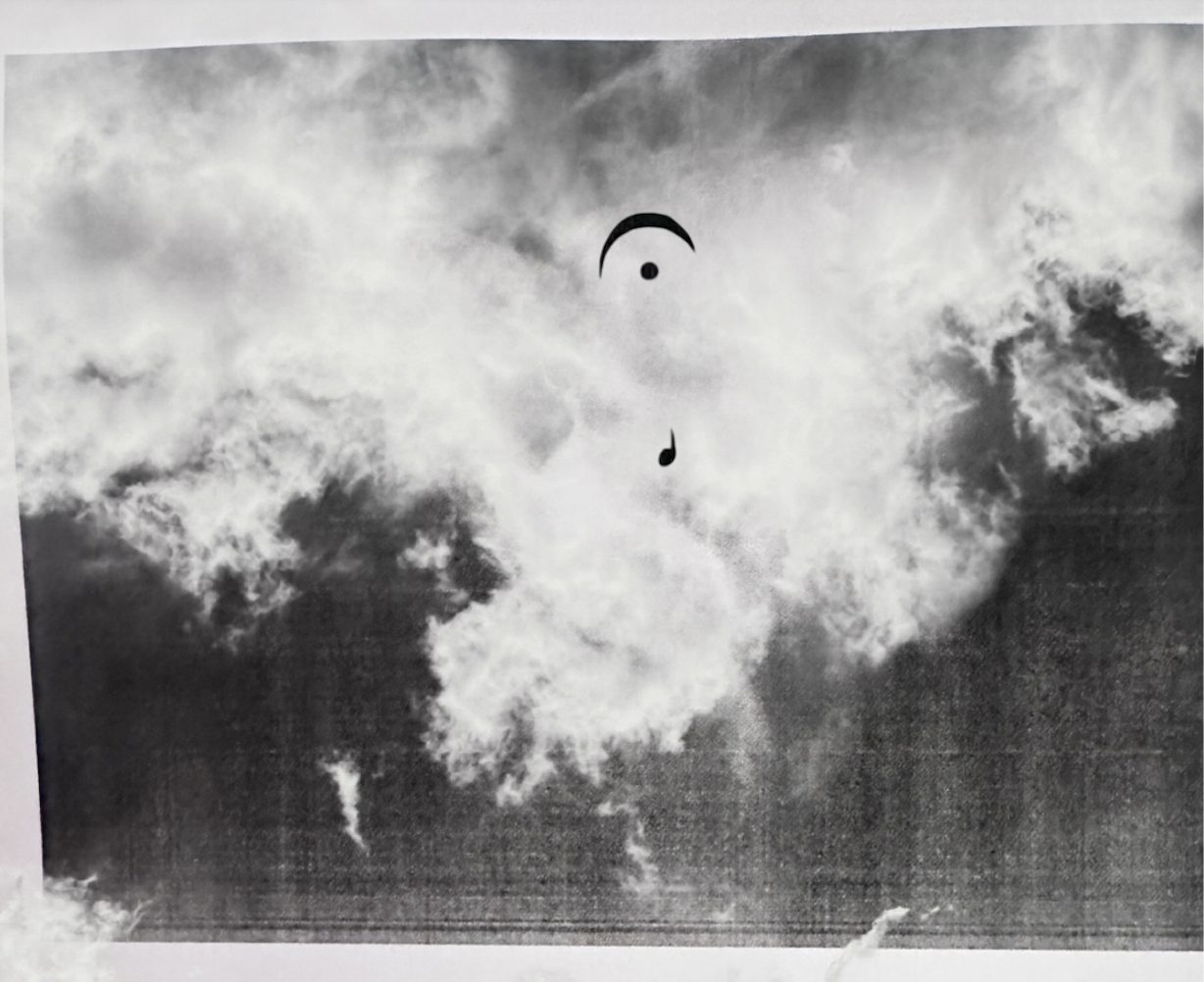
“The whole universe, our life as humans, I always felt to be related to movement and the way it becomes still,” Ion Grigorescu told Calin Bota in an interview.
As I fracture the moving image into screenshots, I divide a motion picture into discrete images that serve as reified souvenirs. I sacralize certain images by saving them. The sacred is always at stake in the games invented by humans.
Although the dictatorship was officially atheist, Ceaușescu’s secularism was religious. He built a religion of the state and rendered things sacred accordingly. Even the dictator’s name was hallowed: using the wrong appellation was a crime. Radu Jude remembers first hearing a Radio Free Europe broadcast at his cousin’s house and being petrified by the blasphemy. “It was beyond shocking for me to hear Ceaușescu referred to only by surname,” Jude said, since the Romanian press always preceded his surname with a superlative, ‘Our Great Leader Ceaușescu.’ Or something.
Digital archives and collections reference Grigorescu’s film as a piece produced in 1977. While viewing the credits, I pause for closer look and snap a screenshot:
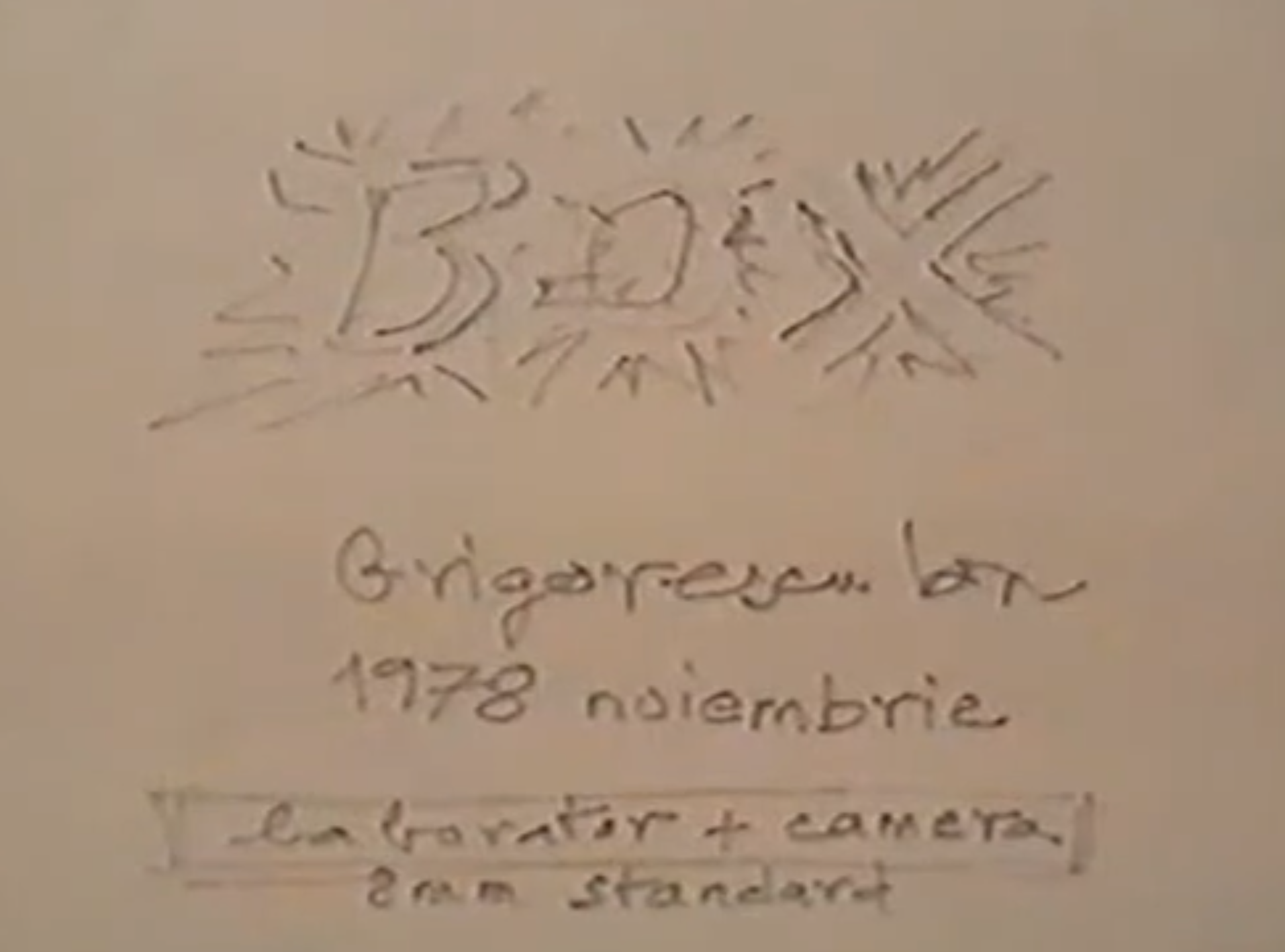
The screenshot announces this as Grigorescu’s “Box” (not “Boxing”), which he made with film lab and an 8mm standard camera in November 1978. To confirm my own confusion, I also took a photo of the film’s title and presentation on YouTube:

The time stamp for Grigorescu’s film seems to also be plagued by a shadow or shadowed by a year and a title. I’m not sure if 1977 or 1978 is the alter ego. Nor am I sure what winning this match would mean for Time. Am I in a box, or am I boxing?
10
In his memoir, Me and Him, writer Ion Ianosi never uses Ceaușescu’s name, thus bringing to the page the spectacle of the televised speeches and the act of identification with the leader which lay at the heart of both grammar and syntax. The ‘me’ exists only in relation to the ‘Him.’ “One could say, in socialist Eastern Europe, the camera did not shoot you: you shot the camera,” Ovidiu Țichindeleanu said, speaking of Ion Grigorescu.
According to scholars, the Romanian Department of State Security (known as the Securitate) was the largest and most pervasive secret police force in the Eastern Bloc. Personal conversations and mail were regularly monitored: the “secret police” knew everything, including the dreams of its citizens. Surveillance files literally created the dictator’s citizen-subjects; the dictator’s polyphonic, paranoid gaze characterizes the tone and scope of the Securitate archives.
Who are you in the eyes of the state? Requesting to see your Securitate surveillance file seems like an act of courage that repudiates fear of being boxed. Similarly, poetry may suggest a repudiation of facile binaries. But poetry, like a film reel, may also sustain binaries rather than refuse them.
I wrote a story about a woman watching pigeons. I shot the camera and then focused on stanzaic divisions and lineation. Like the anchorite Simeon of Emesis who descends from solitude in order to mock the city and upset the smug order of the world, I stared at the words I had written and realized they did little to address suffering, pain, injustice, and the usual suspects that cause us to ask questions about the meaning of life, where ‘meaning’ itself is linked to the disappointment of not being in a perpetual state of “well-being.”
At present, ‘well-being’ is also increasingly defined by corporate products, lifestyles, and multiple biopolitical discourses. In January 1965, Ludwig Wittgenstein published “A Lecture on Ethics” in which he mentioned, briefly, a near-religious experience of “feeling absolutely safe.” It is no secret that Wittgenstein grappled with his longing to believe in a god for the greater part of his life, despite refusing to mention or evoke this in his philosophical writings, leaving metaphysics to his notebooks.
“Absolutely” is a tremendous word. I mean: there is no way to move beyond it. Wittgenstein’s decision to italicize this word underscores its enormity. What interests me is the connection between absolutely and absolution, which is what religion seeks to do, namely, to relieve us of the meaningless suffering that is part of the human condition. To “absolve” is to render or declare (someone) free from blame, guilt, or responsibility. Absolution seeks to erase epistemic gaps. But Samuel Beckett, who shares my birthday, and whose ghost sits on my foot as I type this, showed us that we go on despite waiting for nothing, and so waiting for nothing is perhaps the truest and most consistent experience of being human.
11
Everyday, I play in my boxes and drag my ghosts into them.
Tristan Tzara described his play, Mouchoir Des Nuages, or “Handkerchief of Clouds,” as a tragic farce influenced by the serial novel and cinema. His stage instructions indicated that the cloud-hankie should be staged on a platform in the centre of a box-like room “from which the actors cannot leave.”
I enjoy playing my selves against my ‘selfing.’ As a constraint, the box doesn’t permit us to ignore our unfreedom; it destroys the presumptions of neoliberal subjectivity, much of which depends on this fantasy of ‘knowing oneself’. As for Tzara, he resembles Paul Celan in how the memories of his Romanian childhood and youth never abandoned his texts. Tzara preserved them in words and images: the despair of the fallen bird, the horses of Moinesti, the window-panes framing early boredom, the streetlights strolling through the cities at night, the volition of objects, his violin, the scythed tongues of village gossip, the labor of recounting, the inflammation of all ears in a row, the echo of the mother who urges him to drink more water in every letter she mails to him. If life is a game, one plays it with the cosmos and the nature of time itself. The games that predate one’s existence, the games we are given, involve passports and papers that replace the living being in order to constitute the “national” subject, the passport-bearing human, the neoliberal globetrotter. No man is worth anything apart from the self he displays at a custom border. We live in the virulence of that.
12
A life is “a history in which past contingencies are given the sense of necessities to come… a form of rationalization in which the truth discloses itself as a lie,” to quote Scott Wilson’s foreword to Gary Shipley’s On the Verge of Nothing.
“If you want people to envy your sorrow or your shame, look as though you were proud of it,” Lev Shestov wrote in the note numbered 55.
There are maps in books which are not atlases. Carte de tendre was created as a salon game in the 1600’s, only to return in Madeleine de Scudery’s coded novel, Clelie. George Perec and OULIPO played with maps and other forms of ‘potential literature.’
“As long as I am alive, do not forget who you are comes from all I have been – and all the names on the map,” my grandmother told my father before returning to Romania so she and my grandfather could die there, and be buried in the company of their own ghosts. One should not spend eternity among the ghosts who don’t know you, among crowds of historical phantoms made by others, away from your own ancestors. As for the music of ghosts, it is a curse to die a stranger.