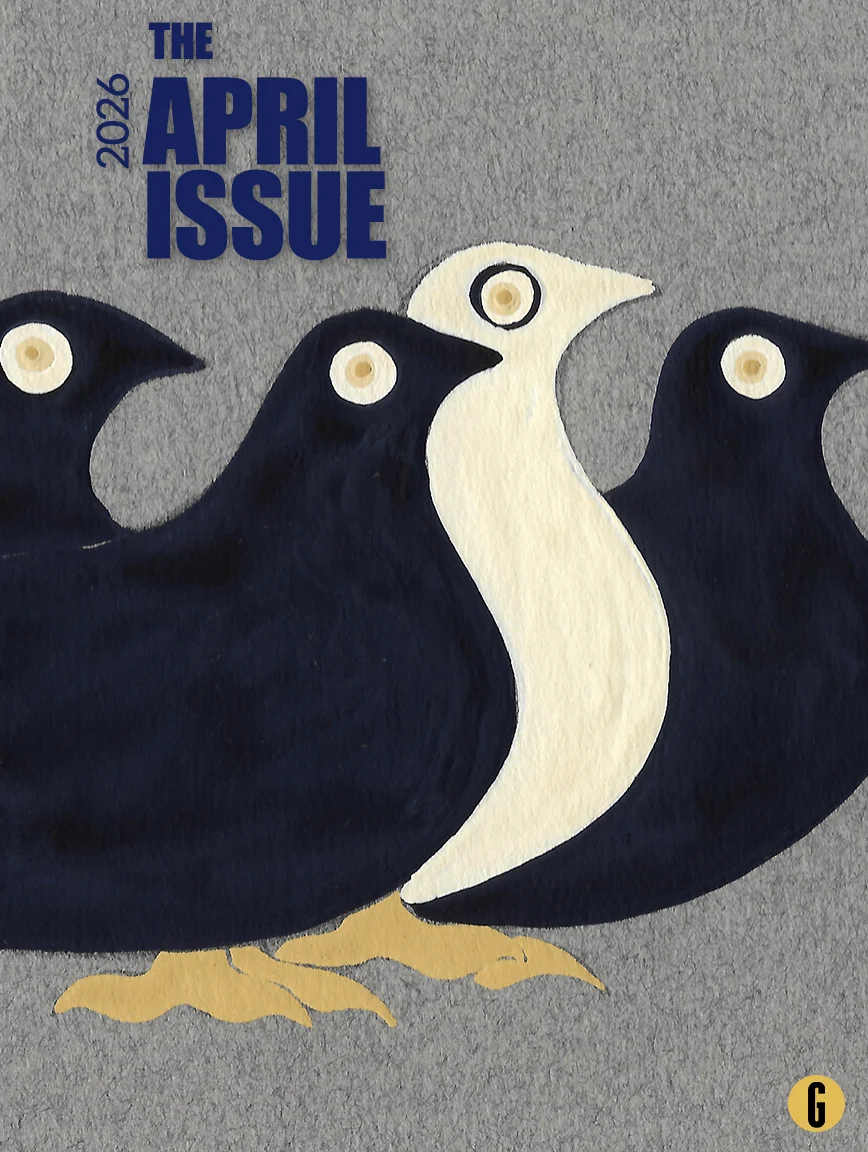
Something magical happens in the gathering of literary works. When pressed together, they begin to whisper to one another, to resonate. So it is with Guernica’s April issue. Across fiction and nonfiction, poetry, conversation, and Spotlights, these works attend to our present moment through the minutiae of human relationships. War and wonder, suspense and arrival, dread and discovery reflect through the smallest of interstices—between siblings, lovers, strangers, children at play. This issue is populated with microcosms that arc toward the universal, and the questions that press upon us in a time marked by rupture, fear, and uncertainty.
In fiction, Stacie Shannon Denetsosie’s John Wayne’s Jacket follows twin sisters learning to look beyond the similarities a mirror casts, and what begins as a conflict over boys and borrowed jackets unfolds into a deeper struggle for identity, and the fractures wrought in the process of becoming. In Abuchi Modilim’s American Actors, a group of children stage an imagined American film, shoving and fighting among themselves, their play masking a deeper grief. Beneath the performance lies the unbearable: mourning the death of a friend, and the quiet, incomprehensible truth of a world in which children are allowed to die.
In nonfiction, Daniela Gutiérrez’s Three Pages of Don Quixote, turns to the question of what books are for, and how they shape the lives that we come to inhabit, at a time when the humanities and literary institutions are increasingly under threat. Alina Ștefănescu’s Boxing: Against the Games We Are Given, traces how larger systems of power inscribe themselves onto the self–through the contained spaces of boxing, music, and memory–while refusing the closures of certainty.
In a three-way conversation led by Russell Reed, climate organizers Mohammed Usrof and Tori Tsui speak from within the insular world of COP negotiations, where disillusionment and resistance open onto a reimagining of climate justice. As a foundational installment in Posthumanitarian, a series rooted in the fundamental solidarity between decolonial and posthumanist struggles, After Activism: In Conversation with Mohammed Usrof & Tori sets the tone for a body of work that reads the universe of climate justice through its smallest, most charged sites of encounter.
In Spotlights, The Relay, by Marek Šindelka, and translated from Czech by Graeme Dibble, a train carriage is transformed into an electric field of human interaction. Darkly comic and sharply wrought, the story reminds us that even in the most transient of spaces, we are never truly alone.
Poetry in this issue moves through the intimate terrains of language, memory, and inheritance. In At Stefan Stambolov Square, Plovdiv, Immanuel Mifsud, translated by Ruth Ward, turns to the quiet surface of an ordinary place where seemingly uneventful moments gather into something held just beneath what is said aloud. In The Father’s Sin, the poet enters the fraught space between father and child, where recognition falters—I no longer understand your eyes—and a private reckoning unfolds. In dragomana, Nisrine Mbarki Ben-Ayad, translated by Michele Hutchison, writes across fractured and interwoven tongues and legacies. A lover once asked me, by the same poet, lingers in the unstable space between language and desire, measuring the distance between mother tongue and the lived experience of love. In Chronicle of My Thirty-Eighth Year, T. De Los Reyes gathers the granular textures of a life into a meditation on actualization, where the self, reflected and recast, emerges slowly into relief.
“The obscure streets of life do not offer the convenience of the thoroughfares. The traveler has to fumble his way in the dark,” Alina Ștefănescu quotes Shestov in her essay for our April issue. It seems that perhaps it is within this fumbling that something begins to take shape; meaning arrives in fragments, assembling slowly, haltingly, through small associations and connections. And if something magical sparks within a collection of literary works, it is because they remain inside that uncertainty. They refract the world until the smallest moments themselves begin to carry the weight of the universe. Perhaps, it is such resonances which allow us, even now, to recognize ourselves in one another.
Featuring, courtesy of the artists, striking original artwork by Ebenezer Edem Kwame Dedi, Jozie Furchgott Sourdiffe, Rana Samir, and Jonathan Wateridge.
Raaza Jamshed, Editor-in-Chief