I burst out of the house into the cool dark morning, backpack slung over my right shoulder, Cloud’s socks and shoes clutched in one hand. Cloud himself is tucked under my left arm—barely. I am holding him horizontally, by his middle, and he is screaming in rage. My co-worker Zoe sees my plight from inside the car and opens her door. I heave Cloud and his shoes in and clutch my left shoulder, which is on fire. Zoe helps again by shutting the door, trapping him inside. I run around to the other side and get in. The sound of my panting fills the air.
Lina turns around from the front passenger seat. “Good morning, Vivian,” she says in her educated Malaysian accent, which has a British-posh ring to it. She’s the most proper of all us employees. I don’t think I’ve ever seen her in anything less dressy than a blouse. You’d think she worked at a desk, not a hobbler’s bench.
“Morning,” I mumble, strapping Cloud into his car seat.
Meanwhile, Zoe tickles his feet as she puts on his socks. He giggles, the white-hot tantrum of a few seconds ago already forgotten. That was why he was crying in the first place: he wanted to go out barefoot.
“We must wear socks and shoes when we go outside,” sings Zoe, Velcroing his little sneakers on.
I said almost the exact same thing earlier when pleading with Cloud, but never mind. It’s different coming from Zoe, the kind of person children love. She’s in her early twenties and had four younger siblings growing up in Vietnam, so she’s great with kids. She wears tiny tees and baggy jeans to work, and always throws in fun jewelry. Today she’s wearing a sparkly fruit-bat pendant, which Cloud is fingering in awe.
I open my backpack and take out our hastily packed breakfast: for me, a slice of bread spread with peanut butter and folded in half, for him a plain slice. We didn’t have time to eat before leaving the house.
“Plain bread again?” asks Lina, who has taken the trouble to turn around once more, this time to inspect our food.
“He likes it that way,” I say, mouth full of peanut butter.
She looks doubtful. “Doesn’t he need protein?”
I know I could try to explain that Cloud only started hating peanut butter two weeks ago. That he now protests at even the thinnest smear. That I try to feed him protein in other ways. But Cloud woke up an hour earlier than usual and getting everything packed and ready with an almost-two-year-old grabbing my legs, demanding my attention, is really hard (physically carrying him screaming and struggling out to the car being the final straw), so, I do not have the energy to defend my decision to Lina, the most annoying of my co-workers, who herself was once a new mother but whose son is now grown and whose rebirth went without a hitch, as all rebirths do, my case being the exception, so she will never understand.
Stop being so negative, Vi. I remind myself she’s just trying to help. It’s not her fault she has lapsed into judgmentalism. People always find my state difficult to comprehend.
Despite my silence, Lina persists. “Have you tried making peanut butter pancakes? You could mix the peanut butter into the batter.”
It’s just as well that she’s sitting in front. Otherwise, I’d strangle her.
From the driver’s seat, Nina observes in her low voice, “I’m sure Cloud will be fine.”
And then, Lina actually shuts up. I’m pleased—and surprised. Nina rarely says anything. She’s a lot like her uncle, Acek, in this respect.
We reach the main road and Nina guns it to 45 kilometers per hour. It’s the fastest we can go on the modified petrol they sell to waste-era vehicles. They want drivers to switch to newer energy-efficient models, insofar as they want anyone to drive at all. But Acek’s done the calculations, and replacing either of our ancient vehicles—this rusty sedan or the company van—would be far more expensive than making do with the current state of affairs.
The sky has lightened to a cornflower blue by the time we pull up to work at the corrugated steel shed behind the run-down house where Acek and Nina live. In the summer, we start early to save electricity and take full advantage of the natural light.
As we spill out of the car, we greet Libby, who prefers to cycle to work. Like Zoe, she’s a student who works for Acek part-time. Libby’s bike is already resting against the shed wall next to our sign, Arvin’s Hobbling Services. She’s taken off her helmet and is fluffing her pink-streaked blond bob. Her full name is Liberation. She’s the only one of us who isn’t Chinese, though Acek swears he didn’t take race into account when hiring. “It just happened,” he claims.
I believe him. We once swapped recruitment stories during lunch. Everyone except his niece and me was hired via a flyer on the Chinese supermarket community bulletin board. Libby shops there too—a fact which made Lina’s eyes nearly pop out of her head.
Though we’re all ethnic Chinese, except for Libby, we’re also quite the international bunch. Acek, Nina, and I are Chinese from Indonesia—Medan, specifically; Zoe’s Chinese (a.k.a. Hoa) from Vietnam; and Lina’s Chinese from Malaysia.
These are fine distinctions that don’t matter to most people in the area, and they’ve dubbed us “the Chinese hobblers.” They think we don’t know, but we do. But today, we’re leaning in to our nickname. It’s Chinese New Year’s Eve. We’re celebrating together, as if we’re one big family. Plus, tomorrow, the first day of the lunar year, Acek is giving us the day off.
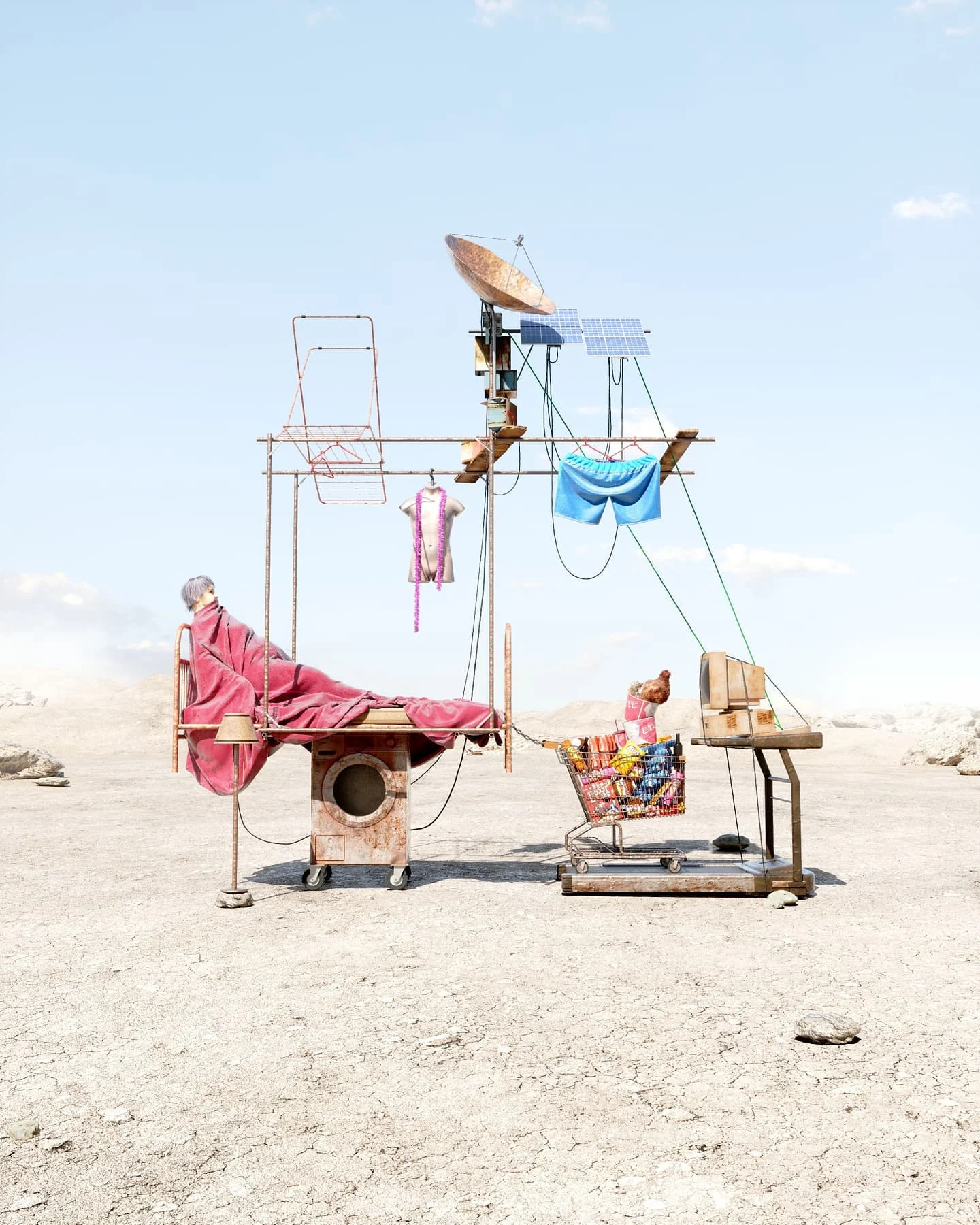
We five employees trickle in through the wide roll-up door, me bringing up the rear, holding Cloud’s hand. But instead of heading to their benches, everyone who enters the shed makes an immediate detour to the left. Once Cloud and I enter, I see why. A waste-era electric generator sits next to two squat silver cylinders of propane gas—a compact trio of highly illegal items. In the meantime, Acek comes through, parting our little crowd, carrying a metal tripod trailing two tubes. He sets it down with a grunt beside the cylinders, and I realize it’s some sort of cooking setup, with a burner and valves and connectors for gas. It looks like he made it himself.
Hands on hips, he surveys the items with pride.
“Is this for tonight?” asks Lina. She manages to sound excited and disapproving at the same time.
Acek fixes us all with a deadpan gaze. “Don’t tell the cops or you’ll all lose your jobs.”
Everyone laughs nervously, not just because of the joke-threat of unemployment. There’s a certain thrill about a celebration so energy-lavish that it defies the law.
The mood changes tangibly. In anticipation of tonight’s dinner, there’s a lightness to everyone’s movements as they settle down to work. Even I feel buoyant. I lead Cloud to his playpen next to my bench. My goal is to finish the toaster oven. Finally. With this goal in mind, I survey Cloud’s toys like a warrior assessing her arsenal of weapons.
The play kitchen generally keeps him occupied the longest, but he used it a lot yesterday. There’s the chance he’ll weary of it too quickly, or worse, for good. The train set keeps him absorbed, too, but requires more frequent intervention if something goes wrong. The xylophone is useless, as is the pull-along duck on wheels—they’ve become non-entities as far as he’s concerned.
Loved one day, discarded the next, I reflect in passing.
After more deliberation, I select the imitation Hot Wheels cars with their broken but still serviceable plastic track.
“They can race,” I say in as excited a tone as I can muster, placing them in a corner of the pen.
He looks doubtful, but I maintain my smile. To my relief, he takes the suggestion and toddles over to play. The clock starts now, not just for the cars, but for me: I estimate fifteen minutes before he calls for my attention or assistance. I scatter a few more vehicles on the other side of the pen, on the off chance they buy me extra time.
My left shoulder still aches too much from this morning’s battle, so I pry open the toaster oven’s side panel with my right hand. I fire up my sluggish brain to recall where I left off yesterday. The new inverter’s already installed. Now I test it for efficiency. Not great, but it’s the best we can do. More importantly, it passes official state requirements, albeit by a hair.
All I need to do now is replace the plug. I’ve just gone across the shed to rummage through the plugs and connectors box when I hear someone hollering my name. It’s Lina. She’s pointing frantically in Cloud’s direction. I rush back to the playpen.
He comes into view, little eyebrows knitted in concentration as he fiddles with two pieces of track. My immediate happiness at seeing him alive and unhurt gives way to irritation. Why has Lina called me over?
“He’s having trouble with the tracks,” she explains loudly in a tone I know well. It’s the one that seasoned, older mothers often use to speak with me whenever I’m with Cloud, which is all the time. The tone that even mothers my age or younger use once they realize I’m faulty, and therefore, how much I require their insight and intervention.
“Thanks,” I mutter.
Lina is often oblivious, but she picks up on my sarcasm. “I’m just trying to help,” she explains. “I know your condition makes it hard to sense these sorts of things.”
“Then why don’t you do something about it?” I ask.
She looks genuinely aghast.
“But you’re the mother,” she says. “I’d never dream of doing that!”
I close my eyes and take a deep breath. I understand what she’s saying. If I were a normal new mother, I would never let someone else attend to my child. Her way of assisting is to stand on the sidelines, trying to get me to operate normally. It doesn’t occur to her to lower the standards for normal operation; my health may be poor, but Cloud’s needs haven’t changed.
I enter the pen to help Cloud, who is getting increasingly frustrated, as Lina has anticipated. He wants to attach the track to another, incompatible one. I try to show him how they don’t fit together, ashamed that even someone whose mothering abilities have long since faded has keener maternal senses than I do. But the more I demonstrate, the more incensed Cloud becomes. He screams and bangs the offending track pieces against the playmat, then hurls them out of the pen where they clatter against the concrete floor.
I glance at the clock on the wall above the entrance. Two tantrums today, and it’s barely seven-thirty. I want to hide. I want to leave. I want to sleep. Instead, I lower myself with great effort into a cross-legged position and pull Cloud into my lap.
A change comes over me, as it sometimes does in such situations, and always beyond my control. Machine mode, I’ve come to call it. My eyes dim. My hearing grows more muffled. My emotions retract like snail antennae, shrinking from the exterior world. “There, there,” I say, my voice modulating to a gentle register. My hands press his little head into the crook of my neck and pat his back. “I know,” I hear myself say soothingly. “I know.”
Except, I don’t know. Not at all. I don’t know how two pieces of orange plastic can infuriate anyone so. I don’t know why, despite my best efforts to defuse these situations, they persist in exploding. I don’t know what I can do to make everything better. I don’t know why I am missing all the skills that I require to improve the situation. Cloud and I have been thrown into a deep pit, and I lack the ability to get either of us out. We will die in this pit, but everyone dies at some point, so if I can just postpone our deaths, it will be okay.
Cloud has calmed down, but not quite enough to be left alone in the pen again without making a fuss. I lift my body to its feet and sit Cloud on my right forearm, taking care to favor my left shoulder as much as I can. I walk back to the box of plugs and connectors. I set him down, and we both sift through. I select three possibilities and lead him by the hand back to my bench. He’s chosen something too. My hope is that it will keep him occupied while I try to compare plugs and make a fit. Instead, he drops his choice and reaches for the three I’ve set on the bench.
“Those are Mama’s,” I say, pushing them out of reach. He lunges for the toaster oven’s disembodied dials, and I push those away too.
“Wa,” he yells in frustration. “Wa” means “want.”
“No,” I say softly but firmly. My fingers close gently around his wrists.
“How is the toaster oven?”
I glance up. Acek is watching us, sipping coffee from his thermal mug. It’s the first time he’s acknowledged my presence today. Even now, it’s really the toaster oven he’s acknowledging. This is normal behavior for him these days, and yet it still stings.
“Pretty much done. Just a bit of rewiring, and I think she’s good to go.”
My approval-seeking tone surprises me. It’s the voice of a bygone era. It reminds me of when I first started working for Acek as a teenager, enthusiastic and eager to please.
Acek’s expression remains neutral. “I told the client how much the repairs will cost. It’s more than she thought. She said if we can sell it for her, she’d prefer that instead.”
Out of the corner of my eye, I spy Cloud making a grab for the toaster oven frame. I haul him into my lap to restrain him. My left shoulder smolders.
“Okay, Acek,” I reply in that same strangely peppy voice. “I’ll give it a good clean too.”
“You set the price, Vi.”
I nod as Cloud struggles to break free of my grasp. “Wa,” he insists.
At this last “wa,” Acek seems to realize I could do with some help. He crouches down, the paunch beneath his gray striped polo shirt compressing into a ball.
“Come to Akong,” he says affectionately, patting his knees.
Cloud toddles into his arms.
As they walk away, I pretend not to see the jellybean he slips into Cloud’s mouth. Or think about the jellybeans he feeds Cloud in a surreptitious trickle when he thinks I’m not looking. Cloud probably gets at least thirty over the course of an average workday. I suppose I should be grateful that Acek is affectionate to Cloud, even if he’s no longer warm toward me. Trying not to care, I return to the toaster oven. I now have added incentive. It’s been Acek’s new system since moving the business out here: for any item we end up reselling, 10 percent of the net profit goes to the employee who fixed it up. If the item comes from a customer—as in this case—they too get 10 percent commission, like selling on consignment.
Acek’s always been savvy at the business side of things. It’s how he turns a decent profit, though you’d hardly know it from the way he dresses and lives—the same cheap polo shirts and polyester trousers on rotation, the same secondhand furniture he salvaged from the streets and through migrant community networks when he arrived in this country in his late twenties, before I was born. Acek only buys something if it’s on discount or cheaper in bulk. Even the jellybeans he feeds Cloud are from two human-torso-sized jars under his desk. I bet WholeSale had a deal: more jellybeans than any single person could consume in their lifetime, two for one. But to his credit, Acek’s not a cheapskate where it matters. He treats us employees well, and our wages are fair.
Employees, plural. That’s taken getting used to. Back in the city, it was just him and me. There are more customers out here. The cost of living’s lower, but so are incomes, and even now, the cost of even the simplest RDC-compatible appliance is an investment that your average below-average household can’t take lightly, if at all. Twenty years ago, when the shift from alternating current to revolutionary direct current was announced, the government assured everyone that more affordable appliances were being developed. Technology evolves quickly to meet consumer demand, they assured the public. But RDC machines are still expensive, and people out here still prefer to hobble old AC ones to fit the new grid.
Free of Cloud, I fit the new plug in no time. I bring the toaster oven to the testing station and turn the dial. I check my watch. At the three-minute mark, the heating element begins emitting an orange glow. I bring my hand close to feel how warm it is. For the final test, I’ll have to ask Acek if he has any bread.
Acek is alone at his desk, doing paperwork. I ask first about Cloud’s whereabouts, then about the bread. The answers to both questions lie in the house. I exit the shed and enter through the back door, passing through the kitchen to the lounge room, where Cloud sits in Nina’s lap on the rattan-frame sofa watching TV. The blue curtains are closed—though the fabric is worn so thin they hardly keep out any sun at all. He’s watching The Wiggles on DVD. As with most hobbled TVs, the screen flickers, but Cloud remains mesmerized nonetheless. I wonder if he remembers the TV we used to watch—the latest in RDC technology; giant flat-screen; crystal-clear images. So energy efficient that we never had to worry about exceeding our household quota, not that we ever had to worry if we did. Those were the luxuries of being married to Gabe.
“So we’ll pay the fine.” Gabe would always say, letting the episode we’d just finished slide into the next, his arm drawing me closer to him on our sofa, his cheek nuzzling mine.
My chest aches at the memory, my body missing the sensation of being held and loved by someone my size. From this angle, in this light, Cloud’s resemblance to Gabe is undeniable—the slope of his nose, the shape of his eyes, the way his little lips break into a smile.
Nina’s startled to see me standing in the doorway.
“Acek asked if I could mind Cloud for a bit,” she explains. “He had something to do.”
Nina and I both call Acek “Acek,” but in her case, he’s her actual biological uncle—her father’s younger brother. Her parents died in a car crash three years ago and left her the house. It’s the main reason Acek moved out here, so his niece wouldn’t be alone.
I met Nina for the first time last year. She came with Acek to pick Cloud and me up at the station. Truth be told, I’m not sure I know her any better than I did back then. She’s quiet, though I wouldn’t call her shy. Reserved, more like it. She keeps a certain distance, even when she does speak, even when she’s standing right next to you. And she wears heavy makeup but pairs it with stretched out tees, ill-fitting jeans, ugly hoodies—streetwear, but without the style. The total effect is jarring. Somehow, you’re not sure where to look.
I catch myself. Don’t be such a bitch, Vi. She lost her parents. As someone whose mother died young, I should be more sympathetic. Who cares what she wants to put on her face or what clothes she wants to wear? Not like I’m fashionable myself.
“Do you have any bread?” I ask. “I need to test a toaster oven.”
Nina slides Cloud off her lap and heads to the fridge. I plunk down next to Cloud and squeeze his little thigh.
“Having fun, sweetie?” I ask, putting on my widest smile.
He answers with an abstracted nod, then returns to the blissful world of full-grown men and women prancing and singing in brightly-colored outfits. The settings keep changing. One minute they’re in a forest, the next minute they’re rowing a boat on a lake. It reminds me of the old Chinese music video DVDs that Pa would watch: a singer on a green riverbank, then at a famous landmark, then on a beach, the song itself rolling relentlessly on. Though he’s happy, I feel guilty that he’s having so much screen time. Twenty minutes per day is the recommendation for children under five, as Gabe was fond of reminding me.
When I remember this about Gabe, the ache in my chest goes away.
“Be good for Aie Nina, okay? Mama has just one more thing to do. Then we’ll have lunch.”
This time, Cloud doesn’t even bother to respond.
I head to the kitchen, where Nina’s taking out a slice of white bread.
“It won’t be much longer,” I say apologetically. “I just want to get this toaster done.”
She hands me the slice. “Take your time. I don’t mind. Anyway, I’m in between jobs.”
“By the way, thanks for this morning,” I add, to make up for my mean thoughts about her fashion sense.
She looks confused.
“In the car. When Lina was being Lina.”
“Oh, that.” Nina cracks a faint smile. “No worries.”
She looks like she’s about to say something else, but shuts her mouth instead.
Excerpted from the novel But Won’t I Miss Me. Reprinted with the permission of the publisher HarperVia, an imprint of HarperCollins. Copyright © 2026 by Tiffany Tsao.