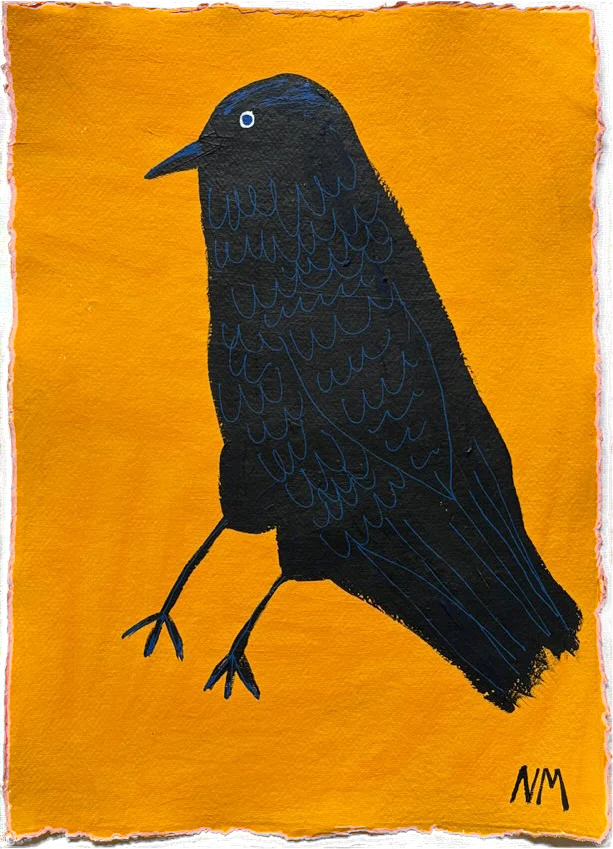
Introductory Note:
Crow Language / Crow Testament / Crow Gospel is a three-part contemporary poem that reimagines the crow—not as omen or superstition—but as a bearer of memory, resistance, and witness. Drawing from Indian geographies, ancestral lore, and urban decay, the poem gives voice to what society often silences: scavengers, lost languages, buried histories. The crow, in this context, becomes more than bird—it is metaphor, ancestor, prophet, and co-survivor. Blending spirituality, protest, and lyrical memory, this poem listens deeply to the dark feathered intelligence that hovers at the edge of civilization.
1
Crow Language
I learn to see the crow differently now— not as omen, aftermath or dark prophet, just a misread glyph in the city’s broken script. In Kochi, on Marine Drive, a crow lands between two lovers. The girl crosses herself, spits three times.My mother’s village built bitter words around them: kaakka—hissed through teeth like history’s complaint.They forget this is also a child’s first noise, language born where shadow meets throat. Everyone wants cleaner metaphors.Black as what? Coal before fire, ink before alphabet, secrets hoarded in a madman’s coat. The kind of black that doesn’t apologize.They say: too dark, too loud, too hungry. They mean: wrong feather, wrong sky, wrong kind of intelligence watching them back.In school, a child draws a crow. The nun says draw a nicer bird. What the child learns has nothing to do with drawing.When you attach -less to love, you get the sound wind makes through an empty cinema, the echo haunting demolished neighborhoods.Crowless, they call it peace. I call it the kind of silence that comes after forgetting your own name.They want their gods clean as hospital corridors, but mine have always preferred the company of scavengers.A crow lands on my windowsill each morning. I’ve begun to think of it as punctuation, the necessary pause between dreaming and waking.
2
Crow Testament
The city worships what it cannot break. I’ve seen men pray to ATM machines, women burn incense before locked hospital doors.Meanwhile, crows conduct their parliament on telephone wires, speaking in dialects older than concrete, older than borders.What did the crow teach Shiva that made him turn blue with revelation? The mathematics of scarcity, the democracy of garbage.At a random Temple, pilgrims feed the sacred pond while crows watch from mango branches, calculating trajectories, practicing patience. They know what gods forget— hunger is the only honest prayer.In Valiyangadi market, a man sells caged birds. Mynahs, bulbuls, finches arranged by price. No crows. You cannot sell what refuses to acknowledge ownership.My grandfather said: notice how a crow never flies in a straight line. The shortest distance between two points is not always the wisest path.Some nights I dream in crow-tongue, wake with my mouth full of sharp sounds, the taste of metal and monsoon. My neighbors hear me cawing on the balcony and cross to the other side of the street.Somewhere between Palayam and Sweet Meat Street, the bus stops without explanation. Through the window, I watch three crows dismantle something unidentifiable. Their beaks like black scissors cutting reality.The woman beside me touches her mangalsutra, whispers a prayer against bad luck. I almost tell her: it’s too late. We’ve already been claimed by what we fear. Last week, a crow dropped a coin at my feet. I’ve been carrying it in my pocket, running my thumb over its worn face. Not currency anymore, just metal remembering a different shape. The priests say crows carry the dead. I say they carry the parts of us we’re too civilized to claim— the midnight ravenous mouth, the eye that sees in darkness, the voice that refuses to sing what others have written.
3
Crow Gospel
What the priests won’t tell you: when Adam named the creatures, the crow refused its given name.Instead, it swallowed a piece of night. Instead, it carried away a splinter of god’s voice.In Kuttichira mosque, men wash their feet before prayer. Crows drink from the same water— their ablutions equally sincere.My mother feared them. Said: they come back as everything we try to bury.She wasn’t wrong.I’ve seen how they gather after riots, patient witnesses to what we pretend didn’t happen. Their black tribunals assembled on charred rooftops, passing judgment we can’t bear to hear.At Mishkal Palli, an old imam tells me: the crow was the first creature to teach humans about burial. When Cain stood paralyzed before Abel’s body, a crow scratched earth with its beak— showed death’s proper punctuation.This is why we fear them. Not for their darkness but for what they remember that we choose to forget.During the floods, when the sea reclaimed what never truly belonged to us, crows remained. Perched on floating debris, making maps of the drowned world.The truth splits open like a ripe jack fruit: we were never the protagonist of this story.Behind Ansari Park, a madman feeds crows each morning, collecting their fallen feathers in a tin box. When I ask why, he says: to remember the texture of difficult knowledge. to keep something that chose to fall.Half-histories, demolished neighborhoods, banned books, forbidden love— the crow knows how to find them all.It flies crooked because straight lines are a human invention, a failed geometry.Last night I dreamed my spine grew feathers, my fingers stretched to wings.I rose over Calicut, saw how the sea is slowly taking back the shore, how temples and mosques and churches all cast the same shadow, how markets ignite at dawn with temporary hungers.From above, the divisions we kill for disappear.Every morning now, I leave rice on my windowsill. Not as offering, not as superstition, but as acknowledgment.We share this broken century— the crow and I— scavenging for what remains after the fires of progress, after the floods of forgetfulness.When they come, they bring fragments of themselves. A feather. A harsh call. A dark eye.Each piece a verse in this gospel of survival, this testament to what persists when everything else has been washed away.
Notes: Marine Drive is a famous seafront promenade in Mumbai, India; kaakka is the Malayalam word for ‘crow,’ often used in colloquial speech; mangalsutra is a sacred necklace worn by married Hindu women; Valiyangadi is a historic marketplace in Calicut, Kerala; Palayam is a locality in Calicut often associated with commerce and history; Sweet Meat Street, also known as Mittai Theruvu, is a prominent shopping street in Calicut; Kuttichira is a historic Muslim neighborhood in Calicut; Mishkal Palli is a centuries-old mosque in Calicut known for its architecture; Ansari Park is a public area in Calicut, featured here for local grounding; monsoon is the seasonal heavy rainfall typical of South Asia; ablutions are ritual washing or cleansing, especially before prayers.