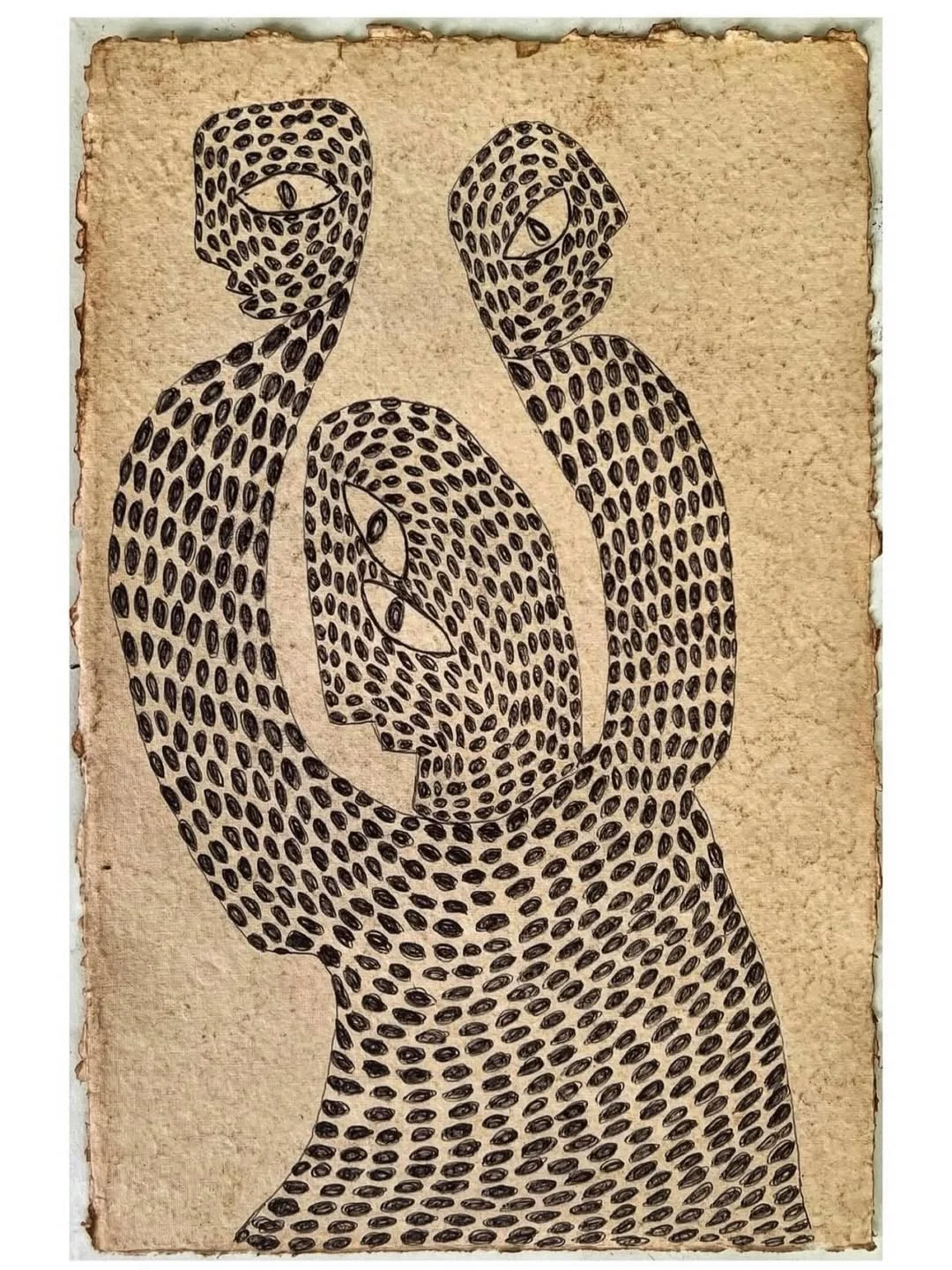
“Kulumawe” by Javier Iniesta


My soul goes out for a walk.

I said it should stay home due to the storm

            but it refused.

It walks out and leaves this body

            like a lifeless crate.

Dogs bark and wonder:

            what kind of ghost is haunting us?

They sense my presence.

I climb out of the trenches:

            it’s the only way to believe

                        that sorrow

                                    is immortalitys

middle name.

David Cruz

David Cruz is a Costa Rican poet and editor based in the United States. He earned an MFA in bilingual creative writing from the University of Texas at El Paso and is currently a PhD candidate in Hispanic studies at the University of Washington. Cruz is the author of numerous poetry collections, including Cine Fractal (New Aleph, 2023); Lazarus (Mantis Editores, 2022); A ella le gusta llorar mientras escucha The Beatles [She likes to cry while listening to the Beatles] (Valparaíso Ediciones, 2016); and Trasatlántico (Editorial Costa Rica, 2015). Cruz has been the recipient of several awards, including the 2011 Luis Cardoza y Aragón Mesoamerican Poetry Prize. He was also a finalist for the Montreal International Poetry Prize in 2020. 
Anthony Geist

Anthony L. Geist is a professor of Spanish and Comparative Literature at the University of Washington, having taught previously at Princeton, the University of Texas in San Antonio and Dartmouth College. He has published widely on Spanish and Latin American poetry, with an emphasis on the Generation of 27, the avant-garde and surrealism. He has also worked in visual studies, curating art exhibits and co-directing a documentary film on the Lincoln Brigade. His translation of the Peruvian poet Lucho Hernández was a finalist for the PEN Prize in 2016. He was knighted in the Order of Isabella the Catholic Queen with the rank of Cruz de Oficial.

Javier Iniesta

Based on the philosophy of art, two works by the contemporary Spanish visual artist Javier Iniesta are examined. These works are a rough drawing on paper and a drawing made with pen and ink. The thesis of the essay suggests that the aesthetics underlying Iniesta’s work would be expressed in an artistic style that could be called mystical-metaphysical. With support from Sloterdijk (2020) and Cavallé (2006; 2008), the main results identify the mystical and the metaphysical with the concepts of supernatural knowledge and philosophy of religion, respectively. Likewise, the art of the Spaniard is considered as the manifestation of a quasi-meditative practice that would embody the world of perennial philosophy. And this, considering the totem—or image of the super-being—as a sort of iconic structure of representation, and totemism as a determining principle of the unfolding of this representation.