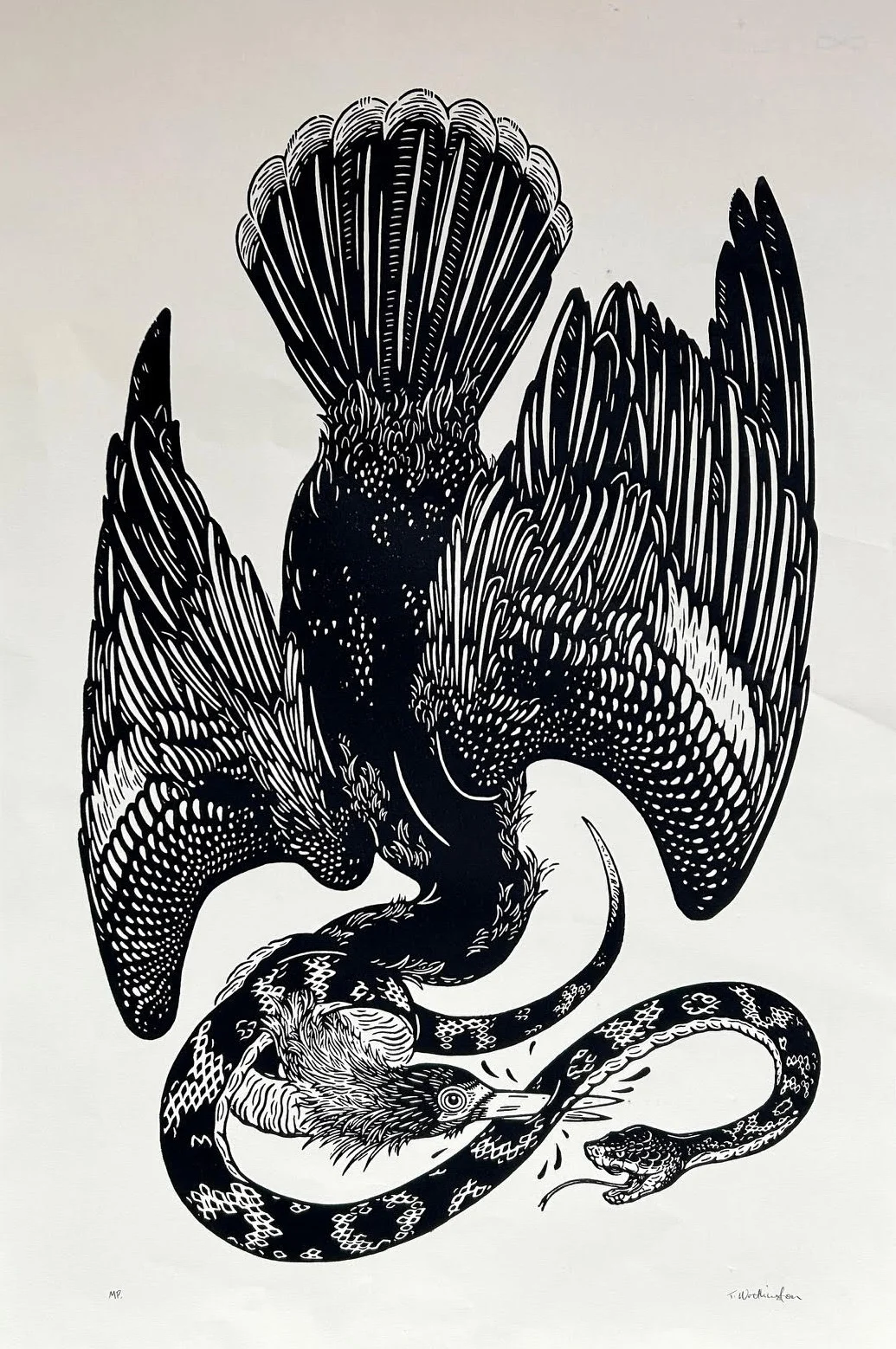
The day’s first job was an opossum: a silver coin on the road. Its head was intact, jaw pried into a permanent scream. Its teeth were both fearsome and piteous in their stiffened gums. The animal’s abdomen had been split open, the intestines congealed ruby and black. Its front legs were bent, dainty paws drawn up. Adam went around the back of the truck for the shovel. It was a bright October morning, a jump in the air, the ground still soft enough to break. He dug a hole under the pines. When the hole was deep enough, he dabbed menthol ointment around each nostril and went for the animal. The smell wasn’t that bad, not as bad as in high summer. After three years of this work, he still wasn’t used to the stench of death—maybe he never would be—but he’d learned to tolerate it.
He crouched beside the animal and examined its pink paws, defunct tools. He always made the same study of the animals he found, proud to have kept up this small ritual. From frog to bear, he hadn’t neglected a single creature. This marsupial, too, commanded a moment of reverence. Its retired tail—long, thin, and pointed—was as mysterious as anything in the world. Only Adam was there to appreciate its evolutionary triumph, this prehistoric appendage tailored to the needs of opossum alone. He admired the nose, the ears: this little dream of Nature. Then he rose, lifted the shovel, and eased its point beneath the animal’s crushed hindquarters. He pushed slowly at the places where fur and flesh had adhered to asphalt until finally the bulk of the creature’s weight rested on the shovel’s head. He lifted and pivoted to the side of the road, angled the shovel, and shimmied it so that the carcass tumbled into the pit. There, it changed, became just a thing.
Back in the truck, Adam motored along the empty road as the sun began its play through the trees, its marshaling of surfaces. All at once it blared through the windshield. He pulled down his visor and scanned the shoulder. A glint in the leaves became a beer bottle, and he stopped to pick it up. He put it in the contractor bag on the passenger seat where he collected objects for the chapel.
He prayed that Jocelyn would come tonight. As he drove, he pictured her sitting where the contractor bag was, wearing her green fatigue jacket. He could almost envision her pale profile in his mind, the soft lips and nose. He could almost see the long dark hair, the ends cut on the diagonal like a broom. In his mind, she turned to look at him, and he tried to conjure the impact of her eyes. The alchemical flame and terror they sparked in him. She’d been coming to see him for more than a month now, quietly, without fuss, as if it were natural. She didn’t announce when she was coming but followed a rhythm of her own, which he was afraid to question and disrupt. But he hoped all day long, every day, that she would come that night. It made the hours sharper, almost intolerably sharp. Every mundane thing flashed with meaning. The pines watched him like silent grandfathers, casting black paper shadows on the road.
He drove onward, searching. He usually found his treasures in town: vibrant snack wrappers, gossamer grocery bags, sturdy plastic straws. He made quick work of the smaller animals. He removed a squirrel from under the intersection stoplight and escorted a crushed chipmunk away from the library before a child could see it. On his way out of town, he found another squirrel that looked like it had been there for days, that he must have missed. As he scraped it up, he wondered how many others in the world shared his intimate knowledge of squirrel anatomy: the brown saber teeth, the labial maw. This one was no more than a pelt, requiring a long-handled scraper. It was the worst kind of cleanup, the kind that left a putrid splotch on the road.
He’d hated his first few months working with the state highway crew. There’d been bloated carcasses that popped when he tried to shovel them. He’d chased vultures from half-eaten coyotes and porcupines. He’d seen creatures with every organ, muscle, and bone exposed to the air. Eyes pecked out, brains partially consumed, entrails unraveled. He’d found animals in perfect condition, too, like the velvet-muzzled fawn that appeared to be peacefully sleeping, its neck broken. He’d vomited often those first few months. Everyone did, the other guys assured him. They all wore bandanas over their mouths, though this did little but provide the illusion of barrier.
Now, he was a sole contractor working for the town. He’d become accustomed to all manner of grisly decay, but there was one thing he’d never get used to: the still-living. He couldn’t stand the contortions, the frantic effort and exhaustion of an animal confused by its ordeal, half glued to the road, snarling at the faceless predator that had hobbled it. He used a heavy shovel for these, a strong swing at the base of the skull. Even so, he heard the cries of pain, of non-meaning, in his dreams.
Late in the afternoon, looping toward home, he made note of a deer and a raccoon. He saved these bigger jobs for dark when there were fewer cars. At last, he turned onto his own dirt driveway and the sunlight was swallowed by trees. His house was burrow-like, not much more than a cabin, a single room with unpainted siding and moss on the roof. Inside, he took off his coveralls and put them in the washing machine. He cranked the hot shower and marveled at the vitality of his own body. Unlike the animals he’d buried today, he could still move about at will. He dried himself and put on clean clothes. Renewed, he pulled the discarded items from the contractor bag, washed them out in the sink, and took them outside.
The chapel had grown to occupy most of the side yard. He called it a chapel in his mind, but it was really just an annex of sorts, resembling a wigwam. As an independent contractor, he thought of trash collecting as a kind of pro bono service. He felt entitled to keep whatever he could use in construction, anything that wouldn’t disintegrate in the elements: plastic juice bottles, cans of Bud Light, broken sunglasses, flip-flops. He interspersed these among the pine branches and twigs, secured them with twine. The result was beautiful, he thought. A hybrid of man and Nature, knotted and perforated.
He especially liked to work on the chapel on moonlit nights, like tonight, when there was a sense of sacred ceremony. After he’d put the new things in place, he climbed into the hammock and admired the patchwork of Snapple and Nike and Lay’s, ocular spaces letting in light. The hammock swayed, and he thought of Jocelyn. This was the time of night she usually appeared. He tried to see her pulling her dress over her head, the rows of ribs beneath the skin, the shy suggestion of breasts, the shock of nipples so neat they looked painted.
He heard a car engine and opened his eyes. A thousand fingers of light pierced the chapel walls. She was there.
He went back out later for the raccoon and deer, wearing a reflective vest. When he saw headlights approach, he stepped off the road into the brush. He didn’t want to court fate, especially now. His body still purred from Jocelyn’s visit. He looked in wonder at the raccoon, its night mask impeccably drawn, its delicate whiskers like sentient grasses. He was so taken by the beauty of the bristling coat that he removed a glove and buried his bare hand in the creamy underfur.
In his mind, he replayed the vision of Jocelyn taking off her dress in her candid way before joining him in the hammock. They’d lain quietly at first, bodies cradled together, Adam’s hands running up and down her back. She’d used her tongue like a paintbrush, tracing color from his mouth down the side of his neck. He saw blue as it lifted over his collarbone, then violet as it wound over his sternum, then red as it thrust into the thicket at his groin. The hammock swung and shuddered. When she’d taken him in her mouth at last, it was a holy visitation, soaring wings and spangles.
They’d lain on the hammock for a while afterward, then gone into the house for cocoa. She never seemed awkward or ashamed. Other girls were always moving, swishing their hair, pinning it up and dropping it down, as if afraid to settle for too long in the wrong pose. Now, Adam was the one who was nervous, who couldn’t think of what to say to the girl holding a mug in his kitchen. He was frozen by fear that she’d snap awake and recognize her error. He didn’t know why she was drawn to him. He didn’t give her gifts, didn’t make a lot of money. Although he technically owned a business, his work was repulsive by nature. He wasn’t yet old, but she was so very young—twenty-two, she’d told him—and almost more beautiful than he could stand.
As he was digging a hole for the raccoon, another set of headlights appeared in the distance. He stepped away from the road, crunching the leaves. The truck slowed and stopped, the window rolled down, and a man in a ball cap called to him.
“The fuck you doin’? Scavenging?”
The tickle at the back of his neck—the physiological response to danger—came before he even recognized the man. His brother’s friend, Mason Hatfield. So many men and boys had targeted Adam since childhood, as if just the sight of him was offensive. He didn’t play sports. He was quiet and fine-featured, and he hadn’t wanted to join the service, which was a further stain. Mason was active duty himself. Adam’s brother Colton had already deployed twice. One of his squadmates had been killed by an IED, and Colton had come back hardened and sour. Now he wore a hat embroidered with the words Molon Labe and carried a SIG Sauer. He stockpiled ammunition and MRE rations, as if the Taliban might follow him home.
“Seriously, man, that’s disgusting,” Mason pressed.
Adam lowered his head, subordinate. “Yeah, it sucks, but some asshole’s gotta do it.”
This brought out Mason’s barking laugh. He extended his fist, and Adam met the knuckles with his own.
“Come to O’Reilly’s for a beer,” Mason said.
“Sure, if you can stand the smell,” Adam muttered, gesturing to his own body, hating himself as the truck pulled away. The exhaust lingered, and he was alone again with the raccoon.
Both of them knew he wouldn’t go to O’Reilly’s. Colton would probably be there, doing shots and dancing with women, slipping them tongue and sliding his hand up their shirts. The women would be tossing their manes like fillies, pressing their hips against him. It was men like Colton and Mason they loved.
“Are you ever sad, when you find them?” Jocelyn asked the next time she came. Amazingly, this woman wasn’t at O’Reilly’s with Colton and Mason, but in the hammock with Adam in the woods. She looked at him with her dark eyes, and he thought he saw real sympathy there. “It must be hard. You really love animals, don’t you.” She ran a finger over his shoulder, and he felt he’d been marked with hot ink.
Adam started talking helplessly, telling her all the things he’d never tell another man. He talked about how, when he was young, he hated his father—and later, his brother—for hunting deer. He hated his brother for calling Adam a pussy when he cried at the severed deer heads. It wasn’t the death that bothered him, he wanted to shout, it was the killing. But he hadn’t fought back against either his father or brother, and he couldn’t forgive himself for this. The animals had no one else to defend them. Adam was the only one who cared, the boy who sat for hours watching squirrels at their business, digging decoy acorn caches.
As a child, the first time he’d seen a squirrel lying flat on the road, he hadn’t understood. He asked his mother to stop the car; maybe the squirrel was sick. After she explained what happened when animals ran across the street, he was silent. He couldn’t understand how anyone could keep driving afterward, how anyone could casually accept the destruction of a creature that had been animated—foraging, scampering—just moments before.
After that, he made his mother turn the car around whenever they saw what she called roadkill. “But it’s already dead, honey,” she pleaded. Still, he needed to see. He felt that someone had to look. Someone had to contemplate the flesh ripped by the fender, the foreleg crushed by the tire, the eye dotted with gnats. Humans had caused the destruction, and a human should witness it. The first time he knelt by a carcass, his mother was alarmed by his tears. She’d taken him in her arms and carried him back to the car, terror glazing her eyes, as if the trouble were with him. He hadn’t known how to explain that his impulse wasn’t a perversion but a kind of penance. He was looking at the shattered creatures in order to right the balance.
When he finished talking, Jocelyn smiled sadly and lay her head on his shoulder. He stroked her back, the smooth skin over the scapula bone, and for a moment imagined happiness.
“I should go,” she whispered.
“Don’t,” he breathed into her ear. “Stay until morning. It’s dangerous out there.”
She laughed, but he was serious. He’d seen so much, he knew how easy it was, how ruthless the impact of steel could be.
Over the next four days, Jocelyn didn’t come, and Adam was sure the dream was over, that she recognized him as the misfit he was, the weakling other men saw.
But on the fifth day, she returned to the chapel. He didn’t wait for her to come to the hammock but went straight to her and pulled off her dress. He lifted her astride him, the way he imagined his brother might do. He pushed her hair back and kissed her deeply. She melted into him, and together they rolled into the hammock. He closed his eyes and allowed pictures to bloom behind his eyelids. Whenever he was inside her, he saw a spacious palatial room. There were fine carved furnishings, fluted columns, art on the walls. He sensed other rooms adjacent, alcoves and antechambers. He would have liked to visit these other rooms but was too involved in this one, enchanted. As he finished—rising to the ceiling, spinning with the chandeliers—he hoped to next time go farther, explore more.
There was a strange melancholy in removing the condom that sagged with his own fluid. So much wasted potential, so many small futures. Maybe next time he wouldn’t wear one. Maybe next time he’d expand into the distant corners of the palace and take up residence.
Afterward, still lying in the hammock, Jocelyn looked up to the ceiling and asked, “What made you start building this?” and Adam again found that he couldn’t stop talking. He told her about earning badges for the Arrow of Light, the highest rank in Cub Scouts. For his Artist badge, he’d made a construction from found objects: plastic utensils, lace, bottle caps, chicken wire. He laughed. “I guess I never stopped.”
She paused. “Are you, like, an Eagle Scout?”
“No, I dropped out at Star. The uniforms and salutes and all the God and country was getting too militaristic for me. It felt like they were prepping us to be soldiers or something. I only really cared about wilderness skills and camping out.”
For his Naturalist badge, he’d kept a cricket zoo and a terrarium of frogs. He’d observed animals in the wild and kept a behavior log. To this day he remembered the exact definition of a naturalist from his Webelo handbook, and he quoted it for Jocelyn in the hammock: “The real naturalist has a pair of sharp eyes and a great love for Nature. He sees things that other people miss. This is because he knows where to look and what his eyes show him.” Adam glanced at Jocelyn, then away. “What I really wanted to be was a park ranger.”
“That’s not a surprise.”
“Well, clearly it didn’t work out. You need a degree to be a ranger, but I couldn’t deal with college. I just wanted to be outside. Anyway, now here I am.”
“Now here you are.”
“You know, it is hard,” he said after a minute. “You asked me before whether I’m sad when I find the animals, and the answer is yes. It’s hard. Especially when they’re suffering, and I have to dispatch them. I do love animals. I’ve tried to never kill a living thing unless I have to.”
She picked up her head and smiled, eyes narrowed. “Never? That can’t be true. You’ve never swatted a mosquito or squished a spider?”
“No. I mean, I’m sure I’ve killed plenty of things without meaning to, just by walking outside or driving a car or breathing. But never on purpose. Never in anger or annoyance.”
Jocelyn shifted away from him slightly, and he feared his words sounded arrogant.
“Wow, that’s unbelievable, but I believe you.” She sighed. “I’m afraid I’ve killed plenty of insects in my life. And mice. I’m not proud of it, but my apartment’s infested. I feel bad for the mice, I know they’re just trying to get warm and have families, but they poop literally everywhere.”
Adam considered telling her about the mice, squirrels, and raccoons that nested in his own house. They rattled in the walls at night, and he’d grown accustomed to the flit in the corner of his eye when a dusky shape skated over the floor. He swept the droppings from his counter each morning like poppy seeds. But Jocelyn was looking at him now, and the transmutation was starting anew. Her eyes, their melting softness and upturned sweetness, broke him down at a cellular level.
“Maybe I could stay here for a little while,” she said. “If the mice get worse.”
He heard the words, but their meaning hovered just out of reach. He responded quickly, before full euphoria burst over him. “Of course you can stay here. Stay as long as you like.”
She nuzzled into him. “Thank you. That’s so nice of you.”
He pulled her closer to him in the hammock. After a while they’d find a rhythm, a comfortable pattern together. Routines, rituals. He could barely breathe. He pulled away, because he had to, and stood up, dizzy. “Let’s eat something,” he said.
He put on his jeans, and she followed him naked from the chapel to the house. He made a curry, the first thing he’d ever learned to cook and which he made several times a week: tofu, rice, cauliflower, dyed bright with turmeric. He’d been a vegetarian for over twenty years. It was his first volley, as a boy, against the system of death. Looking at Jocelyn sitting on his bed—the bed itself salvaged from the recycling station, dressed with sheets from the community center, aglow in the light of a lamp from a thrift shop—he thought of the slaughterhouses and poultry farms, the burning elephant tusks, the whirlpools of trash in the ocean. Everything magnificent rubbed out by the compulsive touch of humans.
He felt like a heroic figure, making a simple meal for a woman in this austere space. He built a fire in the fireplace and served the curry. Jocelyn sat at the table, bare in the firelight, jet hair framing her breasts. There was only a handful of girls like this in the world; it was a miracle he’d found her on a bench outside the community college. He’d stopped to pick up a deflated Mylar balloon from the side of the road and found himself at her feet. He knew nothing except that she was studying nursing and worked at a diner in Dunfield. He hadn’t asked the name of the diner. He didn’t want her to think that he’d come sit in a booth and watch her. He sensed that she’d bloom for him at a remove.
When he asked about her family, she closed her eyes. “Let’s say I don’t really have a lot in common with my parents. They disapprove of my choices, and I disapprove of theirs. My brother’s okay, but he moved to Colorado a long time ago, and I hardly ever talk to him.”
“Well, siblings can be overrated,” Adam offered. “My brother and I never really got along. I kind of avoid him now.” It seemed she was waiting for more, so he added, “Also, I think there’s stuff he did in the service I don’t want to know about.” He stopped there. He didn’t say that he hated being in the same room with Colton. There was a brutality in his brother’s eyes that wasn’t exactly new, but freshly sharpened. When his brother looked at him, he wanted to step away.
“Come back whenever you like,” he told Jocelyn when she left a few hours later, in the gray vapor of dawn. “If you want to stay, you’re welcome any time.”
Again, she did it, left him alone for three, four, five nights in a row. How could she talk about moving in with him and then disappear like that? It was a physical ache to look at the empty passenger seat, the flaccid contractor bag. He berated himself for not having asked the name of the diner, the address of her apartment, even her last name. Any man would have asked. Any man would have wrested control of the story. Only Adam would release a girl like that into the wild.
He was nauseated as he worked. He struggled to see beauty in the animals he found. The smell of decaying flesh just mixed with the acid of his fear and regret. By the fifth day, all he saw was ugly, dumb death.
The temperature dove as the week progressed, and one cold night his headlights caught the mirrored eyes of a cat splayed on the road. A gray cat, likely invisible to the driver that hit it. One of the back legs had been flattened, but the animal was alive. Adam’s gut clenched as he assessed it. The cat had a collar, a metal tag with the name “Dusty.” It was long-haired and its nose was a tight black heart. A beautiful cat. He extended his gloved hand, and the cat lifted its lip to hiss. A good sign. It was possible the driver hadn’t even noticed the collision. Most everyone, no matter the urgency of their journey, stopped for a cat or dog.
Adam’s gloves were made of stiff leather and reached to the elbows, allowing him to lift the cat into the soft crate. It mewled in the back seat as he drove to the animal hospital where a night vet was on duty. He stayed in the waiting room, hunched in a vinyl chair beside a ficus tree, and for the first time in days felt free of Jocelyn. He saw only the image of the cat’s small face, its slit pupils with wisdom beyond measured time. All the cat knew was the ballooning now. This moment, and this one. Life and death and the bridge in between.
He stayed in the chair until the vet had called the phone number on the tag and located its owner. He stayed until it was determined the animal would survive. Only then did he leave the animal hospital and rejoin the night road, its yellow lines now seeming a beneficent guide, thanking him for helping make the world more whole.
It was as if saving the cat had revised the night in his favor, because when he returned home Jocelyn was waiting for him, bundled in the cold. They went straight into the house instead of the chapel, and he started a fire. It was different, less spontaneous somehow, when she took her clothes off indoors. He felt compelled to seduce her in some way. He helped with the green fatigue jacket and the woolly sweater and the buttons of the dress. His fingers trembled. There was, as always, no bra. He pulled her onto the bed, which felt too wide and flat compared to the cradling hammock, but his mind was made up—it must have happened when he’d first seen her at his door, it must have been tied up with the rescue of the cat—and as they lay on top of the blankets, warming each other’s skin, the whisper leaked out of him.
She didn’t answer at first, and for the moment he thought she’d agree he felt a helium rush. But she only smiled weakly and shook her head. Just a slight movement from side to side. “I know it would feel better for you without it, but…”
He didn’t wait for her to finish. “It’s okay,” he muttered into her neck. Her rejection was clear and cruel. It had nothing to do with his pleasure, he wanted to protest, but didn’t want to dignify her insult with an argument.
With effort, he reached across her body to the bedside table and found a condom in the drawer. This time, he didn’t feel the gracious dimensions of rooms in a palace. He felt that he was confined to the vestibule, the foyer, the mudroom. When he came, it was like discharging into a shower drain.
“Listen, I’m sorry about the condom,” she said quietly as he stoked the fire afterward.
“What?” he croaked. “No. There’s nothing to be sorry about.” His face heated, and he was afraid his anguish would be visible.
“It’s just that I’ve had to learn the hard way.”
She was sitting nude on the edge of the bed, hunched over a mug of cocoa. Her hair hung over one shoulder, a slash of dark on light. A midnight pelt, a mink. The meaning of her words skimmed the surface of his consciousness. The visual cortex of his brain was occupied while the auditory cortex did its interpretive work. I’ve had to learn the hard way, the mink was saying, but what had it learned?
“How’s that?” he said.
“I mean I made a mistake once.” She looked up at him, and he stared back at her, this strange creature on his bed.
“You made a mistake,” he repeated.
“Yeah. I got pregnant a while back.”
This statement made no sense to Adam. It slid off the framework of logic. She wasn’t pregnant, that much was clear. She would have told him if she were pregnant. She would have mentioned if she had a child. And yet he was processing her message in a buried place. His chest clamped, and he felt that something new was entering his bloodstream. He didn’t answer the girl but looked at her blankly, feeling his pulse gain speed. She appeared to be waiting for something from him.
“Anyway, it was awful, and I don’t want it to happen again.”
He let his eyes close for a moment, and when they reopened, she was still sitting there looking at him with that unbearable, expectant expression. Adam’s heart raced.
“You mean that you were pregnant, but now you’re not? By accident, or on purpose?”
His voice was cold. Jocelyn blinked, and her face colored. Adam looked away, into the fire. His body had begun to tremble. He took rapid breaths, staring at the fireplace, the madly flapping flames. For a flickering moment, all the world was inferno, consuming anything put in its jaw. He had an image of Jocelyn placing her baby in that great oven.
His voice shook. “What do you want me to say? I’m sorry for you?”
Naked, he went to the sink and poured his cocoa down the drain. He pulled on his underwear and jeans. His ears were full with the slamming of his heart. He couldn’t look at her. The image taking shape in his mind was of a mangled thing in the fire, a bloody ruined body, worse than anything he’d seen on the road.
Without meeting her eye, he took his coat and went outside. He got into his truck and drove. His heartbeat slowed a little as he followed his own headlights into the night. It was a relief to just move forward, to press the sole of his boot to the accelerator and go away. When he came into town, he saw the sign for O’Reilly’s. He hit the directional signal, parked in the gravel lot.
It was more crowded than usual. A few older guys with beards sat at the bar. Some middle-aged women in flounced blouses glanced up as he came in, and their gazes lingered. Adam was shaky on his feet as he went to the bar and found an empty stool. Before he’d even caught the eye of the bartender, a trim man appeared beside him, raising a hand for a high five. Mason Hatfield. Adam brought his own hand up in rough greeting.
“Get a beer and come play, man.” Mason withdrew to the pool table at the far end of the bar.
Adam looked, and sure enough there was Colton, taking a shot with the cue. He wasn’t sure if Colton saw him or not, if Mason had pointed him out. Aerosmith was on the jukebox, loud and jangling. He tried to latch on to the drumbeat. He ordered a Jim Beam and watched as a drunk woman climbed onto a barstool and balanced there, swaying to the music. As she wobbled, Adam stared at the breasts pushing up from the low-cut tank top, the butterfly tattoo wedged in the cleavage. Finally, the woman toppled from the stool onto the lap of the man beside her.
Adam made himself look away. The bourbon came, and he swallowed it fast. He rarely drank, and the alcohol hurt going down. But soon his throat numbed, and he felt only a pleasing heat. He watched the drunk woman. She was in her fifties, maybe sixty. It was a joke that the female body could be owned and operated by women like this. It was an offense that a girl like Jocelyn, with a half-formed mind, could be responsible for life and death. As if the choice were hers, a lever to flip based on mood or circumstance.
He turned his stool away from the woman and watched Colton at the pool table. There was the bald eagle T-shirt, the camo pants, the Molon Labe hat. Sliding up beside him was a girl with flaxen hair, probably bottle-dyed, too straight and smooth to be real, like the hair on a doll. Her turquoise top was just a scrap of fabric, and her stiff, low-rise jeans showed the band of thong underwear. It was like they were dressed for different climates, different planets. Adam watched Colton chat with this girl, drinking from his bottle of Budweiser. She touched his brother’s chest with her fingers. Adam finished his bourbon and ordered a beer, which looked like urine and tasted like backwash. In his mind he saw Jocelyn, whose face wasn’t beautiful to him anymore but pointed and pinched, with flashing teeth. It had been a mistake. The stupid mistake of a boy who’d refused to see.
Now he made himself look. He looked at the woman on the man’s lap at the bar, the bleeding lipstick, the hoops weighing her sagging earlobes, the smudged butterfly between her tits. He looked at the blonde at the pool table with Colton, the dip of ass above the band of jeans, the fried white hair on her head. He looked all around the bar. He looked at what these women had done to themselves.
He made himself finish the disgusting beer, then ordered another Jim Beam, old friend, slipping down his throat like silk. As Adam watched, Colton came out of the pool room toward him, the girl following behind. His eyes landed on Adam as he approached, and Adam swiveled his stool to face his brother. The illustrated eagle on his shirt was suspended mid-dive, talons stretched, intimations of stars and stripes between the spread of its wings. A joke. Bald eagles weren’t noble raptors. They were scavengers, avaricious thieves who stole the prey of other birds, no better than turkey vultures. For a moment, as the angry eagle drew close and filled his field of vision, Adam was certain Colton would ram into him, knock him to the floor. Adam’s body tensed, his jaw locked. He remembered play-fighting with his brother, how they’d arm wrestle and body slam each other. He remembered the adrenaline that surged up in him against his brother’s surprising strength, the bloodthirst of jousting. Now he prepared for the blow, invited it. The fiery rush came through him, a slug of scorn and arousal. He watched Colton turn to take the girl’s hand. She threw her flap of hair and swiveled her hips. Adam’s teeth clenched as they passed, no more than two feet away, on their way to the other side of the bar where the jukebox was.
Adam remained in place. His hot blood coursed in an igneous, futile loop. He felt an impact in his chest as if his brother had actually struck him—like a stiletto through a lung. In one fast drink he emptied the bourbon. As the bartender drifted by, he muttered an order for another. His vision seemed to narrow so that his eyes focused only on what was directly in front of him. Everything else was blurred, the bar just a stage set. He was distantly aware that the music on the jukebox had changed to death metal, power-drill drums and migraine guitar.
A perfect new bourbon appeared and hit his gut like flash powder. The dark borders of his vision constricted further, and Adam slouched on the stool. He stared at the floor, the place where his brother had gone past, his eyes glued to a sick liver-shaped stain on the wood, the scum in the seams between planks. It took brute effort to slide off the stool and move toward the jukebox. With an ungentle nudge, he forced the blond tramp out of the way and pushed up next to his brother.
“Hey,” he said. It came out as a slow drawl.
Colton turned, a look of perplexity on his face, a flash of innocent surprise in the naked moment before Adam hit him. But somehow the punch got sidetracked, and Adam saw his fist skate, sloppy and unfocused, off his brother’s chin. It was the same dumb way he’d fought as a kid. The momentum of his own arm pulled him sideways, and he lost balance. The blond girl squealed as he crashed down.
The next moment, the eagle was overhead, reaching for him with outstretched talons. Colton grabbed his arm. “Dude, what the fuck?” Adam became aware of a pain in his leg and realized he must have collided with the jukebox. “Jesus, man, get up.” His brother’s face disappeared then, replaced with the scowl of a stranger. Adam glimpsed a bouquet of sea-green neck tattoos as the stranger pulled him half-upright and dragged him through the bar to the exit.
Outdoors, he swayed in the parking lot. He stared up at the night sky, a gauzy penumbra around each pin of starlight. As he watched, the stars merged and traded places. Their movements were nonsensical, unsynchronized, and he couldn’t focus on them for long. Something else was tugging at his attention. He felt that a rancid package was beginning to open inside him. He concentrated on keeping it shut, but it was too late—there was barely enough time to get away from the bar door, to scuttle to the side of the building before the fetid contents spilled out, splattering on the gravel. Adam hated himself deeply and thoroughly. He hated every corrupt, loathsome thing he’d allowed into his life. He saw all of it come out, a runnel of poison juice, a bubbling puddle on the ground.
As he hunched, catching his breath, he heard a car door slam behind him. He straightened, dizzy, and saw a truck reversing out of its parking spot. Colton’s truck. It paused, shifted into drive, and rumbled slowly over the gravel. Adam saw the two figures in the front cab. He stepped toward the truck as it approached, lifting his arms. The headlights hit his face, then slid away as the truck turned out of the parking lot and onto the road.
Adam took a drag of cold air. His heart jumpstarted. He wasn’t finished. His brother was wrong and needed to learn, needed to be taught who Adam was. He went to his own truck. In the driver’s seat, he struggled with the ignition key, then cranked the wheel and pulled out of the lot. Colton’s taillights were still visible down the road, taunting him. Adam’s head pounded, and his vision blurred, but he picked up speed. It wasn’t clear where the shoulder of the road was. The peripheral stands of trees moved in and out. He tried to center his truck on the double yellow lines, keeping his boot pressed to the accelerator.
Colton’s taillights disappeared around a distant bend. Adam removed his boot from the gas to prepare for the bend himself, putting all his focus on steering. The yellow lines softened and multiplied before him. Abruptly, the road itself seemed to cleave. He slowed. But now, from around the bend came a pair of glaring eyes, a set of headlights on high beam. They rushed toward him in sudden, ferocious ambush. He slammed the brake too hard, entering a spin as the oncoming vehicle swerved.
He spun, and the acres of night woodland whirled. So many animals hidden there. They swirled around, all around, crouched deep in the trees. Animals in the hundreds. Alert to sound, scent, vibration. The rustle of danger, the step of a predator.
The truck slowed. It came to rest at an incline on the side of the road, a gentle tilt.
Adam spun and spun.
“Salvage” is a short story from Lauren Acampora’s forthcoming book, The Animal Room.