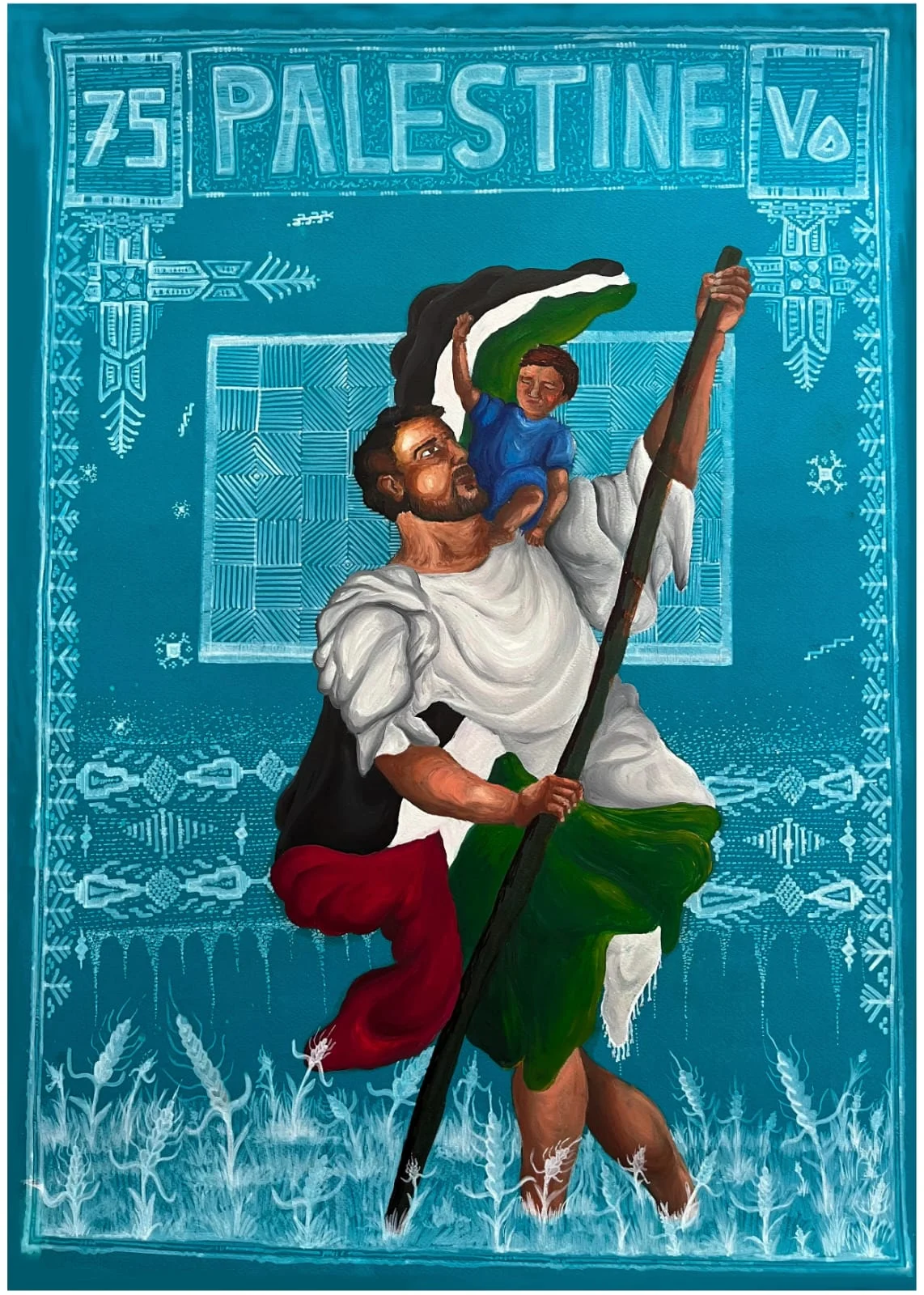
That’s what he says, grinning as he lifts a chunk of concrete above his head, arms trembling, veins flaring like the cracked roads beneath his feet. There’s no gym anymore—just the skeletal remains of what used to be a neighborhood, and a few iron bars salvaged from the wreckage, warped by fire, bent by force. He deadlifts a car door. He presses a stone slab. He does pull-ups from the frame of a bombed-out window. His gym is Gaza, and every piece carries weight.
He trains in the alley off Al-Wahda Street, near where the Abu Asser bakery once stood. Some mornings, the scent of burnt bread still lingers in the air. Behind him the jagged shell of the Al-Shorouq Building rises, his building—what’s left of it—its top floors sheared away by the missiles. But he keeps a pair of tattered training gloves in his pocket—a gift from our cousin Yusuf before he was killed in an airstrike last winter. The gloves are split at the seams, the leather darkened by sweat. I watched him pull them out a few weeks ago and turn them over, as if inspecting a wound.
Before the war, he had a routine. At twenty, he worked part-time at a hardware shop, hauling sacks of cement, unloading crates—strength built in daylight hours, refined at night. Every morning, eggs sizzling in a battered pan, chicken breasts poaching in salted water, rice fluffed and portioned with the precision of a surgeon. He used to save for months to afford imported protein powder, clutching each tin like treasure. There was a gym not far from the beach, paint peeling, mirrors cracked, but it had everything he needed: a bench press, a squat rack, dumbbells rusted to bite his palms. He’d train until his shirt clung to him like a second skin. His dream wasn’t fame, or escape. His dream was simple: to grow bigger. And to carve himself into something unbreakable.
Now the chicken is gone. The eggs are scarce. The rice, when he finds it, is portioned not by macros but by survival. He eats lentils instead, bread when there’s bread, sardines from dented and dusty cans, fish from the Mediterranean Sea, whatever the sea still spares—like many, when that was still an option. He tells me later, in a voice note that keeps cutting out, that fish had become almost impossible to find after May, when the Israeli navy began firing on small boats near Gaza’s coast. He could go to the aid sites, but he won’t—not after what they’ve become: places where people are gunned down as they reach for flour, where the line between relief and execution has vanished, where hunger turns neighbors into enemies and forces them to fight for scraps.
He found the sardines in March after days of rationing boiled lentils. He had eaten them until his stomach cramped. He was out searching, weaving through rubble on Omar Mukhtar Street, when he stumbled on the charred remains of Abu Khalil’s Minimarket. Inside, half-collapsed, he found a metal shelf flattened under debris. He clawed through plaster dust, splinters, shattered glass—and there they were: a row of cans, crushed, dented, and some, to his surprise, perfectly fine, labels scorched but still intact. He took them all, stuffed them into a plastic sack, slung it over his shoulder, the way he used to carry his prizes—the battered medals from local lifting contests, the cheap plastic trophies that once sat on the windowsill of his family’s apartment before the missiles tore it open and left it hollow. That haul lasted him two weeks, no more—and then the search began again.
There’s a rhythm now to his hunger—the old hunger to grow bigger, even as the world crumbles and shrinks around him. In the mornings, he mixes lentils with whatever oil he can scavenge—a dented can of sunflower oil found behind what was left of Abu Nidal’s corner shop, a smear of cloudy olive oil scraped from the bottom of a jar he dug out of a collapsed pantry. Once, desperate, he tried to stretch the oil with water, but it only made the lentils thin and bitter, and left him hungrier. He knows how much fat matters too—the dense fuel his body needs to keep lifting, to keep moving. Without it, he’s convinced, the muscle he’s built will waste away faster than any bomb can destroy it.
On good days, he adds a spoonful of za’atar from a jar he once salvaged from his aunt’s ruined apartment on Al-Nasr Street. Water is harder to find. He walks to the municipal well near the wreckage of Al-Azhar University, queues with others, two battered yellow olive oil jugs at his feet, dust crusting his lips. It feels safer here than at the aid sites. Here, the line holds together like a thread trying to be pulled tight—no pushing, no shouting, no gun barrels watching every move.
A week ago, standing in line, a mother held her son in front of him—the boy couldn’t be more than seven or eight, his eyes wide with hunger and curiosity. He kept glancing at Sami’s arms, at the rope of muscle beneath his frayed sleeves. Then, shy at first, he reached out, brushing his fingers against Sami’s forearm as if to check if they were real. Sami smiled, flexed just enough to make him smile. From his pocket, Sami pulled out a small Ali Baba chocolate bar—melted, found weeks ago and saved, waiting for a special occasion he couldn’t name. He pressed it into the boy’s hand, and the boy’s face lit up as if he’d been handed a prize.
Some days Sami trains throughout the early light, before the drones hum overhead, before the tanks growl awake. Other days he trains at dusk, the air thick with smoke, the horizon jagged with ruin. He lifts, he pushes, he pulls—each motion a prayer shaped in dust. The body as fortress, the body as machine, the body as a relentless supplication. At night, when he can’t sleep inside his old bedroom, curled on the floor of what’s left of his apartment, the warm wind drifting through the hole where the living room used to be, or the non-stop thud of distant bombing, he remembers the old gym: how he loved the hammer strength incline press, the feel of the cold metal handles in his grip, the burn in his chest as he forced out the last rep. Now he dreams of that burn, wakes with his hands clenched, his body aching not only from lifting, but from the hunger to lift again.
On Fridays, when the shelling quiets down for an hour or two for people to pray Jum’ah, he walks the empty grid of streets that used to be markets. Salah al-Din Road, where vendors once sold meat, chicken, pistachios, olives, dates—and a hundred other things he can no longer name, as if hunger has swallowed even memory. Al-Jalaa Street, lined with broken shopfronts, glass crunching underfoot. He scans for anything: a can, a bottle, a forgotten sack of flour—but everything has been picked clean, as if the city’s bones have already been stripped by other hands, by hunger sharper than his. Once, he found a bag of sugar, split open and hardened to a block by rain—he chipped pieces off it for a week, sucked them before lifting, pretending it was a pre-workout. Another time, in a half-collapsed storage warehouse behind a school, he unearthed a crate of beans—faded, dry, but still edible. On the rare days he could spare the water, he boiled small batches over a fire built from splintered wood, doors, broken chairs and bed frames. He ate them slowly, as if savoring them might stretch them out longer. Beans meant protein—the one thing his body needed most, the thing he obsessed over, searching the same streets again and again, for hours and hours, each time he felt his muscles hollow out beneath his skin.
There’s a boy he sometimes runs into on these walks as he searches for food—Khaled, maybe ten years old, always alone, always barefoot, carrying a stick like a young shepherd. The boy watches him lift, eyes wide. “Why do you still do it?” he keeps asking. Sami grins, hoists a metal beam onto his shoulders. “Because I can,” he says. And also because he must. Because to stop would mean surrender—twice: once to the hunger, and once to the silence that follows.
But after Khaled walks away, Sami feels something twist in his chest—sharper than hunger, heavier than exhaustion. He wonders what the boy sees when he looks at him. A fool? A man pretending his body can matter when nothing else stands? A ghost, still going through the motions of a world that no longer exists? Sami wipes sweat from his brow and watches Khaled disappear into the ruin, the stick tapping the ground like a drumbeat. It fills him with shame, for a moment—as if lifting is theft, as if the strength he builds is stolen from those who can’t. But then he feels the bar digging deeper into his shoulders, and the shame burns off like fog under the sun. No—this is what he can offer: the sight of someone who hasn’t quit, not yet. If nothing else, he thinks, maybe Khaled will remember that. Maybe that’s worth something. Maybe that’s enough.
Sometimes, after training, Sami sits on what’s left of a low wall near the shell of Al-Shifa Hospital and watches the smoke rise in the distance. He fingers the scar on his forearm—a thin white line from the first time he dropped a barbell in the old gym, years ago, when he was sixteen and too proud to ask for a spot. That scar, he thinks, was the first proof that his body could take the damage and keep going. Now he wonders how much more his body can take, how much more the hunger will hollow out of him.
And so, he tracks it—what’s left, what’s still his.
In a notebook—tucked into the sole of an old boot hidden in a bombed stairwell—he records numbers: reps, sets, rough guesses at calories. The ink runs from the sweat, but he writes anyway. Each page is a record, a small refusal to let the chaos erase everything. On a WhatsApp video call on June 5, 2025, just after 3 p.m. Gaza time, when the line finally stabilized, he angled the phone so I could read an entry: “Deadlift: 7 reps, 60 kg (I think—maybe more).” The weight was a rusted car axle, its ends jagged where wheels used to be. He gripped it as if it were a barbell, lifted it from the dust and shattered glass—the absurdity of it almost making him laugh. Almost. “Food: 100g lentils.” A fistful, maybe a little more—his best guess, remembering what 100 grams used to look like when he measured it out back in the old kitchen, when there was a scale, clean bowls, and a fridge that was always full.
In the margins of the notebook, he sometimes sketches the outlines of muscles, as if to remind himself of what he’s still building. But sometimes he sketches the outline of a girl—Nisreen, the one he had had a crush on, the one he never spoke to, not really. Just the curve of her hair, the tilt of her chin, drawn from memory in the margins of his numbers. He doesn’t know what happened to her. After the first weeks of bombings last year, she stopped appearing on the street he used to see her on, near her father’s shop in Al-Rimal. Maybe she fled south. Maybe not. She used to steal smiles at him, standing next to her father behind the register, sometimes when he came in and walked the aisles, pretending he might buy something just to stay near her a little longer. He wonders if she’d even recognize him now—leaner, harder, hollowed out. He draws her because it’s the only way he can keep her alive, at least inside of him. Sometimes he imagines spotting her at the end of the alley off Al-Wahda Street where he lifts, watching from the shadows, the way Khaled does. But each time he looks, the alley remains empty.
He tried, once, to leave, back in December when it got very cold and the airstrikes became relentless. He walked south toward Rafah, hoping the border might open. But at Khan Younis he turned back. He saw the line of people, saw their faces—gaunt with hunger, dusted with fear, heavy with waiting—and he couldn’t do it. Couldn’t leave his mother and his father’s grave behind, couldn’t leave the ruins of what he had built, couldn’t leave the boy Khaled who watched him lift.
Khaled, with his stick and his wide eyes, standing silent at the edge of the alley as Sami strained under the weight of metal and stone. That gaze haunted him on the road south—as if the boy had seen in him something solid, something that might last, and to walk away would be to crumble that illusion. Sami had felt it like a hook in his gut. The boy’s belief—or was it just curiosity?—was the last thing that he could not abandon. He kept seeing the way Khaled’s face had lit up, just for a second, when Sami pressed the concrete block overhead. That flash of wonder. And Sami thought: If I leave, I take that from him.
Sometimes, after the day’s work—the scavenging, the lifting, the endless walks through broken streets—Sami finds a corner of roofless shelter and just stands there, breathing. He watches the light shift over the ruins of Gaza, the way the sun cuts through dust like a blade. His hands are raw, his shoulders burning, his stomach hollow, but he feels—for those moments—like he has filled some space that war tried to empty. He remembers his father’s words from long ago, before his father and mother were taken in the first bombardment of Shuja’iyya back in 2021, visiting a cousin’s house in Jabalya: “A man’s strength is what he does when nothing is left.”
There is something ancient in it. Like the men in old folktales who lifted stones to prove themselves on wedding days, who wrestled not for sport but for honor. Like the fathers and uncles Sami grew up watching in the markets, men who carried crates on their backs, balanced sacks of grain on their shoulders, strength built not in gyms but in the hard work of survival. Like the fighters in stories whispered at night, whose bodies became both shield and weapon, whose names, like the martyrs, live on in street signs and school walls. Strength, he thinks, is a kind of language—an act of bulking against erasure.
I think of Yukio Mishima, who wrote of the body as art, as a canvas to be perfected, as a way to reclaim meaning in a world sliding toward ruin. Sun and Steel, he called it—the body and the blade, beauty and death intertwined. Like Mishima, Sami carves at himself, though not for ritual or theater, or necessarily a glorified final act, but because it is the only thing left to shape. Where there is no future to plan for, no safety to trust, the body becomes the last domain of control. Flesh and bone: all that remains. Flesh and bone: all that resists. Flesh and bone: all that testifies.
There is tragedy here, yes. But there is also beauty. To bulk, to build, to lift—when the world wants you flattened, erased, forgotten—is its own kind of hope. Or if not hope, then at least refusal. Sami pushes the rock up the hill. It falls. He grips it again.
I keep returning to Albert Camus’s line: “One must imagine Sisyphus happy.” I place it here because I want to believe it—that in some brief moment, even here in Gaza, as he smiles at Khaled through dust and sun and sweat, Sami feels some joy.
And when the boy Khaled appears again—sometimes just watching from the shadows, sometimes offering him a shard of sugar, or dates salvaged from the wreckage—Sami lifts higher, holds the weight of the concrete or the car door longer, as if to say, not just to the boy but to the world watching from behind rubble, wire, and glowing screens:
Look. Look what a body can do, even now. Even here.