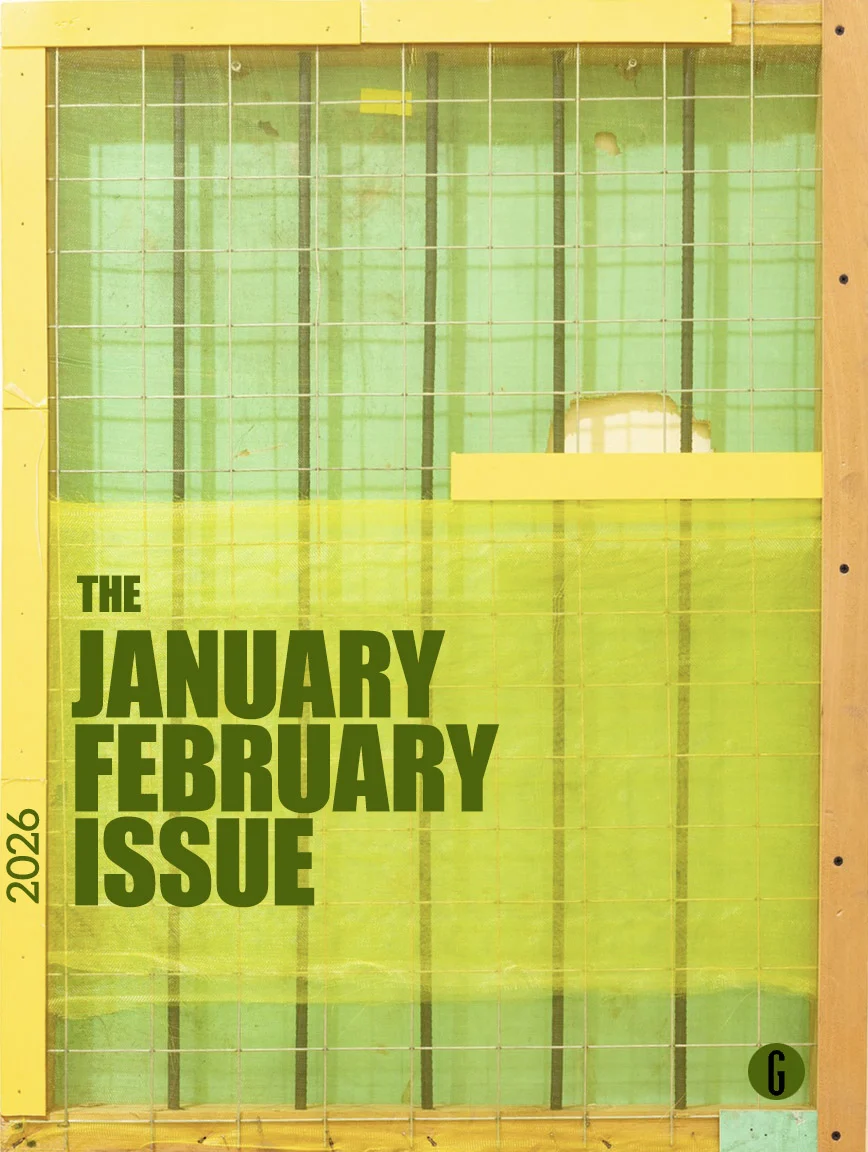
What surfaced across the works gathered in Guernica’s inaugural double issue of 2026 is a confrontation with perception itself. Again and again, we meet lives unfolding inside systems that distort vision—political regimes, bureaucracies, gendered instruction, empire, caste, capital. They settle over lived experience like climate. The world appears through fog.
And yet the writers and artists here resist opacity. Across continents and genres, these pieces stage acts of counter-vision. They follow characters forced to read rooms, scan crowds, decipher myths, translate their own bodies, and conjure futures in landscapes designed to erase them.
In fiction, an excerpt from T Kira Māhealani Madden’s forthcoming novel Whidbey enters the theater of public grief. A mother prepares to bury her son while strangers assemble with verdicts already in hand—mourning fractures under scrutiny. In Kevin 2.0 by Kevin Clouther, in a marriage shadowed by planetary disaster, reality belongs to the person willing to name it. Love falters in the widening gap between recognition and denial. In Confessions of Lilith, by Fatima Farheen Mirza, identity shimmers through rehearsal and self-invention. Moving through burnt toast, gossip, consumer ritual, and inheritance, the narrator measures the distance between the woman she is and the woman she has learned to perform. Vision here is refracted, managed, never innocent.
Nonfiction returns us to the politics of what can be seen and by whom. In Who Can I Dance With? the Iranian writer Arash Dabestani writes from the fault line between failing eyesight and a regime long invested in regulating visibility. From the afterlives of dance bans to the vertigo of migration, the essay asks what forms of knowledge emerge when sight itself becomes perilous. In Letting Go, J. Malcolm Garcia moves between intimate mourning and geopolitical aftermath, tracing how the U.S. immigration system discards the very people whose loyalty and labor the US government once relied on. In The Frigging Fuss over a Rotlo, an excerpt from Chandu Maheria’s forthcoming memoir, translated by Hemang Ashwinkumar, and guest-edited by Sarah Malik, a Dalit writer returns to the chawls of his childhood, revealing how food contours belonging and how caste continues to structure memory long after circumstances appear to change.
In conversation, Russell Reed speaks with the Congolese conservation leader and Strong Roots Congo founder, Dominique Bikaba in the opening installment of our new environmental Interviews series, Posthumanitarian. As Western aid infrastructures recede from eastern Congo, another model comes into view: conservation grounded in community governance, where those historically displaced from their lands reclaim the authority to decide how life will be sustained. We also meet the Iranian writer, Salar Abdoh, and the conversation drifts through the life and afterlife of the internet blackout in Iran, the myths regimes circulate, what happens when those myths fray, and the possibility of a literature no longer gazing toward distant capitals.
Our Global Spotlights selection of the month brings perception down to the scale of the intimate. In Kaori Fujino’s uncanny story, The Key, translated from Japanese by Laurel Taylor, a husband’s fear of an old woman in red becomes an anatomy of gendered vigilance.
Poetry in this issue widens the field of witness. From Trinidad, Shivanee Ramlochan conjures a feral inheritance in Witch Industry and Scissoring in the Tropics, where appetite and brutality share a grammar. Writing from Honduras while in dialogue with the world’s museums, scriptures, and genocides, Rolando Kattan maps a poetics of distance in Insomniac’s Cartography and Color Test, where color and memory become a means of survival. In Chinaecherem Obor’s The Translucence of Mud (after Toni Morrison) an Igbo son in diaspora confronts faith, fatherhood, and desire where the body becomes window, witness, and wound. And in two poems by James Meetze, THE LONG NOW, (EIDYIA), PART IX and (LATE-ORPHIC) PART XIII, myth and digitized afterlight converge, and language is the medium through which time is endured.
What binds these works together is not despair but the attempt at calibration: the ongoing adjustment required to remain coherent inside atmospheres designed to disorient. If power attempts to choreograph perception, the writers and artists in these pages answer with improvisation. They find other vantage points. They refuse to look away.
The fog is real. So is the labor of seeing through it.
Featuring, courtesy of the artists, striking original artwork by Elolo Bosoka, Wolfgang Rempfer, Philipp Eichhorn, and Orlando Boffill Hernandez.
Raaza Jamshed, Editor-in-Chief