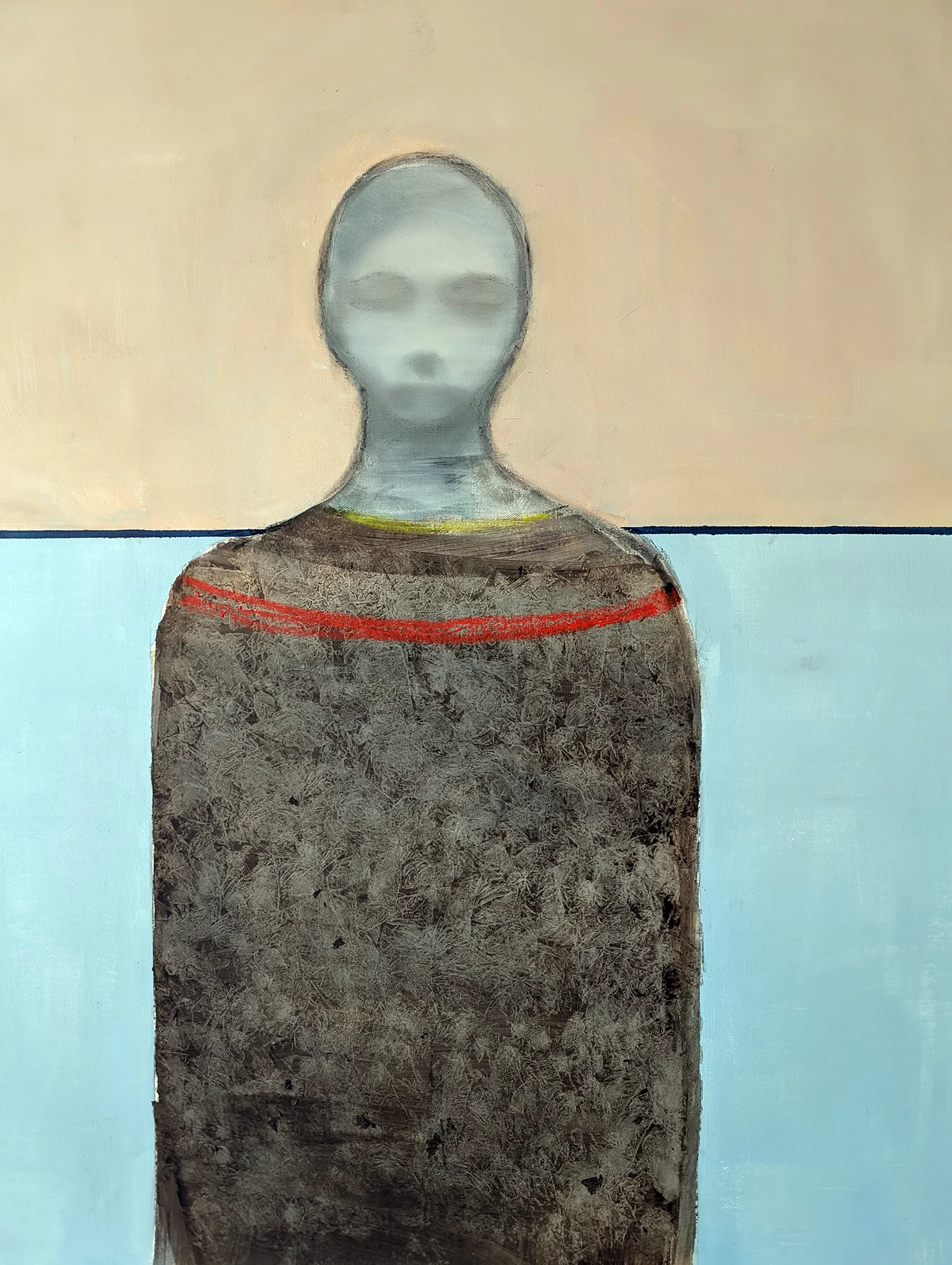
We brought my sister Ximena home after she’d spent a month in the hospital. Her body was still a bag of wounds after the bus accident, but she said the pain was less at home. Her body was wrapped in a cast that hid scars and mending bones but also showed the curves of her breasts, waist, and hips. Even broken, I envied her body and cursed the straight line of my own. Family members took turns watching over Ximena, but she usually asked for me.
“You let me fall apart without questioning my pieces,” she said.
She sensed the mother in me that our birth mother never was, how tenderness could be grasped between our eyes and hands. I bathed her, braided her hair, changed her sheets and bedpan, switched out canvases for her to paint to pass the time. But first, she decorated her cast.
“My world can’t be the shade of skeletons and ghosts. I need living colors.”
She drew spider monkeys, hummingbirds, and pochote trees. Once she finished the outline of each creature, I painted in its skin and slowly her plaster corset became its own ecosystem.
“Can I feel your heart?” she asked one morning. I sat next to her in bed and turned my chest towards her. She undid the buttons of my blouse and her fingers trickled beneath my bra, warm with concentration. Ximena’s eyes were closed, as she drew on the final blank space on her corset the shape of my heart. Just as she was finishing, I heard the crinkle of beads.
“What are you doing?” Our mother stood in the doorway with rosary beads wrapped around her wrinkled hands.
“Creating,” Ximena responded, her eyes still closed.
Mother quickly moved forward and pulled me off the bed. “Well, I came to pray with you. Apparently not soon enough. Leave us, Elizabeth. I suggest you pray too.” She looked at my open blouse as if it was the true wound. She took the pencil from Ximena and let it drop to the floor, then kneeled next to her and instructed her daughter to repeat scripture from Jeremiah 17. “Heal me, O Lord, and I will be healed; save me and I will be saved, for you are the one I praise.”
I wondered if God heard mother’s supplication, or saw our communion of colors.
*
Our father convinced mother to let me continue watching over Ximena. Maybe he was able to convince her for a moment of the art we shared. Or maybe she’d given up on us sinners and decided to leave us to our filth. Though I was the eldest, she had the boyfriends, went to rallies for reproductive rights, voter suppression, and climate change. Even as a teenage girl with a dove-like body, small and fragile, she wanted to know the strength and pain of other lives, bodies, voices. It all fed into her art and made her a good student. She was hailed for her curiosity and rarely punished for her disregard for rules.
Ximena had been a sickly child. Our mother didn’t think her little girl would live to see her third birthday due to a battle with tuberculosis that later resulted in myelitis, which left her limbs weak for a time. She recovered, but those who knew her well saw the uneven way she walked from then on, how one leg was stronger, slightly longer than the other. Our parents believed Ximena was so adventurous because she was living on borrowed time. I used to think she had mangoes for lungs given how sweet it was for her to breathe.
I stayed at home to help our mother, learning how to become one myself. It was the safe, expected thing to do. But I loved it also. I received through my giving to others, that has always been my art and love, even at times when it felt like a curse—the weight of mother’s instruction of cooking and cleaning, the aspirations to sainthood that was always out of reach, and the suggestion of a husband before receiving the marigolds of a kiss.
I like to think that by sitting down and learning the ways of the house, I gave Ximena a clear path to leave for her adventures and a home to return to in between. But the bus accident forced her to slow down so that the only places she could travel to were the ones she painted. After several weeks at home, I entered her room and found pieces of her cast slipping away, revealing her chest, a split down the middle of her body that further revealed the broken column of her spine. There were nails in her hands and tears in her eyes. I went over, uncertain of what to offer. “Don’t,” she said as she pushed the nails into her torso, “I need this feeling.” Once done, Ximena picked up her paintbrush and shifted on her bed to finish her canvas of a desert.
I watched her form broken earth, dry and brittle under sunlight. An unforgiving heat permeated from the paint.
“What are you making?” I asked.
“Myself,” she responded.
I watched Ximena’s hands as they figured out the landscape and yet she was still unsatisfied. After a few moments, she scratched her hand, then around a nail in her left breast. She removed the nail and tore at different parts of the canvas. The painting opened into its own sky and desert, real and whistling in the wind.
“I need to go inside,” she told me.
“How?” I asked.
“You’ll have to carry me in.”
Neither of us was surprised by the world her art had opened up. There were always hints of movement in her work, which she first started with our father on cream cotton cloths: a moving cloud, blinking eyes, a breathing ocean. But now she had begun to figure out how to truly unlock the world of her art. I would never keep her from her path; in fact, I’d give anything to walk it with her. I hung up the painting on the easel and then picked Ximena up as she held a white sheet over her thighs. She bit her lip trying not to cry out in pain. I felt the crooked ridges of skin and bone around her hips and right leg. Somehow her brokenness made her more beautiful to me.
We walked into the painting through one of its scratches and immediately found solid ground. The wind blew through her hair and eventually released mine from its bun. I heard crows in the distance. The scenery was never-ending rubble, offering no escape from its famine.
“Put me down,” she said.
I cradled her tighter to my chest. “Are you sure?”
“Why would I be afraid of my own creation?” she asked.
I slowly lowered her to the ground, but she stood on her own feet, straightening her broken back as much as possible, still holding onto the white sheet, now wrapped around her hips, and grew giant. She took up the entire canvas like a looming column I had to stand back to take in. It felt wrong to share in a place she created for herself. Yet as her first audience, I knew it’d be crueler to look away from what she needed me to see.
*
Ximena continued to paint in search of new ways to interpret her body and our home. This had become the way in which she processed the world now. She even painted me after I cut my hair and made me prettier than I was. “I don’t paint ugliness. You should know that by now.” She healed and continued working.
She found other artists including one who eventually became her husband, Mateo. Tall with bloated features, he seemed more fish than man. Though she was eighteen, I covered for her when she left our parents’ house, making sure to wash out the odor of cigar from her hair when she returned. He’d been married twice before and was known by many a woman’s thighs, but Ximena was the artist and could see visions the rest of us couldn’t, so I trusted her judgment.
Mateo was twenty years older than her and therefore couldn’t escape the role of mentor, looking over her portraits and still-lives, telling her which had the most potential. I became her journal and she’d write her smiles into me when she recounted their talks about state feminism, cubism, and mythical creatures such as the alux. Then they’d top their evenings off by drinking tequila from each other’s mouths.
“It’s like the best parts of school, church, and sex wrapped all in one with him,” she said with a smile as I washed her back.
Having no insight on men, I left her to her choices.
They decided to travel around the US and then Europe to paint and meet other artists. Mateo was also exhibiting some of his work. Before they left, she took me to his apartment and brought me to a gold awning with a small version of Mateo and a priest inside. Ximena grabbed her paintbrush and drew roots into the picture. Once she was done, she drew back the curtain of roots with one hand and led me into the painting with the other. She wore starched lace and flowers braided into her mane as we stood draped in the spiderweb of roots.
“Why are we here?” I asked.
Ximena turned to me and I saw a version of Mateo, small enough to fit on her forehead. He was dressed in a suit. “So that we can get married,” she said.
“Don’t you want to have an official wedding with all our friends and family present?” I asked.
“We will eventually. But for now, we want something just for us. And I want you to be our witness,” she replied, holding my hand.
I didn’t know enough about what love was and what it was not to object. Their union was inevitable, so I agreed to support them, happy that my sister was happy as the priest spoke. I wish it had occurred to me to ask why the love of her life was crowning her head rather than standing by her side. If it was a sign that he was gaining control of her mind in ways Ximena was too struck to see. Instead, we let the roots adorn our necks while the priest took the couple through their covenant vows.
*
When Ximena no longer needed me, mother quickly tried to find a man who would give me nothing but need. Mother would’ve loved nothing more than to see me married in a church, white and wooden, wreaking of pineapple sage. For me to be told I was beautiful by countless mouths, then quickly hidden under a veil as if I was blinding, a vision that needed to be blessed by a husband and holy man before I was seen again. My smile would be made from everyone else’s smiles, waxy as the church candles. With my sister out of the house, our mother’s full attention was on, always waiting for the moment she could be rid of me. But that was her fantasy, not mine.
The days my mother scheduled dates for me to meet suitors, I would conveniently forget the time or the location. I opted to go to the theater, library, or park instead. If I didn’t see the man’s face, I could deny he was real and pretend it was all a bad dream. Then mother caught on and began walking me to my dates, her hand firmly gripping mine, like a child awaiting her punishment for misbehaving at school.
It didn’t matter. My singleness was one decision my mother wouldn’t steal from me. I was full from the love I had for Ximena and our father, and could barely handle the needles of my mother constantly digging into my side. I’d seen so many wives and mothers in our neighborhood with sunken breasts and aching backs. I had no interest in the monotony of children’s cries and shitty bottoms, or asking about my husband’s day because we had nothing else to say. If my back ached, it’d be from the books I leaned over, and my cracked hands would be from the hot kettles I’d carry to fill my own baths. I waited for the men’s polite conversation to run out as we sat under the trees. The sky was more interesting than any of their faces.
After every man walked off in a huff, mother would drag me home to beat my feet. I didn’t know her anger was so strong. “I’d slap you if I could,” she said with her fists still balled, “but you need a fresh face for your next date.”
Swollen and bruised, my feet screamed in heels I was forced to walk upright into each date. I wore my pain as battle scars for a war I’d ultimately win. Eventually the list of suitors ran out, and word spread to avoid Ximena’s stuck up, frigid sister.
“Mothers at the church say even ghosts have better personalities than you,” mother hissed, twisting my ankle. Her thoughts on who I could be were so narrow, that I closed myself off to them. My eyes drifted as I imagined the blissful silence I’d experience after. Mother didn’t speak to me for months after and left whatever rooms I entered, refusing to exist anywhere near me. Finally, I’d won.
*
Ximena and Mateo had been traveling abroad for the last two years showcasing their art. I’d only been able to see glimpses of her in her letters, the worlds she’d seen and how her painting had developed. Still, I could also see the loneliness etched in her cursive, the isolation of being in strange places, and the affairs that were already plaguing their relationship. How he came home grimy with other women on his neck and eventually so did she. How sex had become a venomous bite to sting each other, then somehow brought them back together like an antidote.
I was taken out of myself, transported through sky and sand as I read her words and saved newspaper clippings of her exhibits. These were places I could never go, but was happy to see through her eyes. Through her I was less alone, seen as a peer, and desired in a way that made me feel new again. Ximena always ended her letters with I miss falling apart with you. Our mother on the other hand aged me, made my life feel thankless and mediocre. Motherhood had turned her into its cow, always asking for milk and meat. I wondered if she loved her children, but hated herself for not being more.
Just when I was ready to be done with myself, Ximena wrote to me that she was coming home. I hugged her like she was my own skin when we met and I couldn’t make myself let go. She said I could stay with them as long as I needed for which I was grateful. Mom was getting sick and dying, but still had the energy to grip her rosary beads and suggest who I might marry, men further out of town who wouldn’t mind a woman my age and not having children. I needed to get away from her voice because I’d rather mourn her when she was gone, than bear her final wishes while she was alive.
Ximena and Mateo moved into a duplex connected by a bridge. “Some days are for our art and others are for each other,” she explained.
Of course, there were days they just couldn’t stand each other and crawled to new lovers, but that was not my story to narrate. I was only there for a safe space to stay. I handled the cooking and cleaning, mixed Ximena’s paints and sketched some of the places, objects, people she’d use for her paintings. Her work had become more renaissance-like, beacons of light crowning women and children’s heads, with herself as the child and the women with masked faces.
“What’s your inspiration for this?” I asked.
“Mateo and I have been trying to have a baby,” she said before inhaling from a cigarette.
I was mixing paints together and accidently spilled one mixture into another. It was my first time hearing this. “Why now?”
“My body will only make it harder to carry a child as I get older. It’s now or never.”
“Can your body take it?” Though what I really wanted to ask was if her marriage could take it.
“It’s taken everything I’ve thrown at it so far. I see no reason why it can’t make a part of us. Making something from a place of love is the least painful thing.”
“It’s not art, Ximena. It’s your body. It cannot expand with imagination.”
“I didn’t ask for your opinion. I’m just telling you my inspiration.”
I wanted to stop her, to hold her womb and tell her to be selfish and keep all its life for herself. Deserts didn’t give birth, yet Ximena insisted that the sun cried rain and that sand grew gardens. I wanted to tell her that children don’t sew marriages back together or improve the hearts of men, or women. Children show what’s at the bottom of you, force you to decide what you all will survive on. Ximena had a hunger for the world that a baby wouldn’t satisfy, and it would never tame Mateo. I watched what we did to our mother, how her loneliness grew in our absence as much as it did in our presence. But once Ximena’s mind was made up, there was no way to undo it.
“Come with me,” she said.
I followed her into a still life picture full of feathers. There was a kitchen table filled with ripe fruit. Some cut open and others not. Watermelon bled onto the table, as did the oranges. But other fruits such as guavas, mangos, and papaya sat undisturbed. A few monk parrots swooped down and picked at the fruit’s flesh, ruffling their wings to make room for themselves to eat. Ximena reached out and petted each of their heads. We stood in a background of blue and watched the birds eat for a while. “Which will bring the fruit of my womb?” she asked no one in particular. The parrots jumped around on the heads of the fruits and gathered seeds from each of them before flying away. One of the parrots flew in the opposite direction of the rest and out of the painting.
“Where do you think she’s going?” I asked.
Ximena wrapped her hair up in a messy ponytail with her paintbrush. “We’ll find out when he’s ready to tell us.”
After we left the picture, Ximena didn’t paint for a while. She slept, smoked, went to activists’ parties. She invited me to come along, but I knew those were places I didn’t belong. That they possessed languages I couldn’t comprehend in their innovations and philosophies. My desires were simple as was my conversation. I did not know how to build ideas, only take care of loved ones and houses.
Ximena and Mateo each had lovers that visited the house, always when the other wasn’t around. When I got tired of lying to my parents about the friends that visited, I eventually just suggested we go out for ice cream, a movie, an amusement park. Anything innocent and distracting that could help us build happy memories to blot out the heartbreaking ones. Sometimes Ximena and Mateo met for breakfast or dinner, to go to the market, visit their friends, share a cigar and bath. Sometimes the house was quieter when they were together. Other times their fights whipped both the day and night into terror. Anything could be turned into an argument, a chair, a lamp, one of their paintings. Their ferocity was an old wound that loved staying unhealed.
Are you still fucking her? Why does my sister visit me more than you do?
If I didn’t give you pain, would you even be able to make art? I’ve said nothing about who you invite into your bed or the house you refuse to keep. I didn’t even ask to come back here, you did.
The arguments mirrored the bodies they struggled in. His weight laid heavy and made it harder for him to get around. Her crooked limbs and scars ached years after they supposedly healed.
Several months into living together, Ximena was with child. She’d slept with only women to ensure that no male lovers or Mateo in one of his rages would misplace the unborn child’s paternity. Her belly grew enough to start forming stretch marks that she rubbed everyday. As she grew, she was unable to wear back braces for a time, and often laid on her side. I massaged her back, being careful of her spine as the doctor had told me a few years ago. Her skin was tight with tears Ximena tried to hold back, biting her lip no matter how soft my touch was. I hummed to help the pain go down and sometimes it worked. As I felt and sang into the hard parts, Mateo came in a hurry.
“Where did you put my sand and sawdust?” he demanded.
“How the hell should I know? You know I only use linseed oil for my work,” Ximena responded.
“Don’t act like you’re above being spiteful. You were on my side of the house earlier this morning,” he yelled.
“To cook breakfast for you, asshole. While pregnant and in pain in case you forgot.”
“No one told you to make things harder for yourself.”
She shifted around to shoot him a venomous look. “Why don’t you go down to the hardware store and pick up more supplies? I’m sure the owner has a daughter in the back for you to screw.”
“I actually am in need of a model for my next mural.”
“Fine. Elizabeth will pose for you.”
I looked over at her. Usually, I made myself invisible when they ranted at each other, staying out of the room, or if caught in between them, keeping my head bowed and mouth closed until one or both of them moved away from me. But to be assigned a role by Ximena that I didn’t ask for was a bit much.
My eyes widened as I stared at her, pleading to stay out of it, but she was too busy focusing on him.
Mateo sighed. “Very well, but she’ll need to go to the store to pick up some more materials for me.” I heard him ruffling around in his wallet and putting money on the nightstand. He walked out without even looking at me. How did I become the means to an end for them? No longer a person with my own feelings, opinions, boundaries. And yet I found it hard to say no, or disappoint Ximena while her body tormented her. “Why do you want me to help him?”
She reached over to grab a cigarette and match off the nightstand. “I’d rather it be you than another whore.”
I understood the twisted logic and the appeal of my body as a neutral space for both of them and I didn’t know how to leave. So I did what I was good at: I obeyed. As I went to empty her chamber pot, I smelled wood and earth along with her bowels. The sawdust and sand marinated with her urine like an animal’s cage in need of cleaning.
*
I’d been self-conscious of my body since entering my late thirties. Everything felt uneven, lopsided, and flabby. I didn’t have my sister’s frame which never gained or lost weight, perhaps God figured she had enough problems. I decided to focus on the bodies of Mateo’s art instead of my own. He was primarily a muralist, but I never really observed the collage of sky, flesh, and animals that his paintings held. He liked to take up space in his work, make his ideas known from a mile away by any bystander. “Let’s start with your face. Just look at yourself in the mirror.” Though it was a simple instruction, I struggled to look at myself and not focus on my flaws, my age, my regrets, the wrinkles sagging around my eyes and mouth.
“Your eyes are all wrong,” he said.
“I’m sorry,” I said, looking down.
“I mean they’re sad and I’m trying to figure out why.”
“Maybe I could cover my face with my hair or hands. Or a mask.”
“This painting isn’t about hiding. It’s about fullness. And embrace. What do you like holding? Don’t say brooms or books. That’s too easy and it’s not true.”
I picked at my hangnails. “I like watching Ximena gather materials to work, drawing the subject’s outline. Washing my hair. Prayers that aren’t prayers. Sewing. Sometimes I run my fingers through rays of sunlight.”
He took out a charcoal pencil and piece of paper. “Draw the back of your head and neck for me.”
At first, I was uncertain if he was serious, but eventually I took the dark square and drew a few curved lines. They were all wrong no matter how concentrated I made them. As I was about to put the charcoal down, he stood behind me and circled his fingers along the back of my neck and head. “Remember you have dimension and bones.” I stretched under his touch, became malleable and more than myself and the shapes I was creating.
*
Ximena asked me to sit in the bath with her one evening. I kept my dress on and climbed in behind her, letting the water flood on the ground. Ximena was crying in silence, looking to be distracted from the pain. “It infects everything. I can’t even think clearly. Tell me a story that isn’t this one.”
Storytelling wasn’t my inheritance, so I could only describe what I had known. I told her about my sessions with Mateo. The clay and grass, how the garden was coming in and the tortoises that feasted on the dandelions. She squeezed into me tighter with each detail and forced as much color out of me as I could muster. I needed to be tough for her and wished I could offer more than the home I described, which did nothing for her recovery.
A familiar chirp sounded and the monk parrot that left the painting months before joined us, sitting on the lip of the tub. Ximena petted the bird’s breast as it puffed in and out harshly and spit up seeds that flew onto her thighs. He then flew onto the top of her head and nuzzled into her braid as if it was a nest. I reached to remove him, but she told me to leave him alone. Strings of blood began swimming out from between Ximena’s legs causing her to shiver and moan. I tried to get out to call a doctor, but with the strength of her pain she held me back. Her nails dug into my skin hard enough to cut me open. “Let me feel it. So I can paint it later. If you bleed with me, it’ll hurt less.” Her head grew heavy on my chest as she moaned and squeezed. We felt the water move and deepen with red as chunks of flesh came out. I wished all her torment on the parrot that slept peacefully in her hair.
*
While Ximena was in the hospital, Mateo gave me exercises to perform for him each day. Feeling through the grasslands just outside the house, folding clay, trying on different dresses and shoes. He studied my body one limb at a time, taking in each gesture and telling me to hold when a position struck him, sometimes touching me to see what I felt like in order to embody the sketch. I found myself waiting for his direction and the charcoal’s scratch along the paper, sketching whatever part of me he needed.
“Your eyes go big when they’re curious,” he told me.
There was something larger than life about Mateo’s hands. He worked to turn parts of me in the direction of boldness. My flaws were necessary, and things like spinsterhood, regret, and loneliness were useless to me here.
He didn’t ask me to take off my clothes until the final week. A cigar dangled from his mouth and curls of smoke tickled my thighs. “Hold this,” he said, raising the tobacco near my mouth. I stared at his pudgy fingers before accepting it between my lips, kissing his sweaty fingers. He went back to his canvas and I listened to the strokes of his brush, some quick, others smooth.
I stopped smoking years ago, but inhaling the smoke all the way down to my diaphragm felt natural. It served as a fireplace to my mind, burning everything outside that moment.
Mateo summoned me and we both looked at the piece. A calla lily was braided into my hair and there were orange and gray hues along my shoulders that blended in with the cream of my skin.
He rested a palm against my waist. “What do you think?”
“It’s beautiful,” I said, handing him back his cigar.
He took one puff before putting it out. “How’s it feel to be immortalized?”
I wrapped one foot around another, scratching my ankle. “Feels like lunchtime.”
He leaned his head against the top of mine and moved his hand to my ass. “I could eat.”
I kept waiting for things to feel wrong, to become complicated, messy, shamed, but I couldn’t muster up my conscience. Now I understood what made women easy in his grasp, the comfort of being with someone who didn’t remind us of how alone we were. The fractures in his colors and roots formed beauty I didn’t have before I kissed him. The desire to be a part of something bigger, to experience a sliver of what creators got to have was a blessing I chose to devour. I became the art I wanted to be.
*
Once Ximena returned home, Mateo and I met during her naps. The sex became cheaper the longer we had it. Eventually there were no words or art to it, just the yearning for release. I got the sense he continued coming to me because it was easier than going outside the house. I found I was too desperate to be offended, not wanting to give up the feeling of being desired. A few months later, mother passed. While the hurt she had caused allowed me to breathe in her absence, my love for her made the absence hurt more. I wondered when I would feel safe giving my body back to myself. When my grief ended, I resolved to end the affair, because grief was an open-ended answer that could be over in a week or never if I needed.
But my grief gave way to another’s. Mateo wanted me one morning in his kitchen. As my thighs squeezed into his hips, a sharp crash came from behind us. We looked up and saw Ximena smashing up the pottery and statues in his living room. She was wobbly, her rage bigger than her body. All I could picture was her shattering like one of the broken objects if she fell on the floor. I pulled down my dress and approached her. “Stop before you hurt yourself.”
Her eyes were blurry with tears. “You got tired of being an old maid and settled for being a whore instead?”
I shook my head, even though I knew it was true. My mouth filled with words that didn’t matter and she stopped them by throwing a piece of pottery at me, a shard of which slashed my chest.
“Get out!” she shouted.
I ran out of the house barefoot, my sister’s screams filling my head worse than church bells.
*
My father let me stay with him. I think hearing me walk around, cook, and fuss gave him some respite, reminded him of Ximena and I when we were young. It replaced the remnants of mother’s dying with a little life. He smiled like a younger man when he held me, when we went to the park, or said goodnight. I was glad he was still happy sometimes and lived a life separate from mine, free from filth and anxiety.
I was able to ignore all I was doing until Ximena saw us. Only then did the affair stop being a dream and turn into reality, a marriage, a heartbreak. I didn’t think of Mateo at all because he’d been reduced to being a stain like me. Thankfully our father was blissfully unaware of all that transpired, which made one less mirror for me to look at. The real war in my mind was Ximena’s health. How her pregnancy broke her body down further.
I knew I was banished to the ends of time, that there was nothing I could say or do, and yet I had to try. If for no other reason to make sure she wasn’t killing herself. I wondered if they’d hired another nurse, which in some twisted way made me jealous that someone else could be in charge of the pieces of Ximena that she’d entrusted me with for most of our lives.
I held out for several months before breaking down and going to the apartment I’d heard she moved to. It took an hour for me to work up the courage to go inside. It was a dingy neighborhood where dogs barked and babies cried, that presented cracks and roaches openly, banged itself up as much as the people inside its buildings. I looked for the apartment number I’d been given and knocked at the door. It opened on its own. I walked into sheets strewn off the bed, words written on the wall that’d been partially smudged out. Bottles littered the ground to the point I couldn’t take three steps without bumping into one.
“Ximena?” I called. I was scared of where in the mess I’d find her. When I got to the bedroom, handfuls of hair swam along the floor like eels. Everything stank of semen, moist and warm from a recent fuck, the air was thick as if it was still breeding the sensation of pleasure. Across from the bed, there was a chair and partially painted canvas with a bench inside.
“What do you want?” a scratchy voice said behind me.
I turned and saw her. Smaller than before as if her body had wilted. Her hair was cut short and lay in uneven patches. Her eyes were night skies and she wore a baggy dark suit. The sleeves covered most of her, but I spotted a silver set of scissors in her left hand.
“Where’s your cane?” I asked.
She shifted past me and looked at her painting. “Hopefully still shoved up Mateo’s ass.”
“Is that Mateo’s suit you’re wearing?”
She ignored the question as if waiting for me to say something worth responding to. Our silences stood next to each other. I kept waiting for a moment that felt safe enough to speak, but it never came, so I just spoke. “I’m sorry.”
Her eyes stayed focused on the painting. “I don’t know why, but I’m not mad at you. Well, you were easier to forgive.”
I wanted to look at her, but the glint of the scissors made me stay still. “Why?”
She shrugged. “Maybe because of the years I’ve seen you go without. Things that people took from you, that you denied yourself. It makes sense that at some point you’d fall down. Maybe because I know you’ll spend your life trying to make it up to me and you’re still the only one who doesn’t question my broken pieces. No matter how many times I think of you two, I see Mateo as the predator and you as the prey.”
Most of what she said was true, yet I wondered if I was being let off too easily. If there was more to the pain than Ximena was letting on. I shook my head and stared at my feet. “I knew what I was doing.” Flapping filled the ceiling. The monk parrot from before flew in and sat on the dresser and ate some rotting prickly pear. Ximena stepped forward, sliced open her painting with scissors, and entered. She turned around and said, “Get in.”
Inside the painting, the wall was the texture of storm clouds and the bench sat in front of it. But across from that scene was a naked couple cuddling with each other on the floor. The odor of sex returned.
“Take off your clothes,” Ximena instructed.
I blushed and stepped away from her. “What?”
“You heard me.”
I didn’t know what she was really asking me to do and I was scared to find out, but I knew I wasn’t in a position to refuse her. “Is this for your work?”
She took out her paintbrush from a suit pocket and began designing a white dress. “We wouldn’t be here if it wasn’t.”
The couple stared at me as I slowly undressed, perhaps amused by my awkwardness. Or maybe I was just wearing my shame. Several minutes later, my sister threw the dress at me to put on. It was a European styled dress with frills at the neck and flowers lining the bottom of the skirt. I could barely breathe in it, but I assumed that was the point.
“Sit on the left side of the bench,” Ximena ordered.
As I did, she went over to the couple. “I no longer require you,” she said in the man’s direction. From the way she spoke, I assumed Ximena hired prostitutes.
The young man looked taken aback, apparently unused to being told to leave.
Ximena turned away and created another dress. A heather shaded garb with even cut sleeves at the shoulders that fell down to the torso and gave way to a forest skirt. It was made from breathable fabric that didn’t clench at the waist or hips. When she was done, she put the paintbrush behind her ear. I could see the scissors peeking out of one of her pockets. Ximena helped the prostitute put on the dress and led her to the bench to sit next to me.
The woman looked up at my sister and her skin was like clay in Ximena’s hands. She elongated the neck, pouted the lips, widened the cheekbones, slimmed the eyes, and made the upper lip and brows thick with hair. My sister was sculpting herself onto another body, and soon she did the same to me. I felt her fingers remolding me, stretching and folding, but it didn’t hurt. Then she brought out the scissors and I held my breath. Ximena sliced me open from my neck to my chest. Then she moved on to the prostitute’s body, using the scissors more as a pencil than weapon that time. The lines my sister drew were light, a choreography she was imagining for her next step. I didn’t realize I was crying until she told me to stop.
“Why are you doing this?” I asked.
She ripped open the top of my dress, exposing a breast. “Just because I’ve forgiven you, doesn’t mean my art has to.”
“Does your art involve death?”
Ximena’s face bunched up as if she’d never thought of such an absurd idea. “Of course not. Just a lot of pain.”
I looked over at the other woman. Her face was vacant, in wait. Did she already know what was going to happen? Was she so accustomed to pain that the threat of it no longer bothered her? Or perhaps she was familiar with this part of my sister’s work. I’d only ever seen Ximena’s pain exacted on herself and yet I knew I was deserving violence.
If I understood her vision, I told myself it’d hurt less. “Why us instead of you?”
My sister examined my shoulders. “I need a break from me. I feel too much already, and even if I didn’t, there’s not enough of me for this. But there will always be space in you for me. Right?”
I was scared, but told the truth. “Yes.”
“Good.” Ximena reopened the scar of the wound I got from her a few months ago. But this cut went bone deep, past dermis, ribs, and lungs. I shrieked into her arm, biting the sleeve as she peeled open my heart and studied the veins. She only stopped after the inside of my heart lay exposed.
“Try not to bleed too much,” she instructed.
Eventually she brought out one of the veins, holding it between the pincer sized scissors. “Hold this for me,” she said motioning towards my hand, I did and let the blood run down my dress.
Ximena turned to the prostitute and cradled her face. “Is your heart mine?”
The prostitute nodded.
“Show me.”
The woman reached inside her shirt and into her chest, as if she were just brushing past curtains and brought out her heart, placing it on top of the dress. It was full and red, more like a rose than an organ. A few of her veins reached towards her neck and around one of her arms like roots. One vein grew as if it were searching for another. Ximena gently guided it to one of my own veins, which attached to it instantly. Ximena reached into her pocket, got out a small pin with a face on it, and put it in the prostitute’s hand. Then she put the prostitute’s free hand in mine.
“Look forward, this isn’t for you to see.”
I did as I was told, breathing through the pain, craving the softness the other woman was offered. Ximena stood back and looked at her work, finally satisfied.
“How long do you want us to stay like this?” I asked.
“Until the bleeding stops and it no longer hurts.”
She turned and left the painting, staring at us from the outside while she had a cigarette and drink. How much of myself could I sacrifice for her art? Would it make her healthier or reconcile us? I hoped that feeling this pain would provide answers. I wasn’t even sure if it made her hurt less. Still, I was more connected to this stranger I couldn’t set my eyes on, than I’d ever been to anyone else, because only she and I would know what it was to have love willingly given while also by force.
*
Time seemed to go on without me, disregarding what it did, what it took, and when I needed more. If I’d had kids when I was young, they’d be young adults. My daughter would’ve gone to a university, my son would’ve found his first girlfriend, and all my hugs, songs, food would’ve been slowly forgotten. Still after all those years, I had no regrets about children being no more than a passing thought in my mind. My father followed my mother through lily-filled pastures, old and content to be done with life. Ximena moved back to our parents’ home with me. Wrinkles lined our bodies like sentences filling up the diaries of our lives. Except people continued reading my sister and her work, fascinated with each color, nature, and dimension her pictures unfurled. She sold enough of her art to get by, mainly portraits and still lives. But she became frailer, one foot eventually becoming useless, and her back caused her to lay down after a few minutes of walking.
I spoke to her about it one evening as I brushed her thinning hair. “I don’t want you to give what little life you have left to art instead of to yourself.”
Ximena chuckled. “When I paint, I’m not broken, not by poverty, men, or my own bones. Art is whole in the pieces it displays and so am I. There’s no other way I’d rather go.”
Ximena ate less and took more painkillers. My caretaking was more necessary and yet wasn’t as useful. Mateo had the legs his wife no longer did, toured his work, and managed hers as well. He came around on the days she was feeling well, though she needed him more on the days she wasn’t. I only spoke to him on Ximena’s behalf, the lust that locked our loins had long since blown away like dust. It was assumed he saw other women, but Ximena was getting too weak to argue or even care. All she valued was his presence, while I just valued her comfort.
On our last day together, she’d painted valleys, her lines slightly wavy from shaky hands. The monk parrot had stayed by her side throughout the years, continuing to use the crown of her head as his nest. She asked me to carry her into her painting, and I did. The creases of her flesh and bone pressed against me, soft with exhaustion. We walked into a beautiful day, while the parrot flew in, testing the sky out on his wings. The valleys, her dress, and hair all were the color of sunrise. The design wasn’t as polished as her others, in fact everything smeared like it was melting, but it would always be beautiful as long as I saw her in it. We rested by a stone wall, took in the light, and the skirt of her wine-colored dress fanned over my legs.
“I wish to stay here,” Ximena said, looking off in the distance, “the world out there has nothing more to offer me.”
I selfishly wanted to keep her, because she was the one person who hadn’t left me, whose body always provided me a purpose, and a way into other worlds I would never have seen without her. But art was one of the last places she could control her body and I couldn’t take that away from her. “We could stay here together if you want.”
She shook her head. “You have more life to live.”
I rolled my eyes. “No one needs me out there.”
Ximena placed her hand over mine. “You can focus on your own needs.”
I studied the age spots on her hands, trying to find the right words. “As long as I was trying to earn your forgiveness, I had purpose. I don’t know who I’ll be if I go back alone.”
My sister reached inside a pocket in her dress, took out her paintbrush, and handed it to me. “Figure out what comes next.”
I looked at the brush and then at her. “That’s never been my strength.”
“Who said anything about strength? Just try to find what I can’t give you.” She placed the brush in my palm and wrapped my fingers around it.
“Is there anything more I can do for you?” I asked.
Ximena looked around and touched the stones we sat on. “Burn this painting after you leave, so that no one can disturb my resting place.”
My eyes grew wet, but I refused to make this about grief. “Maybe I’ll see you in the flowers I make.”
Ximena smiled and leaned her head against my shoulder as we watched the sunset.
*
After leaving the painting, I burned it in the fireplace. She smiled back at me as though it wasn’t goodbye. I could smell flesh and bone among the cooking wood. At first, the house was empty without her, and I couldn’t imagine stepping outside. But I slowly started working from Ximena’s room to the front of the house, painting pockets of flowers with faces until I was ready to open the door and find a new canvas.