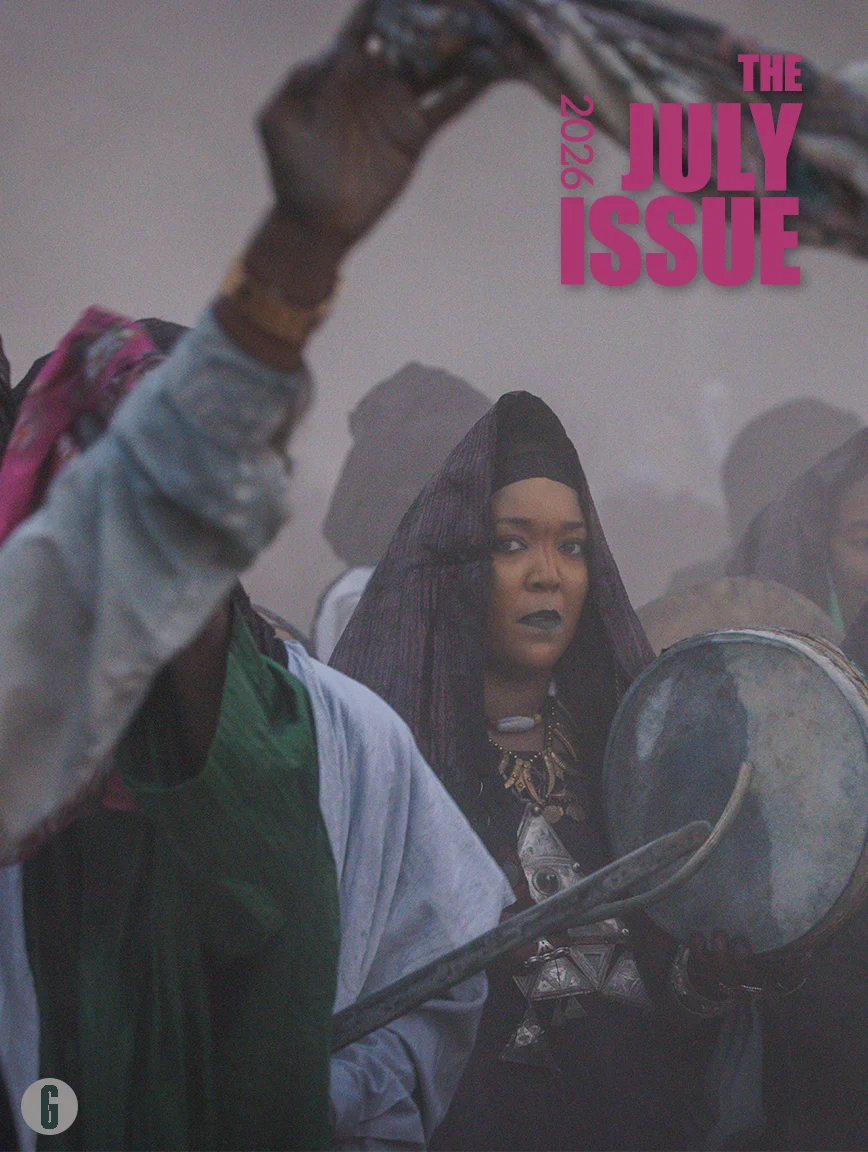
Must a People Disappear for Us to Know That It Existed? The elegiac title of Ben Buckland and Carissa Western’s photo essay poses the question at the heart of Guernica’s July issue: Is our contemporary gaze fundamentally reactive? Does our attention gravitate only toward that which is already endangered? The works gathered in this issue question and resist this belated recognition. Across photography, nonfiction, fiction, interview, translation, and poetry, they ask what it means to look before disappearance, to listen before silence, to love before loss.
Buckland and Western’s photo essay turns to Sebeïba, the centuries old Saharan festival, and the ritual and cultural life of the Imuhar. The essay explores the uneasy ethics of visibility, and questions whether preservation, tourism, state interest, and spectatorship can ever be innocent when they arrive at the threshold of threatened worlds.
Mahreen Sohail’s The Death Years measures motherhood against mortality. Moving between family history, inherited grief, and the terror of loving a child, the essay asks what it means to remember the dead while learning how to live.
In fiction, Herbert Girtley’s Bojack Blues gives us a story of friendship, hurt, and music rendered in a voice so assured it seems to gather force almost effortlessly. What begins as a man disappearing before a gig opens into a rich portrait of friendship between men. By a creek, two men slow down long enough to share a moment of pain, and in that sharing, create room for the communal, and the sublime.
Also in fiction, Andra Otilia Nicolescu’s Places of Memory, an excerpt from her unpublihsed novel Midnight in Exile, follows Paul and Ana into America late in life, where exile becomes at once a strange new beginning and a reckoning. Set in the aftermath of 1989, as the collapse of state socialism in Eastern Europe opens borders, old certainties of country, ideology, and home are unsettled. From the rubble of an old world emerges a layered meditation on migration, marriage, history, and the intimate revelations that arrive only after a life has already been lived.
In The Poems Will Not Stop: An Interview with Kathy Engel, Tyler Barton converses with poet, activist, and organizer Kathy Engel, who has spent a lifetime writing alongside struggles of Palestine, Nicaragua, Indigenous sovereignty, and social justice. Beginning with the 1982 barring of Mahmoud Darwish from a New York poetry event after Israel’s invasion of Lebanon and the Sabra and Shatila massacres, the conversation reflects on art, solidarity, grief, beauty, and the perennial work of refusing the separation between the poem and the world.
In Global Spotlights, Masami Kakinuma’s Go for it, translated from the Japanese by Sharni Wilson, brings us into a grandmother’s ancient home in rural Iwate. Folklore is braided with the muted disappointments of adult life as the story reimagines good fortune as something made possible by the courage to move toward the life one once wished for.
In poetry, Michelle Matthees’s Svetlana at the Dacha, 1938 and Joseph unfold childhood innocence inside the shadow of Stalinist terror. Together, the poems ask how private wounds become historical violence. In Denoo Edinam Yawo’s The Anatomy of a Bullet Alchemising into Death, violence begins as the wound and endures as inheritance stored inside the human body. The bullet becomes a language of displacement, secrecy, and grief—ancestral rites—carried from mother to child. In Her Five Children and Noose, Anna T. Szabó, translated from Hungarian by Ági Bori, traces the point at which the domestic gives way to horror and probes what remains of care when the structures meant to sustain it have broken apart.
In this month’s conversation with Tyler Barton, Kathy Engel quotes Bayo Akomolafe: “The times are urgent—we must slow down.” The line could serve as missive from the July issue: to slow down and attend more deeply to the people made visible only at the edge of disappearance, to the dead who remain among us, to friendships that hold men through shame and hurt, to marriages still revealing themselves after decades, to poems that will not stop.
Featuring, courtesy of the artists, striking original artwork by: Ben Buckland, Andra Otilia Nicolescu.
Raaza Jamshed, Editor-in-Chief