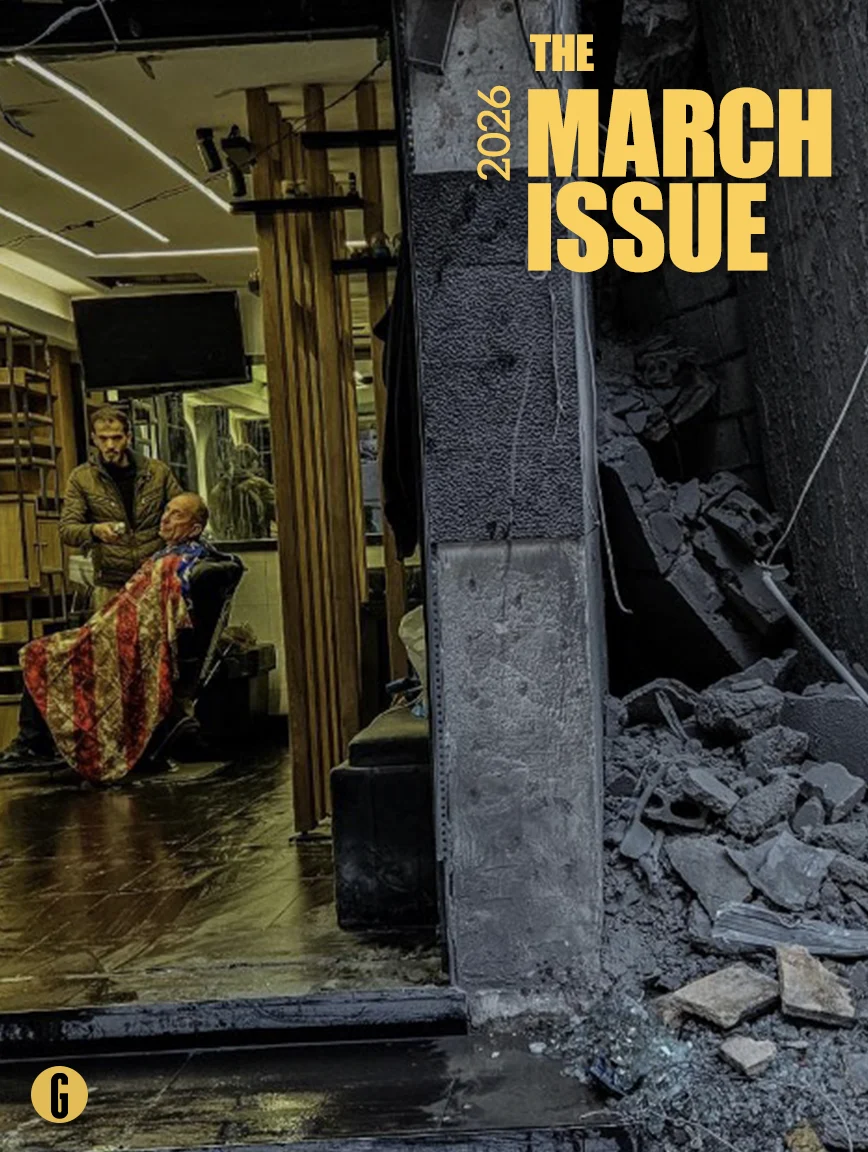
I write this from Beirut, two weeks into a new war, amid another round of airstrikes. A fine dust falls with the rain over the entire city. Still, the streets remain filled. Shops open their doors. Cars and scooters pass by; there is the hum of conversations between people. Life continues in a strange, quiet sobriety. Beirut has always held this contradiction: a city that bustles even as war returns repeatedly. And in the face of violence, something stubborn persists – work, conversation, routine. The self emerges altered, but not broken.
What surfaces across the works gathered in this issue is a shared atmosphere of siege—mirrored not in scale but in texture. From Beirut to Gaza, from the Rohingya camps in Cox’s Bazar to imagined landscapes of Kashmir and Acre, Palestine—places haunted by systemic disappearances and erasure—these pieces inhabit terrains where life continues under assault. They test the tenacity of the self under attack.
The March issue of Guernica opens with a photo essay from Beirut. Anchored by the graffiti line Let Lebanon Live Before I Die, Wartime Beirut, Between Ruin and Routine, by Alex Milan Durie, traces the city during the first weeks of an old war. Drawn from long walks through the city, the photographs capture Beirut suspended between devastation and continuity, where routine itself appears as a form of endurance.
Nonfiction in this issue turns to the question of witness. In Youssef Rakha’s Ring, excerpted from his forthcoming collection of essays, Postmuslim, grief arrives in the space between boxing practice and breaking news: the death of a poet friend, the resumed destruction of Gaza, the unbearable fact of having to continue on. Moving between sparring, literary memory, and political reflection, the essay asks what writing can do in the face of violence that flattens both lives and language. A Month Inside the World’s Largest Refugee Camp, by Jidi Guo, takes us to the Rohingya camps of Cox’s Bazar during Ramadan. Filming inside the world’s largest refugee settlement, the writer lingers on the uneasy texture of daily life under prolonged displacement—its routines, generosities, moral dissonances, and the quiet negotiations required to remain human within systems that control survival.
Fiction in this issue returns to the fragile persistence of the body and imagination. My cousin Sami is still bulking, by the Palestinian writer L.F. Khouri follows a young man in Gaza who continues to train his body amid the wreckage of war, lifting slabs of concrete and twisted iron where a city once stood. As hunger, memory, and loss close in around him, the body becomes his final territory. In Invisible Landscape, by Kashmiri writer Gowhar Yaqoob, two brothers move through mountain pastures haunted by disappearance and death. As the terrain shifts between memory, dream, and political intrusion, the story traces how the self struggles to remain visible when the landscapes that once anchored it begin to dissolve.
In Interviews, Mai Serhan reflects on Palestine, post-memory, and the political work of storytelling. In I Can Imagine It for Us, Serhan speaks with Olivia Katrandjian about writing a homeland she has never seen, blending poetry, archival research, and fragments of family history to reconstruct a place inherited through absence. The conversation explores how narrative becomes a site where memory, imagination, and collective identity meet, and the self learns to speak across displacement.
Our Global Spotlights selection of the month returns us to Beirut on the edge of violence. Mazen Maarouf’s uncanny story The Lion Cub, translated from Arabic by Lina Mounzer and originally published in Rusted Radishes: Beirut Literary and Art Journal, reminds us that war rarely begins with the first explosion, but in the slow reshaping of the self.
Poetry in this issue confronts disappearance directly. In The Emperor Jones, British-born Black Caribbean choreopoet Safiya Kamaria Kinshasa transforms a life shadowed by violence into legend, tracing how bravado, memory, and imagination remake a figure otherwise destined to vanish, and in Siren of the Tropics, Kinshasa turns to a mythic register, retelling the story from the perspective of a hitherto ‘subhuman’ heroine, in which the spectators of the original become the spectacle. Three poems by the Spanish poet David Cruz, presented here in translation by Anthony L. Geist, move through shipwreck, nightmare, and wandering spirits. Ships sink, poets choke on their own language, and souls step briefly outside their bodies. Yet even as defeat threatens to swallow the speaker, something continues speaking—the stubborn self that refuses silence.
With our March issue, we at Guernica hope that from landscapes under siege individual selves continue to emerge, recognizing one another and rising in solidarity against the violence that seeks to break our communities apart.
Featuring, courtesy of the artists, striking original artwork by Jean-Robert Alcindor, Dave Bowers, Javier Iniesta, Samar Hejazi, Ray Hwang, Fahed Shehab, and Camilla Skye.
Raaza Jamshed, Editor-in-Chief