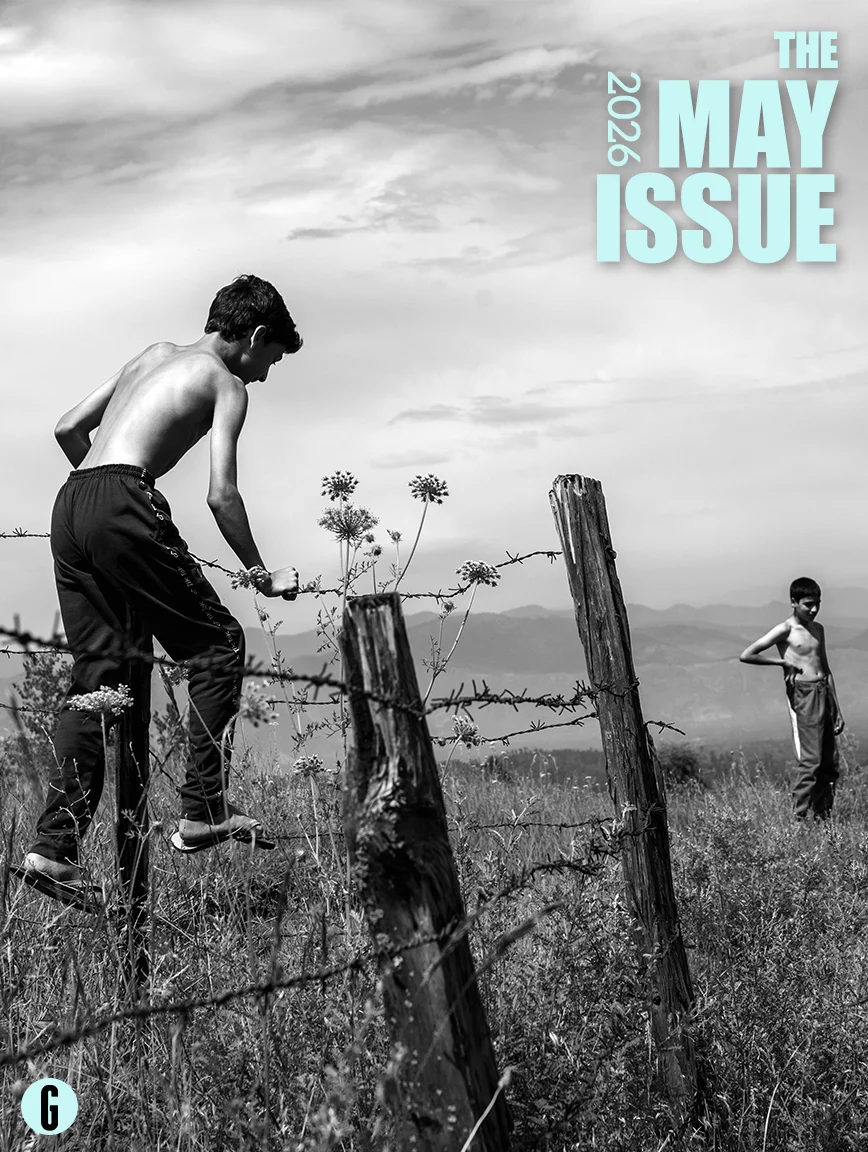
Hervé Guibert once described the photograph as “an event of light.” The works gathered in Guernica’s May issue move through similar illuminations, but they also expand the events captured outward, asking us to consider not only what the light reveals inside the frame, but also the invisible pressures surrounding it: history, violence, memory, migration, intimacy, labor, and survival. Across fiction, nonfiction, photography, translation, and poetry, these pieces resist the urge to treat the image as extraction or spectacle. Instead, they transform revelation into a psychological and historical experience, insisting that we are implicated in the worlds these works bring to light.
Photography remains central to the issue’s inquiry into visibility, witness, and the ethics of looking. In I Was Trying to Photograph a Feeling: Showkat Nanda on Buried Archives, Generational Memory, and Dreaming Against Forgetting in Kashmir, Youmna Melhem Chamieh speaks with Kashmiri “opinion photographer” Showkat Nanda, who lives and works in Baramulla, Kashmir. Together, they explore “objectivity” as a limitation rather than a virtue, the moral and emotional shift from war photography toward what Nanda calls opinion photography, and the atmospheric normalization of violence in a place where children often only recognize the strangeness of war once they leave home, or encounter the world through screens. Mothers preserve the touch of disappeared sons in handfuls of soil; buried archives linger beneath ordinary life; memory becomes both witness and resistance. Read alongside this conversation is an excerpt from Sohrab Hura’s recently published photobook Snow, a work that moves through Kashmir’s winter landscapes as through a vanishing field of time and history. That the project itself remains incomplete deepens its force: the image becomes a record of what light could reveal before history itself intervened.
In fiction, Jeneé Skinner’s Canvases turns art into both refuge and reckoning for two sisters bound together by devotion, betrayal, and care. Stepping inside paintings of their own making, the story’s characters move through surreal thresholds where suffering, desire, and bodily constraint can briefly be reimagined. Lauren Acampora’s Salvage lingers among roadside debris, roadkill, moonlit structures, and discarded objects, tracing how its protagonist Adam’s devotional gaze attempts to salvage meaning from brutality before tenderness curdles into possession and violence. In Tiffany Tsao’s But Won’t I Miss Me speculative realism illuminates the uncanny pressures of motherhood, labor, and selfhood, revealing a woman trying to inhabit a role her body has entered before her consciousness can fully follow.
In Global Spotlights, Pingali Chaitanya’s Cupid’s Bow asks what happens when inherited narratives are renewed from within. Translated from Telugu by P. Samata, the story turns myth and folklore into sites of bodily knowledge and refusal, as a woman rejects the logic that has governed her life and begins to write another ending for herself. In nonfiction, Notes on Going Viral, written by Isaac James Richards, moves between Idaho, India, Telugu, and the afterlife of missionary experience, and interrogates what it means to encounter the “other” through language, faith, and lived proximity. Here, revelation emerges not through certainty, but through the unsettling light of continuing self-interrogation.
In poetry, Ron Riekki’s work moves through inherited and institutional violence, searching for a language capable of holding what history attempts to disappear. Molly Thapviwat’s Cherry Coke and Chevron Lights and Self-Portrait with Expired Green Card find revelation within the harsh fluorescence of gas stations, DMV cameras, parking lots, and convenience stores, illuminating the fragile textures of migrant and working-class life beneath bureaucratic and economic systems. In Two Women and the Rain, illumination arrives through rupture itself: moments when wind blows backward or light rises through ice rather than falling upon it. And in Arya Gopi’s Crow Language / Crow Testament / Crow Gospel, the crow becomes witness, archive, prophet, and co-survivor, carrying fragments of memory and difficult knowledge across flooded cities, sacred geographies, and broken urban worlds.
In a time saturated with endless streams of spectacle, the works gathered here ask something slower and more laborious of us. They invite us not merely to consume images of conflict–both intimate and global –rupture, migration, and survival, but to stay with them long enough to understand our place within the worlds they illuminate. These are works concerned with learning how to see: how to recognize the histories, pressures, and intimacies that surround every frame, every body, every landscape touched by light.
Featuring, courtesy of the artists, striking original artwork by Jérémie Guiguen, Mike Blackman, Deepak, Taelor Worthington, Cliff Warner, Faheem, Erik Hadifel, Will Yackulic, Nancy McKie, and Ayush Kejriwal.
Raaza Jamshed, Editor-in-Chief